IF you were to come up with a two-week stay in Cambodia, what would your itinerary look like? Would you be able to name five places to visit off the top of your head? Unless you’ve spent a considerable amount of time there, Cambodia is probably defined by its most touristy destinations. According to Jacques Guichandut, Managing Director of All Dreams Cambodia, a socially and environmentally responsible travel agency, that collective impression of Cambodia isn’t doing the country any favours.
In order to shine a light on Cambodia’s many hidden attractions, faces, and places, Jacques turned to conscious tourism to attract new travellers. As conscious tourism continues to gain traction the world over, modern-day tourists are looking for more fulfilling trips – ones that will help them connect with local communities and experience a destination in an authentic way.
Sustainability is really becoming the name of the game.
As such, the #ONESTEPNOPLASTIC campaign was initiated in July 2022 by All Dreams Cambodia and musicians Tos Yerng, in order to combat plastic pollution in Cambodia and promote the kingdom as a sustainable and attractive tourism destination.
The way this campaign came to be is an interesting story.
Tos Yerng is a musical group formed by Monika Virak and Honging Thorng, the 2 artists who composed and performed a song promoting the 5Rs called “Refuse, Reduce, Reuse, Recycle and Remind”. When they met with Jacques Guichandut of All Dreams Cambodia, the mission became clear – to federate as many people as possible, including tourism professionals, to contribute to a cleaner environment and to make Cambodia an even more welcoming destination for visitors.
Together, they decided to launch the #ONESTEPNOPLASTIC movement and span it over the course of 6 months, with a clean-up operation in a different city each time.
The campaign kicked off in Kep on 31 July and moved to Siem Reap on 27 August. It then took place in Kratie on 17 September and was most recently in Phnom Penh on 22 October. The campaign’s next stop is Battambang on 15 November, and it will end on 8 December 2022 in the capital, at the Royal University of Phnom Penh, under the RUPP Free Plastics event. There, Tos Yerng will launch their music video called Re-Five, using video footage from all seven Cambodian locations.
All this, in an effort to contribute to the methodical rebranding of Cambodia in the public eye.
Cambodia’s comeback in the Asian tourism scene has been positive but shaky. Despite a slow start, the pace of travel recovery is picking up strength across Cambodia. According to the Ministry of Tourism, Cambodia welcomed 740,000 international visitors in the first seven months of 2022 – a significant increase of 560% from the same period last year.
However, those numbers pale in comparison to neighboring countries in the region, some of which opened a lot later than Cambodia but are seeing tourists return in surprisingly positive numbers – which is why creative campaigns like #ONESTEPNOPLASTIC, a carbon neutral campaign, are not just inspiring, but also necessary.
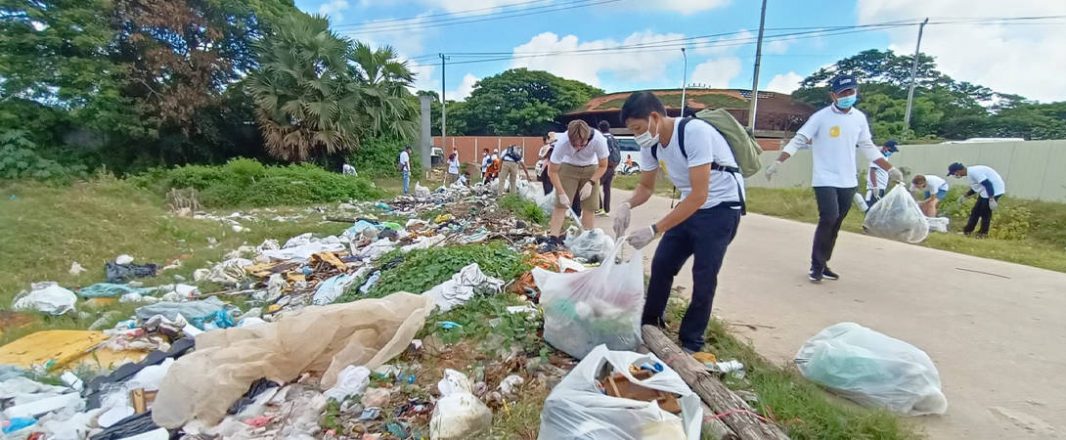
On July 31, 55 participants (representatives of partner organizations, volunteers and media professionals) collected 1,200 kg of waste in Kep. In Siem Reap on August 27, the clean-up campaign saw the level of engagement rise, with over 300 participants, including 70 tourism and hospitality businesses, environmental NGOs, social enterprises and even tourists, collecting 1,500 kg of waste.
In its environmental commitment, All Dreams Cambodia calculates the carbon footprint of each event in order to offset it by purchasing carbon credits or supporting ecological projects in collaboration with the Ministry of the Environment. In addition, All Dreams Cambodia provides free drinking water to all participants during each clean-up operation. This filtered water is purchased from TEUK SAAT 1001, an association to which the agency also donates 2 USD per participant in order to provide free drinking water for one year to a child in an elementary school.
We recently caught up with Jacques Guichandut, Managing Director of All Dreams Cambodia, to get some quick insight into tourism in Cambodia, the impact of collective perception on a country, as well as travel recovery in the nation.

“The key challenge for the industry is to go back and to be an attractive place to work in again.”
Q: Based on your observation, how is Cambodia tourism performing since reopening a while ago?
Jacques: I have to say, we had a lot of hope for this reopening because we were one of the first ones to reopen on November 15. Cambodia has been one of the top leaders in terms of handling Covid. We were expecting to get a lot of requests and bookings, but unfortunately it’s not the case. The main reason is, the major tourists for Cambodia before were Asians – China made up 45% of arrivals, Japan, Koreans and so on. A lot of these countries are still closed, or not fully open.
So the only countries we can count on are long-haul destinations like Europe and the USA. But for travellers from these regions, Cambodia is seen as an extension of a trip to Vietnam or Thailand, but not as a single destination. As long as those countries were not fully reopened, we did not really have proper tourists. We had tourists from Singapore because it was the only destination where people could really come in. Plus, we don’t have direct flights from the USA and Europe.
Today, we are among the countries in Asia with the lowest level of arrival of tourists, compared to Bali and Thailand, which is doing pretty well. Cambodia is still at the end.
Q: What are you expecting this year end, which is usually the high season?
Jacques: Bookings have been increasing for October – December, but we’re still far away from the figures of 2019, which is our reference point. For 2022, we’ll do about 20 – 25% of the figures we had in 2019… which is pretty bad.
Q: What do you think are some of the challenges in getting tourism back on track?
Jacques: This will take time, but it’s to change the image of Cambodia. Again, for Europeans, South Americans, Americans… the only thing to see in Cambodia is Angkor and the temples.
But Cambodia has much, much more to offer. That’s why the idea of the #ONESTEPNOPLASTIC campaign was to go to different places and to show travellers that there is something else to do, and that they can spend two weeks in just Cambodia and return home having enjoyed their trip. One of the particularities in Cambodia is the diversification in terms of landscape, and of course, the people – one of the most charming people in Southeast Asia, for me at least. Also, there’s the countryside, which is beautiful.
Q: What do you foresee in the coming year as far as tourism goes?
Jacques: It’s very difficult to predict, but the Ministry of Tourism is planning to go back to figures of 2019 by 2025 or 2026. I hope we can get there by 2024. One thing that can help us achieve this is probably the Indian market. There have been a lot of discussions and negotiations to have direct flights – because for any destination, the key is to have direct access. The Indian Embassy is really pushing to have direct flights by next year.
If that happens, we may reach the figures of 2019 faster than planned. Because the Chinese will take a while before they can travel abroad, so we cannot really count on them for next year. They will come back for sure, but not on the same level as 2019.
Q: Do you think the hospitality industry in Cambodia is prepared to tackle new challenges now that it has learned from the pandemic?
Jacques: That’s a very good question… I hope so (laughs)! The key thing is human resources. Lots of talent working in hospitality have left and are not coming back. So, the key challenge for the industry is to go back and to be an attractive place to work in again. It’s not easy.
The government has implemented some training sessions that they’re doing with the Cambodia Travel Association, so I’m very confident that we will manage to succeed on this big challenge. Some of the hotels have not yet reopened – only 40% in Siem Reap have reopened – so it really depends on the area. In the business districts, it’s very covered in terms of hotels so it’s not an issue. In some of the Southern parts, hotels managed because there were a lot of local tourists travelling. For me, the key thing is to focus on places like Siem Reap where things may not be so good. But I’m convinced we will find solutions to all these challenges.
Featured image courtesy of All Dreams Cambodia