A new report from Sabre, Consumer Mega-Trends Impacting Hospitality, reveals six trends expected to impact the hospitality industry in 2016 and beyond.
The global report also analyses changing consumer behaviour and emerging trends to identify what consumers will want next.
The study is a collaboration between Sabre Hospitality Solutions and TrendWatching, a company that tracks emerging patterns in consumer behaviour, attitude, and expectations.
Sabre said that these trends would present new opportunities for hotels to differentiate and drive growth.

Sabre’s report identifies changing consumer behaviour and emerging trends. (Image credit: fcscafeine/iStock)
This is because competition remains high in many markets despite a positive landscape, and hotels must keep innovating to find, and keep, competitive advantage.
The Asia Pacific region reported a 1.7% increase in occupancy to 66.6% compared with Q1 2015. Average daily rate remained nearly flat (-0.2% to US$105.04). Revenue per available room rose 1.5% to US$69.93, according to a recent report by STR.
“In today’s fast-paced world, emerging trends can quickly go beyond a niche, early-adopter group to a deeply-held expectation for a large portion of consumers,” said Sarah Kennedy Ellis, vice president of marketing and strategic development of Sabre Hospitality Solutions.
“Hotel brands that learn, understand and respond to these emerging trends will strengthen their customer relationships by providing experiences that go above and beyond what guests expect.”
Below is a summary of the six mega-trends:
Youniverse: This is where an individual’s tastes and preferences reign supreme. In today’s market, personalisation is centered on consumers telling brands what they want as the brands work to react. A host of new technologies – including facial recognition, biometric sensors and brainwave readers – will allow brands to customise guest experiences based on deeper, more authentic, or even subconscious motivations of their guests. This will mean even more choices for consumers who are already often overwhelmed with the multitude of options they face. With more than 50% of consumers now willing to share data in return for tools that help them make these decisions, hoteliers have an enormous opportunity to fulfil unmet needs through the use of data and technology – not only helping consumers make their decisions, but bringing their hidden travel preferences to light.
Helpfull: Brands that make travellers’ lives easier, simpler, and more convenient will win with future consumers. As consumers continue to be bombarded with generalised messages, ads, and offers at every turn, click or swipe, they will embrace brands that use new channels and new contexts in order to be at the right place at the right time, with the right offer. Location is already a pervasive consumer context, aiding brands in personalizing offers and experiences. But in the future, anything will be an actionable context, from a customer’s stress level to the emojis they use in social media.
Human Brands: Consumers want brands with meaning and personalities that are open, honest, generous, have some fun and stand for something. From tailor-made loyalty perks to supporting a shared value. For example ‘two-way transparency’ – primed by the peer2peer economy and on-demand services such as Uber – a more two-way review and rating process may be on the rise, subjecting customers to the same reviews we expect for brands. Loyal guests will get rewarded, and the minority of travellers who can ruin shared experiences for others are called out!
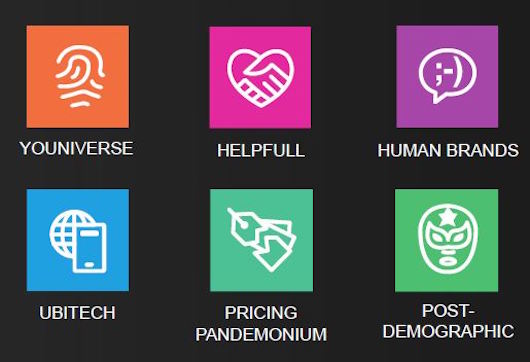
Six mega-trends impacting hospitality and travel.
Ubitech: Technology has become ubiquitous, universal, and impossible to live without. Consumers continue to crave (and build their lives around) the unparalleled ‘superpowers’ that technology offers them: instant information, seamless convenience, limitless choice and more. In 2016 and beyond, consumers will expect brands to use machine learning and Artificial Intelligence to put truly smart products and services into their pockets, homes, inboxes and more.
Pricing Pandemonium: People have always been concerned with price, but thanks to a range of new technologies and services, perceptions of price have become more complex and 2016 consumer attitudes to price will actually become more malleable than ever. What are brands doing? Playfully reframing product offerings as an entirely different product in order to shock consumers into a radically new perspective on – and appreciation of – the value delivered. For example brands – including hotels – will get bolder when reframing their offerings: newsagent candy and crisps (casual purchase, grab quickly) could be re-framed into hotel nights (considered purchase, carefully researched).
Post-demographic Consumerism: Demographics are dead. Today’s consumers – free to construct their lifestyles according to their own ideals and tastes – will choose products and services with little regard for traditional demographic conventions. The internet has created a global brain with access to the same information, culture and ideas. And consumers from Boston to Beijing are served by global megabrands (think Apple, IKEA, Airbnb, and Uniqlo). The result? A worldwide convergence in tastes and aspirations.
The study concludes with a consumer trend canvas to help hoteliers act on these insights and prepare for consumers’ future expectations.