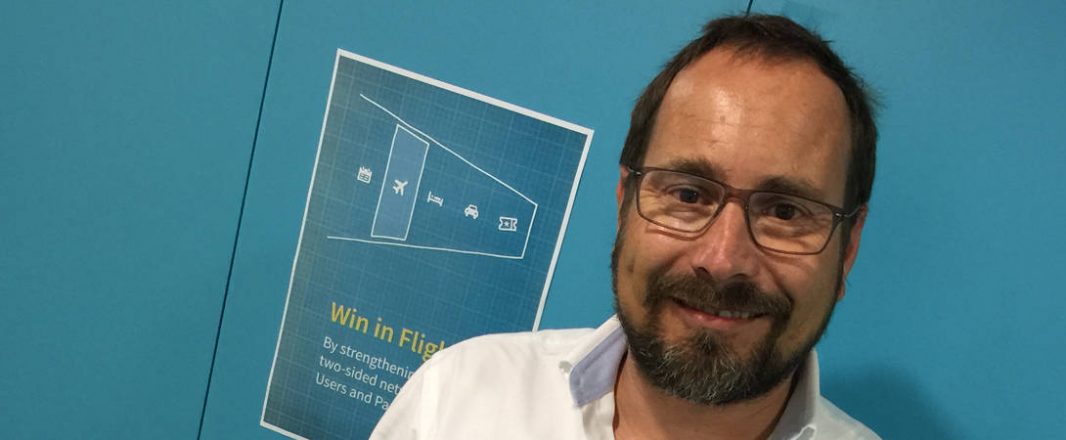
Gareth Williams, CEO and co-founder of Skyscanner, on what it will take to win big in Asia, his ambitions for the company he co-founded in 2001 and why he won’t give his AI project a girl name.

Gareth Williams:
CEO and one of the three co-founders of Skyscanner, Gareth Williams, is spending more time in Singapore these days. This is because he believes, “if we are to win, we have to win in Asia.”
Despite months of looking, it has yet to find a suitable candidate to run the region following the transfer of its regional director Andy Sleigh to Edinburgh. “We are looking actively for someone with extremely strong product and software knowledge and growth principles.
“The biggest message we have to get across is that it is no longer a regional manager role – that isn’t the way we are operating going forward. We want someone who have what it takes to win big.”
So what will it take to win big? He reels off the list.
Build local product and deep localisation of global products
One, build product for particular markets like China, Japan, India and Singapore. “We need to not only conduct marketing and commercial discussions but also build product and deep localisation of global products.
“We’ve done our largest category of hire of software engineers in the last six months in Singapore, China and Japan. In Singapore, we’ve taken on 50 engineers. The idea is to build product here and deploy it for that market and worldwide.”
Asia will become the test bed of innovation and experimentation for the company that’s always prided itself in putting product first, with Williams saying “we’ve always concentrated a greater proportion of resources on product and software as a percentage of of revenues”.
“In India and China, we have to build modern payment methods first. In Europe and Americas, it was, build credit card integration first – credit card is legacy technology.”
Its Chinese app, Tianxun, was built in Shenzen by the team from Youbibi which it acquired in June 2014 and a new website was launched April this year.
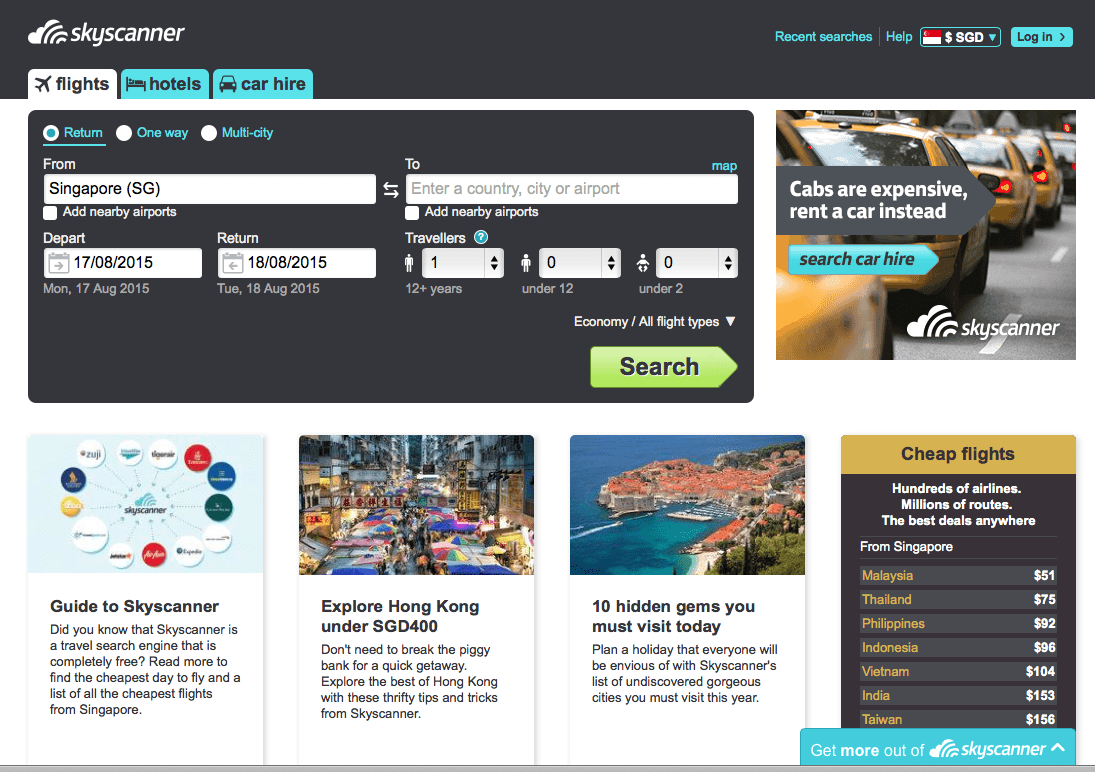
Skyscanner wants to build “the original network effect” similar to airlines
Building the global network effect
Two, building out global platforms. Its partnerships with Yahoo Japan and the recent deal to power flight search for MSN Travel in 31 markets expands its global distribution and reach.
“Our partnership with Yahoo Japan is great news for the Japanese traveller and great news for the 13 million people travelling into Japan. It will benefit inbound into Japan – and if we add low cost carriers from Brazil, it will give them South American coverage.”
Similar to what airlines try to build to create “the original network effect”, Williams said this was what Skyscanner was after. “We’ve always pursued a global strategy, we never saw it as valuable long term to focus on one market.
“The long term advantage to having global coverage is direct connections to well over 1,200 airlines, OTAs and hotel chains. Even very dominant airlines in Europe or Asia have relatively low visibility in other continents, we can surface the routes they fly.”
Creating the best software building company at scale
Netflix: “There’s a lot of learn from Internet economies outside of travel.”
Three, underpinning it is the mission “to create the best software building company at scale that we can possibly be”.
“Our efforts are hugely geared towards that – to build a software company that addresses the travel market, almost like Microsoft 20 years ago, Amazon, Twitter, Facebook. There’s a lot to learn from Internet economies outside of travel.”
Asked which company he admires most, his first answer was Netflix, then he added LinkedIn and Amazon.
“They have achieved two things. One, they have been an inspiration for setting company culture. Two, they have released lots of open source software. They’ve established ways to be a CTO, to think about Internet economy scalability. They have reduced the knowledge gap that enables far more people to successfully scale Internet companies.”
At the heart of all this is speed of product release – this is the greatest longterm competitive advantage, he said.
“The Internet minus Google is far larger than Google itself”
What about Google, I asked? Aren’t they also a software company that’s getting into travel fast and deep?
“Anybody has to pay close attention to what powerful companies. do, I think they are incredibly successful as the profit extraction engine for the supplier – hotels or airlines. But the Internet minus Google is far larger than Google itself.
“There is the opportunity to compete in other places. Our Yahoo joint venture and mobile are examples of those places – social acquisition and engagement are other ways to reach the consumer. Google has been very smart but they are not unbeatable in any area other than search.”
Facilitated bookings is another evolution of meta-search. Google offers that as does Skyscanner. Reportedly the former is not seeing much adoption in bookings given that we are more used to using Google to search, not book.
In Skyscanner’s case, Williams said it is seeing improvement in conversions particularly on mobile, with up to 20 times more conversions in markets like Australia, New Zealand and the UK. “That’s on the high end. From the start, a very large percentage of Skyscanner users never stopped to consider the distinction between meta search and OTA, what they cared for was, were the results better?”
This development is of course not very welcome by the OTAs who now see the metas as their competitors, companies they have spent money building up. But Williams said, “OTAs are excited by the volume of conversions on the whole – it is an uplift for our commercial relationships. Our goal is to represent their brands fairly.”
Search will go where mobile technology goes
Search, he said, will go where mobile technology goes. “The evolution of travel search will be entirely guided by the context of the mobile device, less or different input from users, greater awareness of preferences and other forms of personalisation and greater trigger points from other apps and personal operating systems. There will be greater work flow integration into other apps.
“We need a big leap.”
As for Artificial Intelligence, it has deployed four projects that use AI algorithms within Skyscanner. As an aside, I asked him what name he would give Skyscanner’s AI project given that most companies seem to be giving them girl names – for example, Moneypenny by Facebook, Lucy by Virgin – and movies casting female leads as AI characteres – Scarlett Johansen in “Her” and Alicia Vikander as Ava in “Ex-Machina”.

Ava in Ex-Machina
“Boris,” he said. “No girl names.”
The journey has yet to be completed
Asked why Skyscanner has not done an exit such as what Trivago and Kayak has done by selling to Expedia and Priceline respectively – the company, founded in 2001, took in investment from Sequoia Capital in late 2013 which valued it at US$800 million – Williams said, “We haven’t completed the task we set out to do, which is to make online travel efficient and even pleasurable to plan and book and to represent a small and fair distribution cost to suppliers.
“The order of magnitude in improvement in usability and reduction in costs to people who fly in planes and stay in hotels – we have 10x way to go.”
Williams said, “I personally have had incredible moments of luck and fortune. The journey has required incredibly more perseverance and tenacity than I ever anticipated.”
Asked how he saw Skyscanner 10 years hence, he said, “It will be much more than a meta-search or a price comparison company – our use of AI, machine learning, the degree to which we do itinerary, route construction and fare processing.
“The greatest external perceived change will be like parts of being a personal travel assistant. It will assist you to move in physical time and space, rather than a single booking or utility.”
For instance, trip planning which he called “the worst travel start-up idea”. “As an independent entity, it’s very difficult to get traction but as a signed in Skyscanner user, it becomes much more doable.”
This means Skyscanner moving beyond the content it now has – flights, hotels and car hire. “Package tours is of interest as are alternate transportation options,” he said.
Asked which pieces he would acquire to build the big picture, he said, “Our acquisitions have not been that many but it’s always of smart product technologies that gave domain expertise.”
Asked what he would buy – Airbnb or Uber – terms being equal, he said, “I’d be so in debt that I would be miserable. But setting that aside, I am quite torn. They are both amazing companies that I suspect I wouldn’t get on with either management.”
Flashback to 2001 when he and his partners, Barry Smith and Bonamy Grimes, got together to start Skyscanner and I asked him if those days of great adventure are gone and if travel had become too money-driven rather than dream-fuelled.
“I do think there is a danger that as you enter online travel, your passion for solving travel problems get converted into running a business and becoming a business person.
“At Skyscanner, we have been reasonably successful at keeping our eye on the original mission and solving travel problems better than anyone else.”