
Sojern and Google have just released the “Japan Travel Report”, offering an analysis of inbound consumer travel trends to Japan.
The report utilises Google search data, coupled with Sojern’s ‘travel intent’ and booking data from a pool of roughly 350 million anonymised traveller profiles. The Japan Travel Report has collated data on how different traveller preferences and habits vary internationally.
The results are then used to provide meaning marketing advice to brands keen on attracting capturing Japan’s inbound travellers. In particular, the Japan Travel Report highlights the challenges marketers faced when attempting to engage with different demographics.
Firstly, Japan’s key origin markets are identified. Unsurprisingly, the leading origin countries come from within APAC i.e. Taiwan, Hong Kong and South Korea. However, the USA, UK, Germany and Australia also rank in the top 10. Perhaps unexpectedly, fastest growing intent is stemming from Latin America, highlighting Japan’s growing international appeal.
However, plans to visit Japan are potentially disrupted by competing interests to visit other destinations in the same region such South Korea and China. Nevertheless, competing destinations are apparently contingent on where the traveller is from. Within Japan, while Tokyo and Osaka rank as top destinations, the third most popular varies, for example Fukuoka ranks third amongst APAC travellers, contrasting with Okinawa for North Americans.
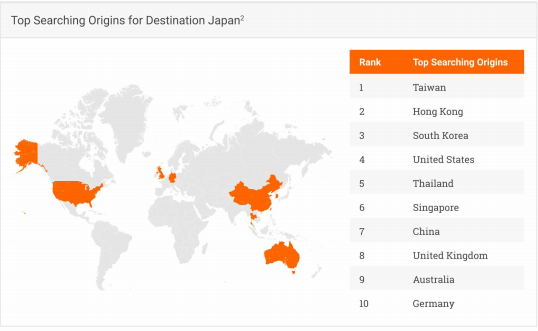
The Japan Travel Report revealed the top searching origins for Japan
The report then goes on to highlight which specific nations show consistent interest year-on-year and recommends diverse methods of engaging with these markets.
Another observable different between different inbound markets is seasonality of travel planning and booking. The Japan Travel Report reveals that internationally, search for Japan as a destination peaks in March and June, however booking peaks in March, then August to October.
The data also shows a correlation between the proximity of a traveller’s origin to the destination, with more advanced bookings made by North America and EMEA versus much higher variation in APAC. South Korea and China ranked most likely to make last-minute booking decisions, booking within a week or less from the date or search.
Finally and unsurprisingly, APAC travellers tend to be mobile-first when it comes to travel search (with 44% of in-region Google.com APAC travel queries, compared to 34% in the USA). Travel searches for Japan peak on Tuesdays and Wednesdays but bookings peak between Tuesday and Thursday internationally. According to report statistics, desktop seems to dominate bookings made on weekdays but there is a device shift over the weekend.
Overall, the Japan Travel Report data by Sojern and Google highlights the need brands to adopt multi-channel strategies, coupled with an experimental approach to different markets. The data provided within the report should be regarded as instrumental to developing creative approaches to targeting Japan’s inbound travel market.
See the full report.