
 Damien Cramer, Global Head of Travel & Airlines, Worldline
IN many ways, the COVID-19 pandemic acted like a reset button on people’s relationship with the travel industry. Trends that were already underway were turbocharged by the pandemic; today’s ‘digital travellers’ want greater personalisation, better value, innovative interaction, and more flexible options for payment. Despite several clouds on the horizon, the travel industry is presented with a great opportunity to meet these evolving customer needs.
As we look back on 2022, for the vast majority of participants, the year saw a dramatic rebound in demand for travel and, while there are several unpredictable clouds looming on the horizon, there is huge pent-up demand for seeing the world again.
But today’s travellers have quite different needs and expectations than before the pandemic hit – and it would seem there is no going back. What’s changed?
Pent-up appetite for travel
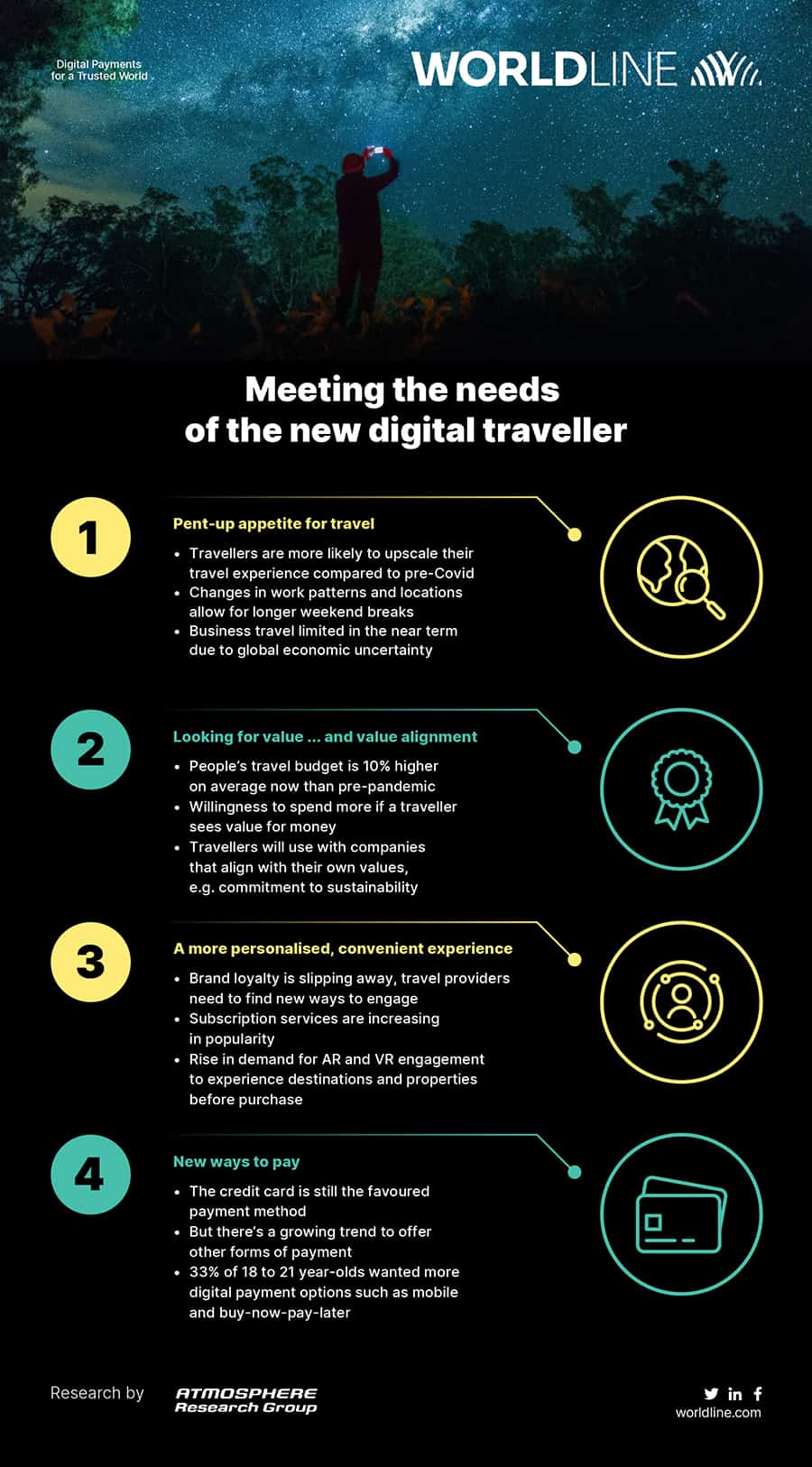
People built up a serious appetite for travel over the past couple of years, and 2022 saw a dramatic uptick in bookings for both domestic and overseas travel around the world. Some of the reasons for this were uncovered in a survey from travel industry research firm, Atmosphere Research Group, which were presented at the Worldline-hosted travel industry event Rise 2022.
When asked what they were most looking forward to doing once COVID-19 was under control and restrictions had been ended, respondents put travelling for leisure as their third choice – behind only going to restaurants and spending time with family and friends, and ahead of activities like attending in-person parties or gatherings, or visiting bars, cinemas or music venues.
Survey respondents said they were more likely to get together with friends and treat themselves to better things than they were in 2019, before the pandemic hit. Many also said they are also more likely to live for today as they don’t know what the future might hold.
The most likely types of travel in the near term, according to the survey, are two- to four-day getaways (solo or with family), ‘chill-out’ experiences, and visits to out-of-town family and friends. When it comes to travel, people are looking for emotional as well as rational fulfilment.
The dramatic and apparently long-lasting changes in work patterns brought about by the pandemic are having an impact on when people travel. With work no longer tightly coupled to a physical office, travel is becoming less focused around traditional holiday times and more evenly spread through the year. People are more inclined to travel during off-peak periods. Weekend breaks can start earlier and finish later. These trends should benefit the travel industry in the longer term.
However, there are signs that demand is being tempered again by uncertainty surrounding the global economy. As a late-2022 report from Atmosphere Research showed, inflation, rising costs of everyday necessities, and concerns about a potential recession and possible job losses have begun to weigh more heavily on travellers’ minds in recent months. Business travel in particular looks likely to be limited to essential travel only, with companies keeping a lid on discretionary travel, at least in the near term.
Commenting on the findings, Atmosphere Research Group president, Henry Harteveldt, said, “It’s very hard to make firm predictions about the travel industry in the face of such a confounding economic picture. On the one hand we have higher living costs and fears of recession; on the other we have strong employment figures and a willingness to tap into built-up savings for travel. The final chapter of the pandemic story is still being written; the industry needs to be ready to adapt quickly as it unfolds.”
Looking for value … and value alignment
Atmosphere’s research found that, even though leisure travel is a discretionary expenditure, people are keen to prioritise travel within their available budgets. However, they are looking for good value: travellers are more prepared to spend money on things like premium economy seats and club-level hotel rooms but want to know they are spending their money wisely.
The research found people’s budgets for travel are typically 10% higher on average now than they were pre-pandemic. Interestingly, travel buyers also appear to have a ‘second wallet’ available for discretionary spending on enhancing their travel experience with add-ons and upgrades.
The research revealed a critical mass of travellers who are receptive to premium-rate offers. When Atmosphere asked travellers how likely they were to choose certain premium options, significant numbers said they were likely to pay extra for more legroom, changeable or refundable hotel rates and flexible airfares, if the price was right.
Travellers are also increasingly looking to do business with companies that align with their own values, especially among younger age groups. For example, Atmosphere’s study found that the 22–34 age group is 50 per cent more likely than the 35–49 age group to base their travel purchases on the provider’s commitment to sustainability.
A more personalised, convenient experience
One big challenge for the travel industry is that brand loyalty is slipping away, and travel providers need to find new ways to engage.
As an illustration, 20 years ago 40% of travellers were loyal to a single airline; today that figure is around 15%. Travellers are more open to trying new brands and experiences. They are looking for the same levels of convenience, accessibility and personalisation in travel services as they receive in other buying situations.
One good example of this is the subscription model, which has proved so popular in areas such as digital content and recipe kits, for example. Around one-third of respondents in the Atmosphere survey would happily subscribe to a service that gives them access to a block of fixed-price flights, the inclusion of checked baggage on every trip, or access to extra leg room, for example. This is one important way that travel providers can engage and capture ‘brand-neutral’ consumers. US airline Frontier recently announced their ‘all you can fly’ pass for $599.
The rise of remote and home working during the pandemic has led us all to expect to be able to do pretty much everything online and researching and purchasing travel are no exception.
Travellers increasingly want to engage with travel providers through mobile channels, for example. It is estimated that 10 per cent or more of travel revenues will come from mobile gateways by 2025, and this channel will be especially important for buying ancillary products and services.
This makes it all the more important for travel providers to offer better levels of personalisation – not just using the traveller’s first name in an email – with profiles that encompass a whole host of individual preferences. Mobile devices enable highly relevant offers to be made to travellers at just the right time.
In addition, travellers are keen to try out new ways of experiencing destinations and properties before they commit to booking, using AR and VR technologies, for example. Ultimately, we might see travellers taking full vacations in the metaverse. Travel providers need to be prepared to move to these models quickly if and when the time comes.
New ways to pay
While the credit card is still the favoured payment method for travel in most countries, there is a growing trend to use other forms of payment, especially among younger age groups.
Atmosphere’s research found that in the 18–21 age group, 33% wanted more digital payment options (including mobile payment), and a similar proportion wanted more payment flexibility (such as buy-now-pay-later) in paying for travel. Only 23% of this age group were satisfied with current travel payment options, compared with 72% of over-65s.
Travel providers need to be able to meet this demand for new and more flexible ways to pay, especially given the renewed feelings of uncertainty among travellers.
Damien Cramer is the Global Head of Travel & Airlines at Worldline, a global leader in secure payments and trusted transactions. Learn more at www.worldline.com