
EPISODE 4 of the WiT Travel Roadshow on June 24 was a jumble of emotions – from exhilaration with the news today that finally, Singapore is preparing its population to deal with Covid-19 as part of their daily lives, to the mixture of excitement and trepidation in Phuket with six days to go before its reopening with the first flight from Qatar Airways, to the anticipation in Bali and Cambodia which await their turn to reopen – and the sadness at the damage caused to people’s lives by the greatest travel upheaval in history.
But what stood out like a shining light was the industry’s resilience and determination to come out of this stronger and better – we may be down but we’re not out, even after 16 months into the pandemic.
First, Kevin May, editor in chief of Phocuswire and Pete Comeau, managing director of Phocuswright talked through the various developments that have taken place in the online travel world the past 16 months and the different bets each was taking – shown in these two charts put together by WiT.
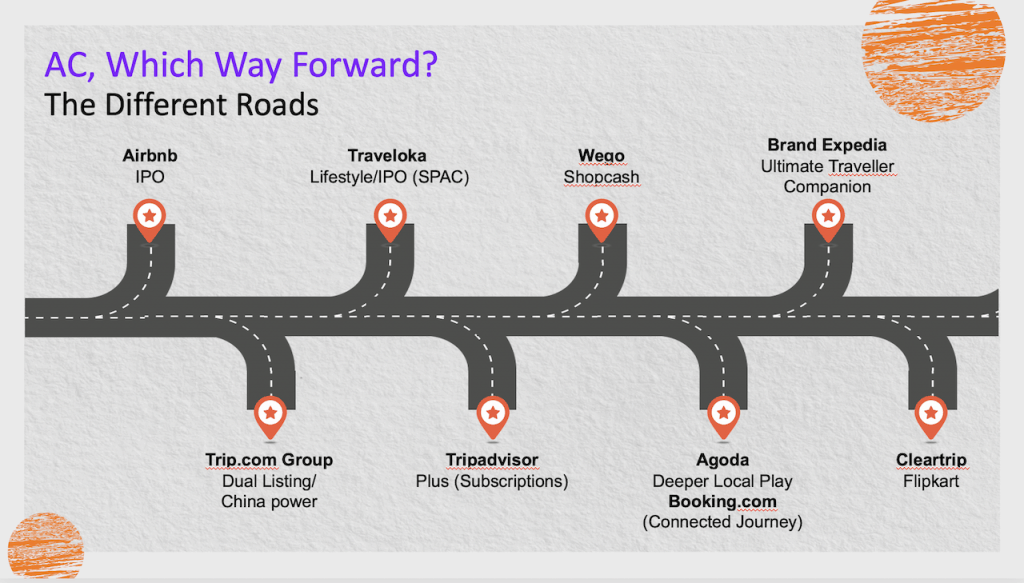
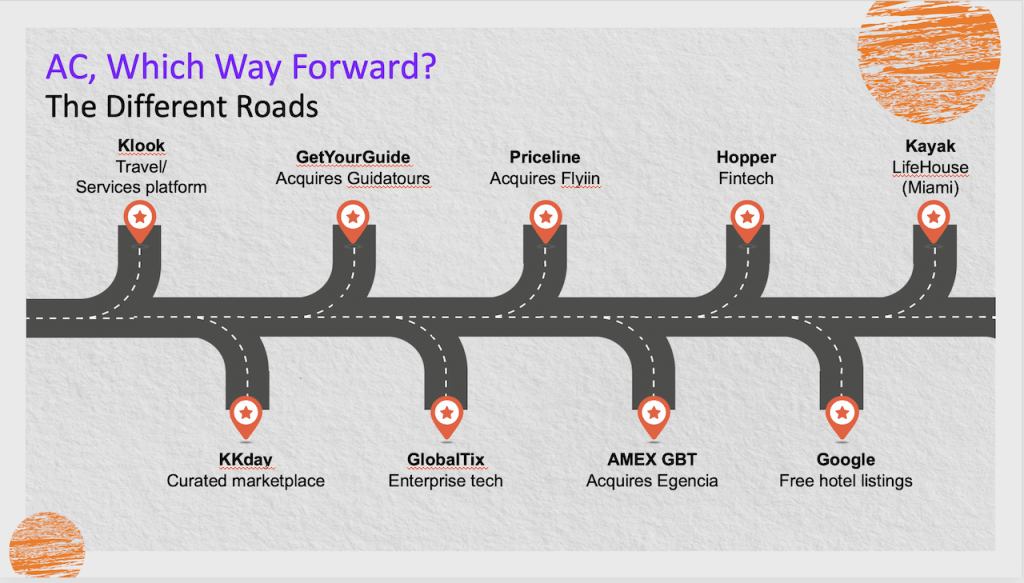
It is by no means conclusive but it gives an idea of the roadmap to an After Covid world and where each player is headed.
Will Airbnb with its focus on alternative accommodation prevail? Will Tripadvisor’s push on subscriptions work? Will travel services/lifestyle platforms (ala Klook, Traveloka) be the way to go? How about Booking.com with its connected journey and Expedia going for “ultimate traveller’s companion”? GetYourGuide buying a physical tour operator, Guidatours, and KAYAK partnering with LifeHouse to open a hotel Miami?
What’s clear, said May, is online travel brands are expanding their offerings to sell as much stuff as possible which, he observed, was ironic because that is what traditional travel agents do. Which proves the adage, everything always comes full circle.
Comeau, citing Priceline’s acquisition of Flyiin, said, “It is not a major acquisition but it is a signal of what approach Booking Holdings will take on sourcing airline content for its connected trip initiative, and probably not good news for the GDSs.”
So it would seem everything is up for grabs right, with new spaces being carved out by various brands.

Kei Shibata, co-founder & CEO, LINE TRAVEL jp & Trip101, spoke of its bet on a chat-based corporate booking tool integrated with LINE Works, and how different it was being a merchant versus meta – and is convinced that chat and messaging are platforms where travel, including bookings, can happen, something that’s proven after four years of partnership with the messaging superapp.
Tiket.com, in 2017, took the path of being part of an e-commerce giant when it was acquired by Blibli. Today, the four founders have bought back the company’s equity and it continues to work with Blibli, leveraging its customer base, which expanded considerably during Covid. “Covid has levelled the playing field and gives a fighting chance for everyone to compete,” said Gaery Undarsa, co-founder and CMO of Tiket.com.
Stephan Ekbergh, CEO of Travelstart, said the OTA, which dominates in South Africa, is investing in three pillars – payments, a co-working Innovation centre aimed at digital nomads to support the South African startup ecosystem and a high-end luxury concierge service for the “private jets, private villas” market.
Sharing some good news from Europe, Lisa Katsouraki, SVP, Corporate Development, Etraveli Group, said bookings on the global flight platform since April had surpassed 2019 levels (in volume, at least) and that the company, which took in no debt or financing during Covid, was investing in becoming the number one global flight platform as well as in payments.
Indeed, Ekbergh said “if you weren’t doing something in payments right now, you’d be missing out”.

Hospitality too has been shaken by its roots – from valuation of hotel assets, to design, to operations (productivity and automation), to sales and marketing. Shin Hui Tan, executive director of Park Hotel Group, believes for hotel companies in it for the long game, there was no turning back the tide on sustainability, digitisation as well as changes in design and operations, accelerated by a Black Swan event such as this.
The company is investing in a tech stack that will increase productivity, create value-added work for staff and enhance the customer experience. “If your cash flow allows, this is a good time to upgrade your tech stack. Some of the changes will be visible to the consumer – the website. Less visible will be the operational efficiencies which will create value-added work, which is the next step in attracting and retaining talent.”
She added, “We are looking at systems that are cloud and API-based. Legacy PMS systems are closed eco-systems and they do not lend themselves to productivity. We need systems to talk to each other, and have a single database which underpins our website, transactions, loyalty. This is good for the consumer at the front end and at the back end, it gives our people a 360 degree view of the customer.” (Full interview next week)
Meanwhile, you only have to compare these numbers of the two islands of Phuket and Bali to appreciate the extent of the damage of Covid to hoteliers in both places as well as small local businesses that rely on inbound tourism.
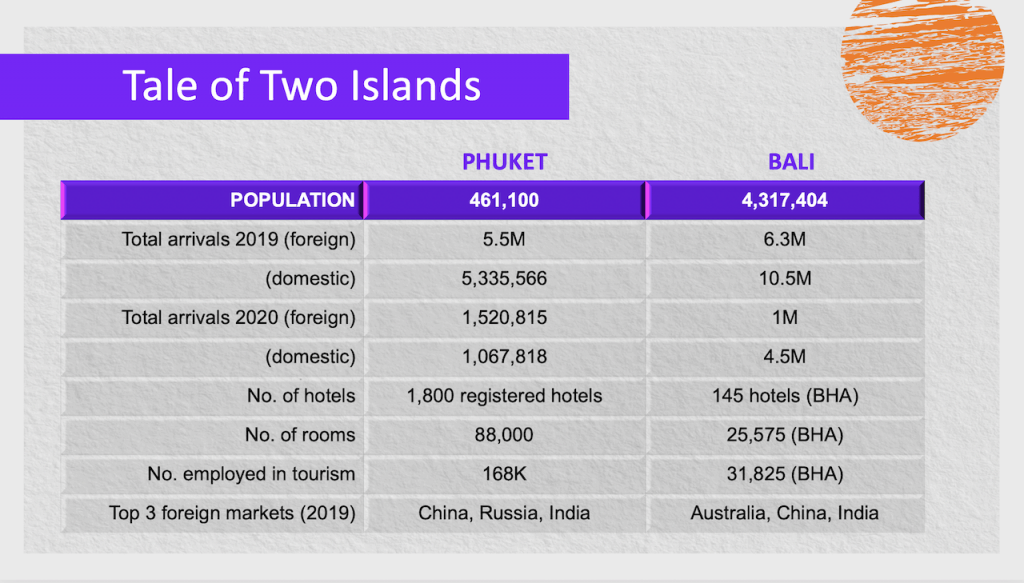
With six days to go before its reopening, Anthony Lark, president of Phuket Hotels Association, said there was a mix of emotions on the island – excitement, trepidation, anxiety and of course, the pressure of being the first resort destination in Asia to open to vaccinated travellers.
He shared a video, Imagine Phuket, that had been produced last year in anticipation of an earlier opening but in a way, the video being released now is even more poignant, given how long the wait has been for everyone.
Waiting next in line is Bali, with Jean Heliere, chairman of the Bali Hotels Association, acknowledging the uncertainty currently because of rising cases in Indonesia as well as Bali but reiterating the island’s hoteliers stand ready, after a very challenging time.
Asked what would be the first thing they’d say to the first foreign guest to check in, Heliere said, “Finally” while Lark said, “Can I buy you a drink?”
And in those two phrases carry the sentiment of an entire travel industry in Asia – that despite what it’s been through, everyone stands ready to welcome travellers back with the warmth and hospitality Asia is known for and, of course, for us to be able to travel again to have the reunions we are yearning for.
In the article written by three Singapore ministers in the Straits Times, the last point of how to live with Covid stood out for us. “Fifth, we will be able to travel again, at least to countries that have also controlled the virus and turned it into an endemic norm. We will recognise each other’s vaccination certificates. Travellers, especially those vaccinated, can get themselves tested before departure and be exempted from quarantine with a negative test upon arrival.”
Soon, soon …
Featured photo credit: Imagine Phuket, Phuket Hotels Association