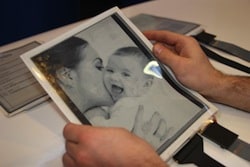
I was reading an article the other day about development work being done on a tablet that looks and feels like paper, and I couldn’t help but think, isn’t it interesting – the more advanced we get, the more we yearn for simple, or the way it used to be.
 We spent most of the last decade trying to get away from paper, investing our future in chips and bits that would enable us to reduce the use of paper and not read on paper.
And here we are, 2013, a month after the Mayan calendar ended, working on new research that would allow tablets “to look like that paper you just tossed in the trash”, says the article.
In other words, we are using technology to reverse technology so that we can go back to the way it was.
According to the article, this flexible paper-computer, developed at Kingston’s Queen’s University, in collaboration with UK based Plastic Logic and Intel Labs, may redraw the image people have of computing.
Based on a plastic touch-screen powered by an Intel Core i5 Processor, the paper computer features 10 or more interactive displays or PaperTabs instead of using several apps or windows on a single display, The people behind it says it may take three to five years before we can put our hands on it and when it does, each PaperTab could likely cost less than $100 – I guess that depends on how inflation goes.
And Roel Vertegaal, director of Queen’s University’s Human Media Lab, believes that within 10 years, most computers will feel like paper.
It brings to mind another article I read by Nassim Nicholas Taleb who argues that despite advances in technology, our world looks very much like the way it was centuries ago.
According to this article, in the early 2000s, we produce two and a half times as many bicycles as we do cars and invest most of our technological resources in maintaining existing equipment or refining old technologies.
Singapore for instance is trying hard to become bicycle-friendly and these days, you see as many bicycles as joggers on its roads when, in the past, bicycles were looked down upon as the peasant’s vehicle.
And one of the most consequential technologies, Taleb points out, is the one people talk about the least: the condom. “Ironically, it wants to look like less of a technology; it has been undergoing meaningful improvements, with the precise aim of being less and less noticeable,” writes Taleb.
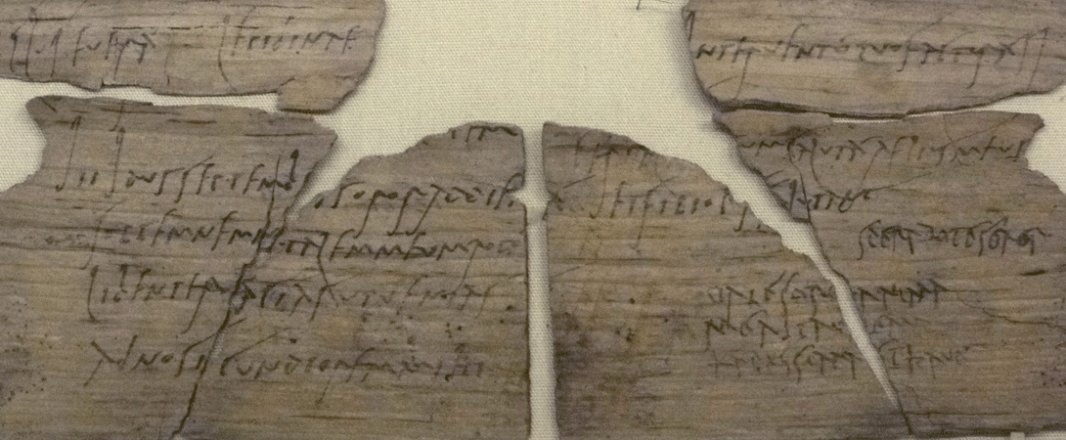
The tablet, he argues too, allows us “to return to Babylonian and Phoenician roots of writing and take notes on a tablet (which is how it started).”
And look at the evolution of the running shoe – from the time we were told we needed to buy shoes with all sorts of padding made with gel and stuff to now where we are told it’s better to emulate bare feet when running and now we have shoes that look like you’re not wearing any – like the barefoot sports shoes from Vibram.
 I recall a supermarket trip I made with my mother over the holidays in Singapore. We walked past the “organic chicken” section and she asked me what that meant because they were more expensive than the others. I told her that meant chickens that are free-range and not fed funny stuff. She said, “Oh you mean like the ones we used to have running in our backyard.”
See, everything comes full circle. We yearn for tablets to feel like paper and we want our chickens to be “kampong” (village) chickens, the way it used to be.
I just wished my parents had kept that chicken coop. Then I wouldn’t have to be cooped up in a small room that feels like a rabbit hutch writing on a computer that doesn’t feel like paper. I could be a farmer because I’m told that’s where the future is.