.gif)
The two airlines have had numerous differences for years – from landing rights to charges of favouritism from the government and unfair pricing, to name just a few. Their spats have been carried out openly and widely reported in the country’s media.
Pictured left: AirAsia’s Tony Fernandes
It was thus refreshing when MAS and AirAsia decided to put aside their differences in the wake of the demonstrations in Egypt to work together with the Malaysian government under Ops Piramid to bring home stranded Malaysian students, workers and visitors.
The result? Two satisfied, happy airlines bosses, a grateful government and a history of sorts in the airlines’ cooperation for a common good.
Both MAS managing director and chief executive officer, Tengku Datuk Azmil Zahruddin, and AirAsia group chief executive officer, Datuk Seri Tony Fernandes, expressed their delight on the close cooperation that saw the smooth execution of Ops Piramid to bring more than 8,000 Malaysians out Egypt.
The two men, who were at the Kuala Lumpur International Airport (KLIA), to welcome home the stranded Malaysians, also acknowledged the hard work by their staff and the government.
“Many of the operations, cabin and ground crew volunteered to help in the evacuation operation,” said Tengku Azmil, adding that MAS had also been in touch with AirAsia to work together and help each other out.
AirAsia’s head honcho Fernandes shared the same sentiment, saying the cooperation was proof of the achievement that could be reached with the two airlines working closely together. .gif)
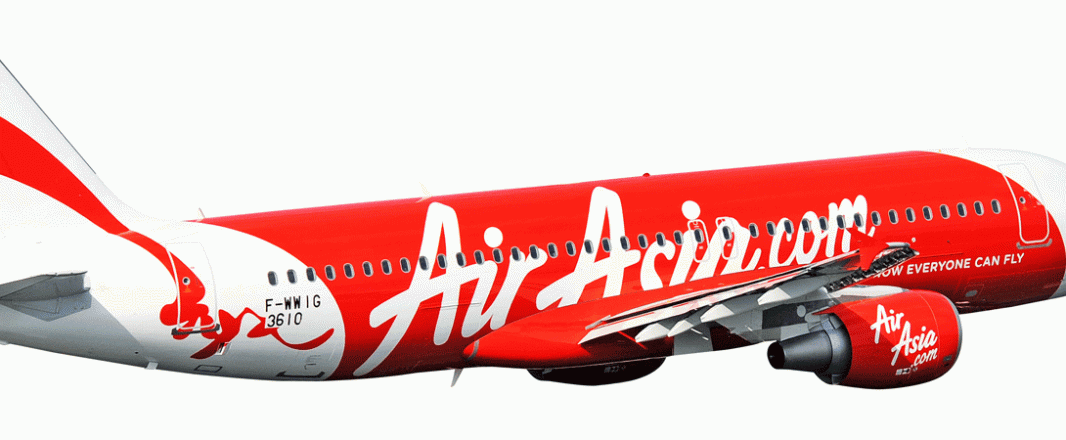
AirAsia flew 1,200 people from Cairo to Jeddah on three flights using its A340 aircraft and around 860 people from Alexandria to Jeddah on five flights using its A320 aircraft.
Pictured right: MAS’ Tengku Azmi
The LCC also took a daring risk as its first rescue flight took off without landing rights in Cairo. However, as AirAsia senior first officer Dinesh Alwyn, who co-piloted the first AirAsia flight, said, “Although we took off without landing rights, we knew that everyone else was rushing to ensure we would have the green light once we were about to arrive,” he said.
MAS sent the 359-seater Boeing 747 aircraft, which made numerous daily shuttle flights between Jeddah and Cairo. It still has an aircraft in the Middle East and will await coordination efforts by the National Security Council to see how many more flights would still be required.
The close cooperation between MAS and AirAsia may be just yet another rescue mission in the numerous mounted by countries to ferry their nationals to safety. So from a global perspective, the action of MAS and AirAsia may be nothing much to shout about. However, in the Malaysian context, this cooperation is an achievement bearing in mind the rivalry between them.
Even Prime Minister Datuk Seri Najib Tun Razak was delighted, hailing Ops Piramid as a “fine example of a joint effort between the private and public sectors in the face of a national emergency”.
Dare we hope that the close cooperation between MAS and AirAsia continue long after the rescue operation is a memory? That they could put aside their differences on aviation policies, landing rights, pricing, airports and related, cooperating to make KLIA an aviation hub? A position that KLIA has been striving for, but so far has eluded its grasp.
Didn’t AirAsia’s Fernandes say at KLIA on arrival of the stranded Malaysians that the mission’s success was “proof of the achievement that can be reached with close cooperation between the two airlines”?
Couldn’t then this “close cooperation” be the norm between MAS and AirAsia? It is only through such cooperation, and not bickering, that Malaysia can achieve its dream of being the region’s aviation hub so that truly, everyone can fly anywhere and everywhere from Kuala Lumpur.