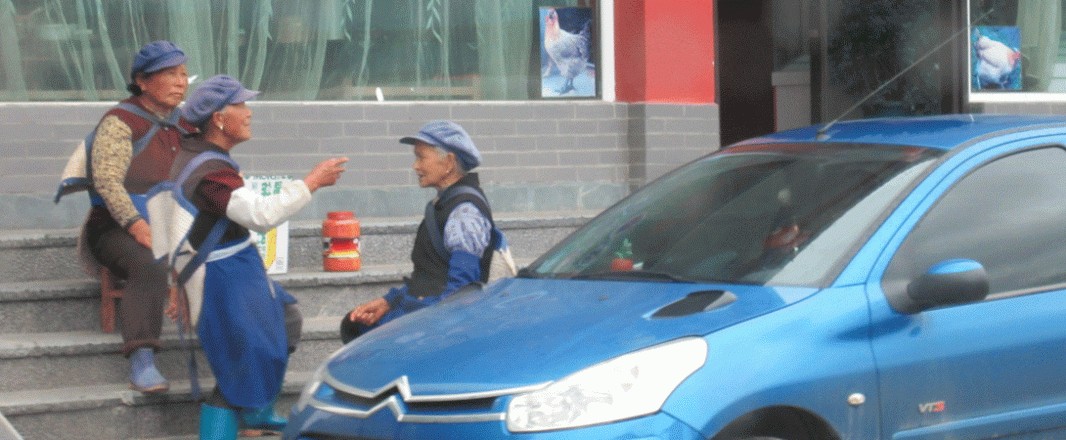

Painting class
Overnight rain has left Shaxi looking drenched and there’s mist in the mountains. It’s early morning but the students are already out, taking their painting classes. In one corner, a teacher marks their work.
I watch as she comments on each piece and someone keeps tabs of the scores. The students are serious and attentive – this is a land that respects and reveres authority. She tells them about attention to detail and having discipline in their work.
I look at the students. Perhaps one of them, like Jenny, will decide to return after graduation to lead a simpler life in Shaxi as urban life gets too competitive and stressful for young Chinese.
Yesterday, driving through the amazing landscapes of hills, rivers and valleys, I could already see the encroachment into rural life as China’s progress continues. Hills are being cleared, agricultural land is being commandeered, dams are being built.

Development encroaching into the rural landscape
As I look out at the villagers going about their rural lives, I wonder how they will adapt to urban living as they get moved to the cities. There’s talk of moving millions of farmlands to the cities.
Enroute to Lijiang, we pass through Jentuan, one of those Chinese cities that have grown out of nowhere with not a lot of urban planning. We stop for a quick bite – this is not a place for lingering.
The scenery is spectacular as the hills open up into the green valleys of Lijiang and we drive through alpine countryside. You can also see the architecture change from Bai-style to Naxi, which is the majority tribe in this part of Yunnan.
But it’s a relief when we finally pull up at the Pullman because Pangan, our driver, has not been well – something he ate, he said, and he’s been self-medicating with Chinese herbs.

Tranquil valley of Lijiang
The Pullman Lijiang is a stark contrast to Laomadian in Shaxi. It’s a modern complex and it’s lovely to relax in our villa with all the mod-cons we are used to in luxury hotels, although I am already missing the small-town charms of Dali and Shaxi.
The Pullman is about a 15-minute walk to Shuhe. During my first visit, I had preferred the smaller feel of Shuhe to the bigger town of Lijiang and it was with some trepidation that I revisited it, wondering what changes had taken place in four years.
Well, let’s say, I hardly recognise it. There’s a huge car park for coaches, and it’s as though the whole of Shuhe has been redeveloped and caricatures of old Shuhe houses have been built and converted into shops offering loud music and flashing neon lights. All the shops seem to be selling the same tourist stuff, reminding me of Patong in Phuket. There are karaoke bars, dim sum restaurants and faux Parisian cafes.
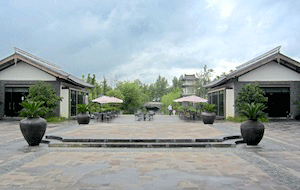
Entrabce to Pullman Lijiang
Once again, it’s packed with Chinese tourists but on a far, far bigger scale than in Dali or Shaxi.
This is the dilemma of Chinese tourism from the foreigner’s perspective – domestic tourism is so huge that it overwhelms everything – and as I walk through Shuhe, jostling with people, I wonder if any of our destinations are really ready for Chinese tourism on a mass scale.
We left Shuhe by horse cart, bargaining the ride down from 80RMB to 50RMB. The rider says he usually doesn’t take passengers outside the old town but since he’s going home anyway …
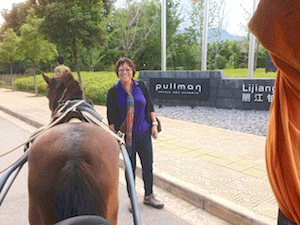
Siew Hoon all set for the horse ride
Obviously in good spirits, he takes us for a canter round the old town and then we hit the main highway and he shows us what he can do with his horse. First he trots, then he gallops … pulling up at the Pullman in a horse cart is an experience to be remembered.
On a clear night, it would have been possible to see Jade Dragon Mountain from the Pullman but with the rain, clouds have settled onto the peaks. But the stars are shining as we feast on Lijiang trout and cumin-roasted chicken that night at the hotel.
I go to sleep that night, dreaming of Shangri-La, the final destination on our trail.
Next: Onwards to the first bend of the Yangtze, onto Shangri-La