
I do not fast but I have always had fond memories during Ramadan as a child. My mother would take us to our cousins’ apartment late at night, where we’d sit around a table and help my aunt bake a phenomenal number of batches of sugee cookies and honey cornflakes, which she would later sell to her friends and extended family.
The apartment transformed into a little factory, with our tiny hands moulding tiny cookie-dough balls to bake, sneakily popping a few into our mouths before it could reach the oven.
We would then go to Geylang Serai’s annual pasar malam (night market), keeping a firm grasp on my mother’s hand as we navigated dense crowds, on the hunt for a new colourful Hari Raya outfit. As we weaved through, I can remember music blaring from dodgy boom boxes and fluorescent lights illuminating the tented stalls.
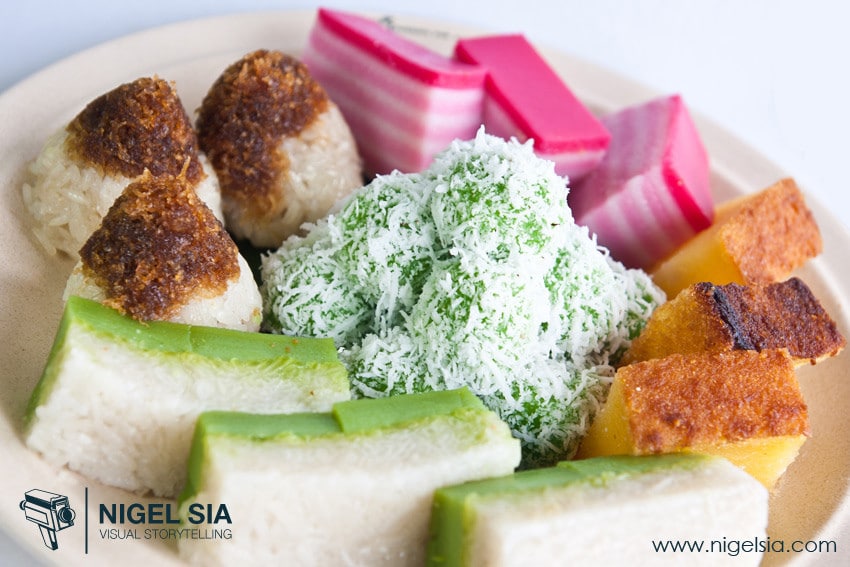
Traditional kueh often sold at the Geylang Serai Ramadan Bazaar | Photo courtesy of Nigel Sia via Flickr
Yet, my favourite part was always the food market… rows upon rows of sweet and savoury snacks. Stall owners would place free samples into my outstretched palm and I’d munch away happily until it was time to go home. It was all part of the build up to Hari Raya, where we’d make annual rounds to extended family members’ homes to feast on their cooking.
The market has changed a fair bit over the years and while I no longer make an annual visit, I’ve always been keen on hearing about gastronomic highlights and discoveries from friends that continue to go. Yet every year, it became less and less about finding out which stall produced the best kueh lapis and more about what bizarre creations were now being passed off as food.
At least for me, that is when the Geylang Ramadan bazaar began to lose its character and estranged itself from many members of the Muslim community.
What began as a fantastic way to celebrate iftar during Ramadan – with colourful lights, music, sweet treats and a dizzying array of Halal local food to temper voracious appetites after a day of fasting – transformed into a food-fad-following mega market, with little to no focus on its original purpose.
Halal food blogs even felt compelled to notify their readers that many of the stalls were in fact neither Halal nor Muslim-owned at all. Ironic, considering the market’s target demographic. It is terrible considering Muslims patronising the bazaar should feel safe in knowing that everything at a Ramadan-focused market is safe for their consumption, unless otherwise labelled.
In the same way Christmas fairs have evolved into hyper-commercialised marketplaces, Geylang’s pasar malam has morphed into a microcosm of food-trend fanaticism under the guise of religious celebration. Bloggers and influencers dragged focus away from the quality and diversity of flavours they found and instead published articles listing “20 Instagrammable Foods to Expect”, promoting frankly revolting, artificially-coloured treats that look about as appetising as a box of crayons.
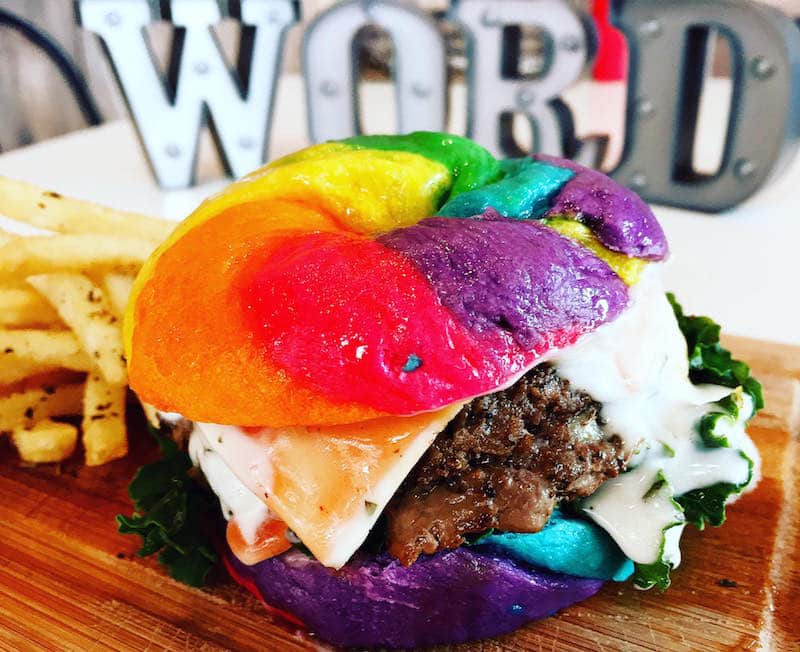
Rainbow Beef Burger The ‘Handsome Burg’ at this year’s Geylang Serai Ramadan Bazaar
Of course, there is absolutely no issue with the traditional market attempting to modernise by encouraging more ‘innovative’ food stalls to participate. However, its rebrand seems to have come at the expense of alienating many of the people it is actually intended to cater to.
It evolved from an annual market designed to encourage everyone to participate in a significant part of Muslim culture, by forming social relationships through food, into an over-commercialised business opportunity.
The annual Ramadan market built its reputation as the place to go to buy some of the island’s best traditional kueh (local snacks). Now, these nostalgic treats are buried beneath endless queues for “unicorn milkshakes”, a “rainbow tamagoyaki” omelette and even a “rainbow beef burger”.
Once the initial excitement of early Ramadan fades and good bloggers return to a world of ranking Singapore’s truffle fries (another laughable trend), I wonder if many of Singapore’s Muslim community will continue to return to the bazaar.
Ramadan is a global event and it’s uniquely celebrated around the world from the Middle East to Indonesia and beyond. The famous Geylang Ramadan bazaar was characteristic of how Singapore chooses to celebrate the fasting month.
Yet now, it seems it has begun to lose its sense of character and identity, in the midst of trying to brand itself as a farcical food-fad fair, instead of a community celebration of the fasting month.
As we approach WIT Japan & North Asia, we should consider the Geylang Serai Ramadan bazaar a cautionary tale of what happens when an attempt to “reimagine” perhaps goes one step too far.
In travel, innovation and technology is at the forefront of what we do as an industry. We must continue to push boundaries, challenge how we do things and be able to evolve as the landscape changes around us.
However, what must fundamentally remain the same is the recognition that “reimagining” does not come at the expense of losing the original value of what companies or brands bring to the table.
In travel, “reimagination” is about constantly figuring out how to make travel more accessible to more people, how to keep up with changing habits, and raising our game through technology and innovation, without sacrificing what makes different brands fundamentally unique.
Lead image courtesy of yeowatzup via Flickr