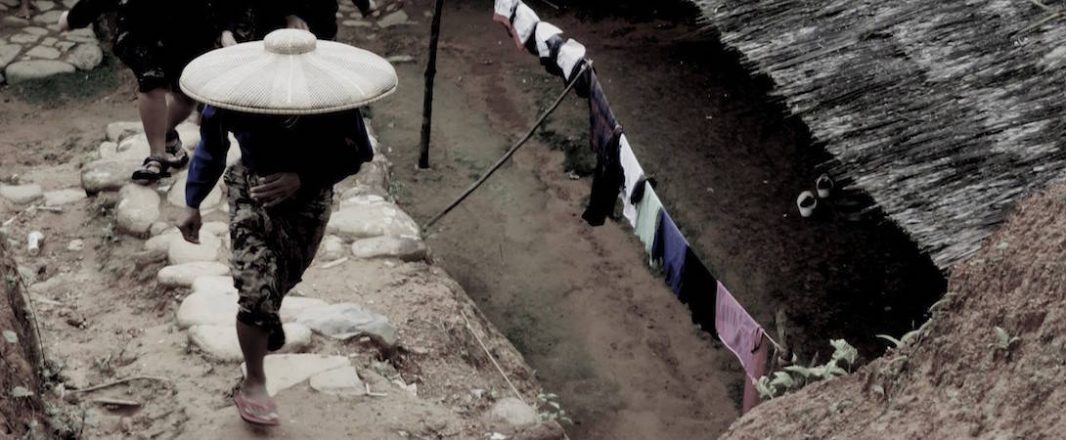
Even as we travel into lost worlds, we find ourselves lost without our creature comforts.
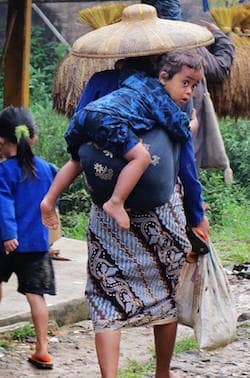
Badui, an insular tribe living in the Indonesian province of Banten.
A few years ago, my parents and I strapped on our backpacks and strode out to the Banten province of Indonesia to hike with a tribe of people known as the Badui. Almost the Indonesian equivalent of the Amish, this tight-knit, insular community live a life devoid of all technology. No light bulbs, no TV, no radios, no mobile phones, no motor vehicles and, would you believe it, no social media (hold your gasps till the end).
The tribe is divided into two subgroups, the Badui Dalam (‘inner’), who are highly insular and are strictly prohibited from interacting with any outsiders let alone with foreigners, and the Badui Luar (‘outer’), those that do have some (albeit, limited) necessary contact with the outside world for reasons such as limited trading for essential commodities.
Primarily practising a form of animism, they observe many mystical taboos, involving protecting their land from outside influences and absolutely forbidding them from using any forms of modern convenience.
It was a stark comparison with our small troupe of foreigners marching all gung ho with our cameras, taking snaps of everything from the little kids that ran naked through the marketplace to obscurely-shaped leaves on trees that we happened to pass. With lives so definitively polarised, I couldn’t help but continuously wonder what they thought of our dependency on all these little gadgets. In our defence (and some is needed for sure here), we were not using our mobile phones (no signal!) and we were not simply taking ‘selfies’ but were, in several cases, quite serious photographers.
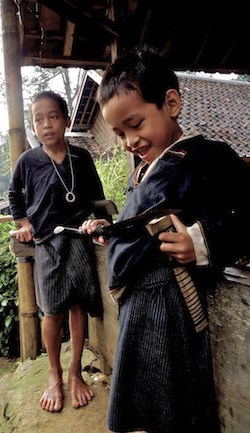
Simple joys of life devoid of technology.
I wonder if they thought we were tech-obsessed or could even comprehend what that means. We had come so far to seek the novelty of what life is like without our 21st century creature comforts yet brought them with us like our own superstitious amulets and charms.
While our porters would bunk up together and sleep on the floor, the rest of us would inflate airbeds and slather on insect repellant before it got too dark to see. Our dinners would take place under (not so romantic) flashlight, providing just enough brightness to help us bring a fork to our mouths but not luminous enough to reveal what mystery stew we were actually eating. Our guides, in contrast, would simply open a cloth parcel of rice and salted fish before calling it an evening.
After a minimally comfortable night’s sleep, our breakfast would comprise supermarket staples like black coffee sweetened with sachets of condensed milk, and dry Ryvita crackers, which we could only manage to swallow after topping it with generous lashings of processed peanut butter and jam. I can still remember the quiet panic that rippled through the group when we each began to realise our peanut butter rations had perhaps been too aggressively consumed and that we might not have enough for the rest of the trip. To our guides, a matter of polite amusement as they observed us struggle with ‘roughing it’.
As imagined with trekking, we marched single-file down the trodden paths between the trees, occasionally arriving at tiny villages standing three-huts wide for a brief repose. At each stop, we routinely unpacked our trail mix – a veritable mixture of roasted nuts and fluorescent gummy candy – washed down with the mild flavour of rehydration salts we had dissolved into our water bottles earlier.
Meanwhile, the porters that carried the rest of our luggage simply sat next to us, observing and waiting for us to feel ready to move on. While all of us were flushed pink in our cheeks with physical exertion, our guides had not even broken a sweat despite carrying our luggage. On the contrary, they found our definition of travel ‘essentials’ almost a wondrous collection of luxuries.
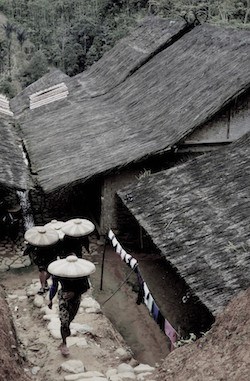
Trekking past a small Badui village.
We may claim to be the advanced race but surely there is something to be said if our ‘advancement’ means being so dependent on tools we have created to make our lives easier. Even in our attempts to venture into the Indonesian wilderness, we could not abandon all of them. We did not join our hosts in their diet of rice and salted fish, nor sleep without at least a thin buffer between our bodies and the floor. We could not trek the same terrain without shoes or a hiking stick, while our guides went barefoot at all times. We simply would not cope had we ever attempted to fully adopt their lifestyle.
Throughout our journey, we had become quite close to our porters who were very open about what normal life meant for them. They did not deny that times could get tough but expressed no desire to adopt the technologies we take for granted. Rather than seeing it as a source of convenience, it was as though they saw it as disconnecting us with what was truly important – their communities, families and the pride they took in their way of life. Their demeanor often hinted at this inner peace and tranquility… ironically the same thing we were seeking by undertaking this trek.
We felt genuinely sad to be leaving them behind. We were by no means the first foreigners to explore their land but with visitors still being a relatively rare sight in this area, even small groups of hikers must make quite a strong impression.
We visit places with an intention to experience a culture or lifestyle we may not have come across before. We expect it to leave an impression on us but we never stop to consider what impressions we give of ourselves. It left me wondering what they genuinely thought of us and our bizarre habits and customs that they experienced during our brief visit.