
Robots delivering room service in San Francisco, a 200,000-square-foot wellness floor in Athens with a longevity clinic attached. At WiT Queenstown, a panel of operators, owners and investors tried to work out what actually matters once the gadgetry is stripped away.
Travellers now have multitudes of choices when it comes to picking the accommodation they want, a point moderator Darrell Chan, Deputy General Counsel at Airbnb, made when he opened his panel at WiT Queenstown on “The Next Generation of Hospitality”.
For example, on a summer cruise from Venice to Athens, he’d booked a newly opened hotel purely because it scored a perfect 10 online and found a first floor built almost entirely around wellness, biohacking saunas, a Pilates reformer studio and a clinic offering longevity testing.
Weeks later, in San Francisco, his room service arrived via robot, one of four working a property that runs breakfast for 9,000 guests a morning. “You can see that between technology and the changing expectations of travellers, the pace of hotels is changing quite dramatically,” he said, priming his panellists for the discussion.
There was Rob McIntyre, running 15 Accor-branded hotels across New Zealand and Fiji inside a 6,000-property global group spanning Ibis to Raffles; Tim Alpe, whose company LyLo is rebuilding the communal accommodation category; and Mark Zawacki, whose Shashi Group has quietly run eight tech-company-adjacent hotels in Silicon Valley for a decade.
The pain point isn’t the wellness floor, it’s not knowing your name
Asked how traveller expectations are shifting, McIntyre said, “They want the pain points to disappear, reduced. They know what they can do with technology, but then they still walk into a hotel, and we don’t know their name.”
Worse, he said, is the moment of financial confusion that follows: “You’ve booked, you get to the hotel, you’re asked for your ID, you’re asked for the credit card, and then we take the credit card payment, and they’re like, ‘but I’ve already paid you.’ There’s this distrust of – where’s my money, when do I get it back?”
In other words, he said, guests don’t care whether check-in happens automatically or manually. “No one cares whether AI has done the check-in in the background, or it’s a manual process. They just want a good experience.”
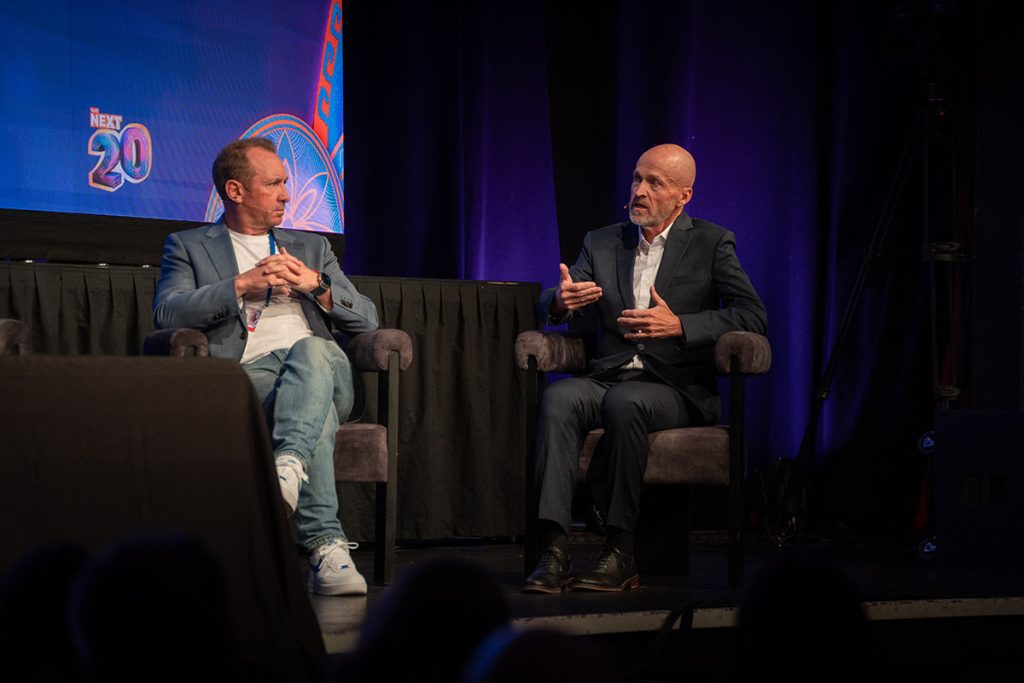
Mark Zawacki: “I run probably eight digital employees in cohort, and one of them is a shopping app. It can easily expose loyalties and efficiencies. If I’ve got points here and points here, what’s the better value? They’re exposing their loyalty programmes, and I think they’re going to commoditise very quickly.”
LyLo: Solo, female, and done with jägerbombs
LyLo, meanwhile, is busting hostel stereotypes. Alpe said LyLo’s clientele skews 70% solo travellers and 60% female – a profile that has quietly rewritten what “communal accommodation” needs to deliver.
“Historically, hostels and backpackers were all about the cheapest option, with not necessarily any innovation or design into it,” he said. What’s replaced the free-shot-fuelled backpacker ritual is community programming – cooking nights, yoga, ladies’ events – built around a different definition of value. Sleep, once an afterthought, is now central: “It was always a Jägerbomb at the bar, which – you all participated in, we still do – but now it’s about matcha.”
Travellers, Alpe argued, will pay more for a “sufficient experience,” and the operators who strip friction and hand their teams back to hosting rather than processing will be the ones who capture it.
The AI honesty gap: “They’re going to talk like they’re doing AI”
Zawacki, who also runs the Techne Infiniti Ventures fund, singled out the major branded chains for his response on how AI was changing hospitality.
“There’s a problem with the multi-franchise brands where they say they’re ‘in AI’ – it’s a socially desirable response. They’re not going to put in their annual report that they’re not doing anything about AI. They’re going to say they’re doing something about AI.”
He offered a live example: staying at a well-known international brand in Queenstown for the conference, he’d checked what the hotel actually knew about him. “They know nothing about me. Nothing. My profile has my name, my mobile and my email. I’m a trail runner, a cyclist, I’ve been a firefighter pilot for 10 years – I live in Colorado part-time – I mean, hello. They have no game.”
The structural reason, he argued, is franchising itself: corporate can publish all the AI ambition it likes, but franchisees rarely have the budget or obligation to implement it. “I think all the big brands are suffering, because if you understand this franchise relationship – they can have all the dreams they want, but they can’t push it down on the franchisees.”
His larger claim was that AI isn’t just the next technology wave to bolt onto existing workflows, the way the internet, mobile and social media were. “AI is fundamentally different. You’ve got to rethink from the ground up how this is going to work… The competitors are going to come in and build AI-native businesses, period.”
Every hotel company, he said flatly, “has ultimately become a software company”.
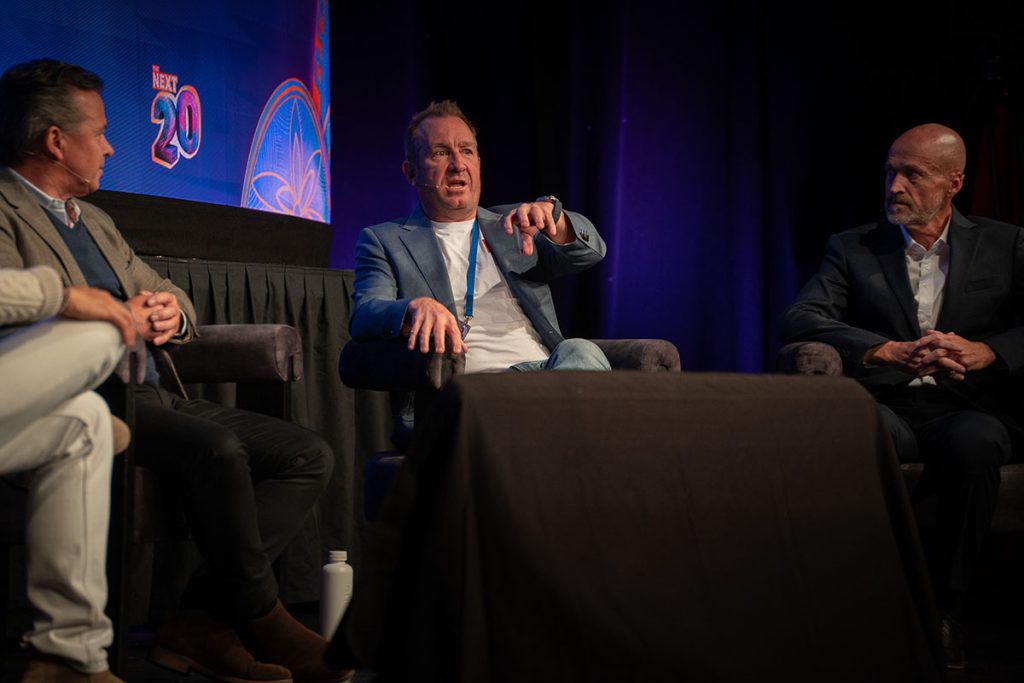
Tim Alpe: “What’s replaced the free-shot-fuelled backpacker ritual is community programming – cooking nights, yoga, ladies’ events – built around a different definition of value. Sleep, once an afterthought, is now central.”
Loyalty is being given away to AI agents, whether brands meant to or not
One of the panel’s more pointed exchanges concerned loyalty programmes. Zawacki argued that major chains, fearful of losing bookings if they blocked AI intermediaries, have quietly opened their loyalty programmes up to agentic shopping tools – without fully reckoning with what that means.
“They’ve opened it up to the OTAs’ AI agents, but they haven’t thought about the consumer. I run probably eight digital employees in cohort, and one of them is a shopping app. It can easily expose loyalties and efficiencies – if I’ve got points here and points here, what’s the better value? They’re exposing their loyalty programmes, and I think they’re going to commoditise very quickly.”
McIntyre’s counter was that Accor is trying to move loyalty value away from anything an AI agent can arbitrage – out of the transaction and into the experience. With around 130 million ALL members globally, the group is increasingly trading points for access rather than discounts: a preview of the “World of Liberal Arts,” entry to an Eden Park rugby match.
“We’re doing a lot with loyalty outside of the hotel,” he said. “People don’t come to Queenstown to stay in a hotel. They come to Queenstown for the experiences, and the hotel is one part that makes it a little bit easier for them to sleep at night.”
Alpe, notably, said LyLo’s guests barely think in points at all – loyalty for his audience is built on pricing and consistency across properties, not a rewards ledger.
Discoverability now means showing up inside someone else’s AI answer
Pressed on distribution in an AI-mediated search world, McIntyre pointed to a line from Accor’s chief data officer, Jean-François Guillemot: the real battle for the industry will be over who controls distribution “in the AI world,” with the eventual winners being whoever stays “visible, differentiated and actionable” inside AI-generated answers rather than traditional search results.
His own read on the shift was pragmatic – “you can ask AI who’s got the cheapest rate at the southern end of town, and it will tell you very quickly, so you’ve got to own that space”.
Letting AI do the process so humans can do the hosting
The panel found common ground was on using AI to free staff for higher-value, human work rather than replace them outright.
Zawacki described a Shashi Group engineer on the night-audit team who built an AI tool that monitors the shared kitchen overnight and flags anyone leaving mess for the next shift – quietly removing a recurring friction point without adding headcount.
“That actually frees up our person,” he said. “You want them to be hosts. You want them to be that experience, not be processes. Let the host host.”
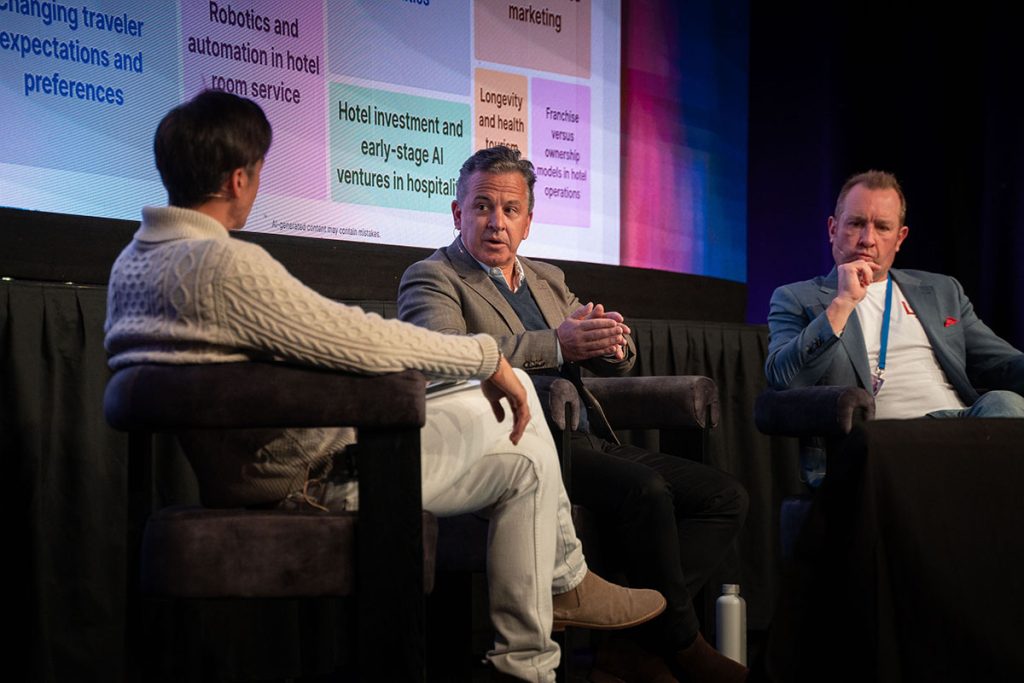
Rob McIntyre: “You’ve booked, you get to the hotel, you’re asked for your ID, you’re asked for the credit card, and then we take the credit card payment, and they’re like, ‘but I’ve already paid you.’ There’s this distrust of – where’s my money, when do I get it back?”
McIntyre agreed, framing the opportunity in almost architectural terms: Accor’s “digital factory” in Paris, staffed by 800 to 1,000 people, exists specifically to identify pain points across the group’s 45 brands and partner with outside technology to solve them centrally, rather than leaving each property to reinvent the wheel.
Both men were candid about the risk sitting underneath the opportunity. “The risk is two risks,” McIntyre said. “One is that people just do the same work and keep the same people [without improving anything]. The second risk is that hotel owners go, ‘cool, save some money,’ and take that person out of the business – so you’re actually not improving the service.”
Zawacki observed that hospitality, travel and tourism are “underfunded on tech, very fragmented [on] data,” and lagging sectors like banking, luxury and retail that have spent more heavily solving the identical questions – where does margin go, what do digital employees look like, how do you get ahead of technical debt.
“I encourage you to look a little bit outside hospitality, tourism, travel,” he said, “because other industries are ahead of us, and we can learn from them.”
The room built for 2035 – and the thing guests actually noticed
McIntyre talked about its “hotel room of the future” project it had built in Singapore, designed to preview what guest room might look like in 2035. Guests were put in the tech-loaded room and asked for feedback.
“They didn’t care about all the tech in the room and everything there,” he said. “They cared about: did I have a good night’s sleep? And the best thing about that whole room was the shower. It was just a little shower, probably a bit more pressure.”
He added, “Tech’s really, really important, but it’s the second focus of hospitality – I don’t think it’s the first. As hoteliers, we need tech to make it better, but we’ve got to be better at hospitality first and foremost, and let the tech help us get there.”
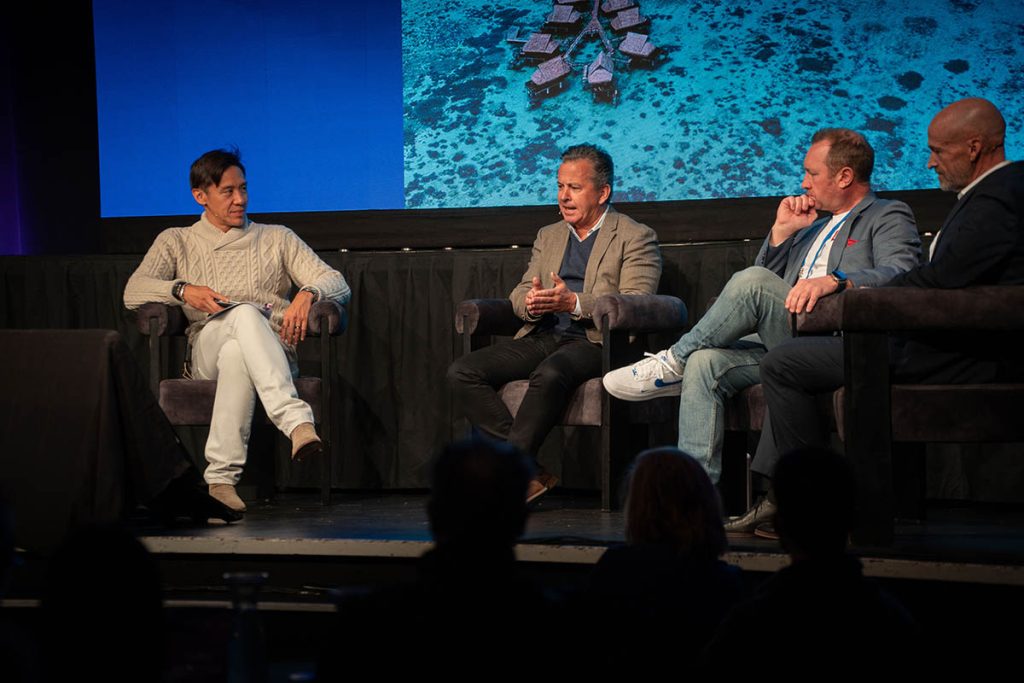
Quickfire: What’s the hotel of 2035?
The final question – what might a hotel of 2035 look like?
Alpe predicted a shift away from the standard room entirely: “A real move from traditional hotel rooms to cabins, to tiny homes, to small-format products – real diversity, because customers want different types of accommodation… frictionless, focused on sleep, focused on the environment.”
Zawacki: “Three times the technology, twice the guest experience, and half the staff.”
McIntyre: “They’ll be the most trusted. And trust comes in lots of ways – what you deliver on, what your promise is, your pricing, all of that. We’ll be part of the technology story too. But if you’re not trusted, none of it matters.”