If ever there’s a reboot story, it is that of Alan Joyce, CEO of Qantas, personally and how he led and engineered the biggest airline turnaround possibly in the history of aviation.
During the CAPA Aviation Awards night in Helsinki, of which I was the emcee, Joyce picked up both the Airline Turnaround Of The Year and Airline CEO of The Year awards and in the course of our 20-minute interview on stage, he shared both his personal story and that of a transformation that took Qantas from near-death and an A$2.8 billion loss in 2014 to a A$1 billion pre-tax profit in fiscal 2015 ending June.
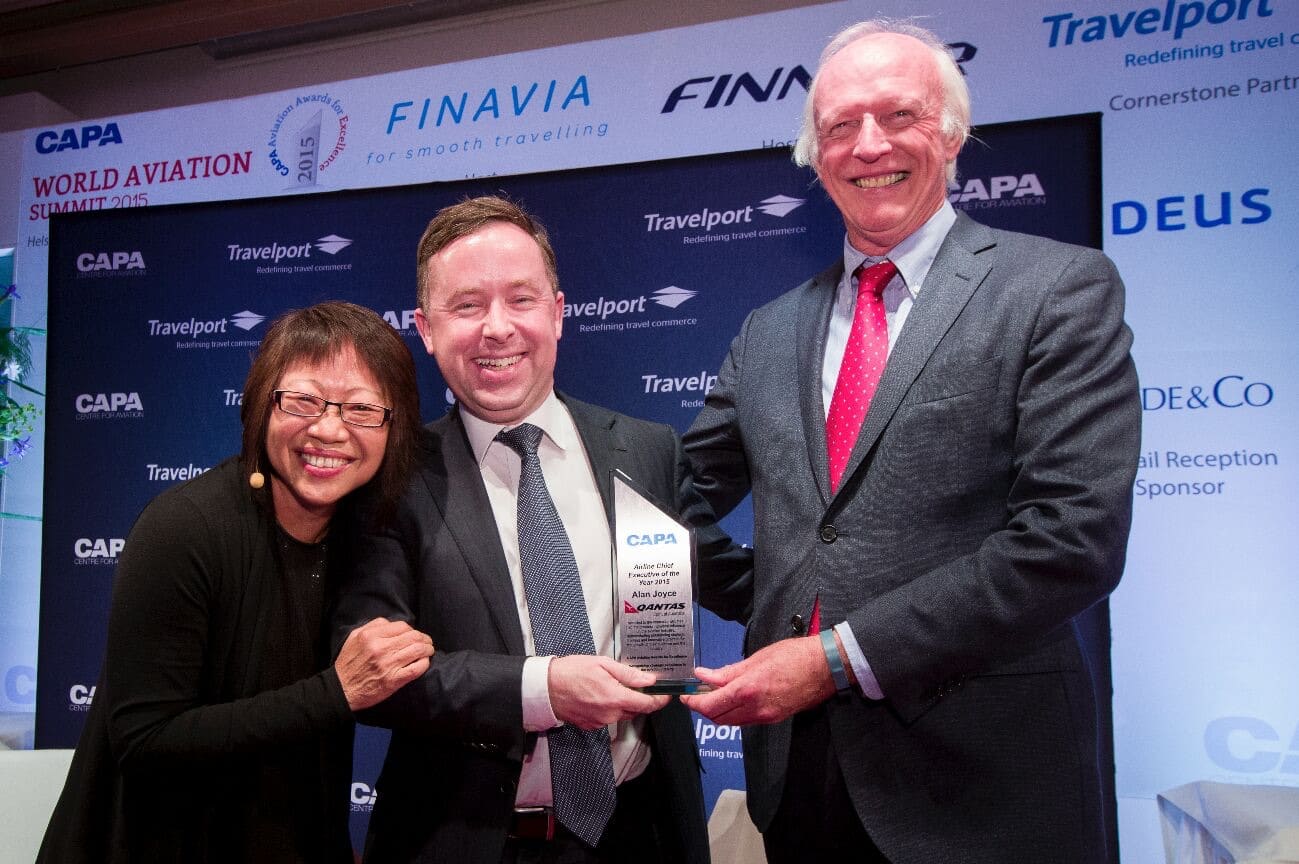
Alan Joyce (middle) accepting the two awards from Peter Harbison, executive chairman of CAPA, in Helsinki
Born of an Irish working class background, Joyce did not take his first flight until he was 22 when he flew Aer Lingus from Dublin to New York, business class.
Asked how he scored that business class ticket, he laughed, “Join an airline.”
And while he thanked his 30,000 staff for the “amazing transformation” and called them all superheroes, his biggest superheroes are his parents. Both working class, they had no secondary education and his father held three jobs to support the family. “They are my biggest influence.”
It’s probably that upbringing that toughened him up for the biggest challenge of his career.
In recognising Joyce, CAPA said, “Ever since he took the helm of the airline in November 2008, the airline has lurched from one crisis to the next, culminating in a near death experience in fiscal 2014, when the airline notched up an A$2.8 billion loss.
“His strong will in taking very hard decisions – grounding the airline during a battle with its pilots union, large redundancies and abandoning its capacity war with a competitor on the domestic market – contributed to the turnaround.
“He also has driven new partnerships, including the bold decision to tie-up with Emirates and more recently forge a joint venture with American. He has a plan to reduce debt and gearing through until 2017, aided by improved earnings and much stronger cash flow.”
Every decision he took was criticised by the media. He was skewered over the grounding of the airline but it was that which led to the breakthrough with the unions. He was lambasted when he signed the partnership with Emirates, and accused of selling out an Australian icon to a Middle East interest.
He spoke of his lowest point, when he was being interviewed by a TV crew around the time of the grounding. It was in a park and an irate man, walking his two Jack Russells, suddenly started shouting at him and the two dogs got loose and went for Joyce’s ankles.
“To this day, I hate Jack Russells,” he said, adding he preferred the beautiful Irish wolfhounds.
It’s probably also that sense of humour that saw him through those dark days. I asked him if the Australians gave him such a hard time because he’s Irish and he said that Qantas, being a 95-year-old Australian institution, is one of the most mentioned companies in the media.
The other most mentioned name is James Packer and “there was a day when Packer had a fight on his front lawn and I was glad I wasn’t the headline of that day”, he laughed.
“The biggest transformation story of any airline in history”
He recalled that moment when, speaking to his team, he said, “We are going to create the biggest transformation story of any airline in history.
“I said a lot of things that day but people remembered that. I didn’t know it at the time I said it,” he said. It became the rallying cry for the team.
He said leaders have to create a vision and then lead the team towards it.
Leaders also must be able to take a lot of pain. I quoted him a paragraph from the book, “Elon Musk: Tesla, SpaceX and the Quest For a Fantastic Future”.
Referring to the 2008 period when Musk was testing the SpaceX rockets and it took six years, four and half more than he had planned – “ Most people who are under that sort of pressure fray. Their decisions go bad. Elon gets hyper-rational. He’s still able to make very clear, long term decisions. The harder it gets, the better he gets.”
“In crisis, you overcompensate by focusing on what you know”
Joyce said that “in crisis, you overcompensate by focusing on what you know” and being a physics, math and science, he became obsessed by analytics and data and concentrated on the rational as opposed to the emotional.
And interestingly, this focus was what led him down his favourite topic of the moment – customer data – and how the use of customer insights has led to the doubling in profitability and size of the Qantas Frequent Flyer programme and how Qantas launched and invested in new businesses including Red Planet, an ad agency, as well as Qantas Catch.
He is chasing the sweet spot between customer analytics and profitability and this is an area airlines are missing out on.
At this point, he joked about how Qantas now had 11 million members in a country with a population of 24 million. “My staff are handing out membership forms in maternity wards,” he jested.
Asked if this was the highest point of his career – turning around Qantas and proving his critics wrong – he referred to the launch of Jetstar. “Starting an airline from scratch, that’s a great experience.”
I reminded him that in an article, he once gave these leadership tips. Have a vision. Create a diverse team. Ask questions and empower. Take calculated risks. Own up to mistakes and clean up fast. Don’t bully or thump desks.
I asked him which was the hardest to live up to and he said, owning up to mistakes.
He recalled the time when he realised that Jetstar’s free seating model, based on RyanAir’s, was not working in Australia. It’s hard to admit a mistake and move on, he said.
The transformation of Qantas is by no means complete, he said. “It’s still not finished, there’s still lots to do.”