The weekly news roundup: TNS Marketing Monitor study on social media influence in marketing, Singapore DBS Bank’s chatbots, Tourism New Zealand’s new halal food guide
TECHNOLOGY: Social media overtakes traditional marketing metrics in Singapore and APAC, says TNS study

Top 3 channels in Singapore are Facebook, Instagram and Twitter (Image credit: Anatolii-Babii/iStock)
Brands in Singapore and Asia Pacific are placing social media at the heart of their marketing strategy as they strive towards 360o customer engagement, according to a study by global insights consultancy TNS.
The results from TNS’ second annual Marketing Monitor study across Asia Pacific revealed social media ranked as the top element guiding the planning process as well as the top metric used to measure the performance of campaigns for marketers.
According to the study businesses are using a variety of sources to inform their marketing strategy, but insights gathered through social media monitoring have finally overtaken more traditional metrics such as market share data and brand tracking to become the most popular component used by marketers.
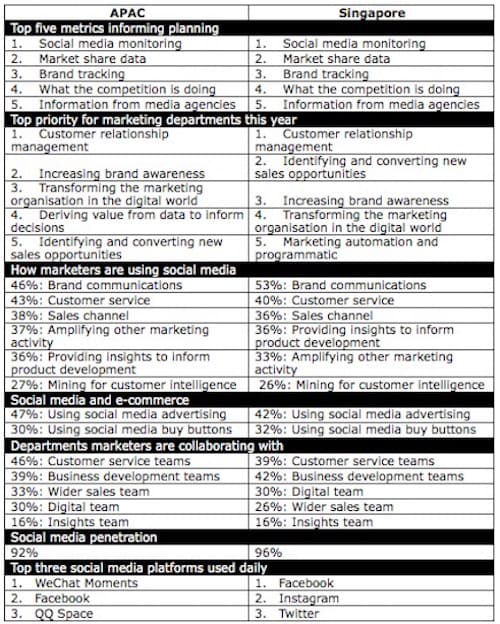
The top five metrics informing planning are social media monitoring, market share data, brand tracking, what the competition is doing, and information from media agencies
These findings echoed the changes happening in consumer behaviour across Singapore with about 96% of connected consumers in the country using social networks, with Facebook, Instagram and Twitter as the top three channels.
“This mass adoption of social provides marketers with an array of sources when it comes to developing strategies and evaluating the effectiveness of their marketing activity,” said Zoë Lawrence, digital director, APAC for TNS.
The study also highlighted the top priority for marketing departments this year – customer relationship management.
Findings revealed that marketers’ sphere of activity has now broadened, as they concentrate on how to deliver the best overall customer experience, ahead of the traditional aim of increasing brand awareness.
To achieve this, businesses are using social media across a range of disciplines. For example, 53% of marketers are using social media for brand communications, while 40% are using it to provide customer service.
Social media also appeared to be a big part of e-commerce strategy, with 42% using social media advertising and one in three (32%) using social media buy buttons.
The study noted that despite this approach to using social to support a variety of marketing goals, businesses are not working as collaboratively as they could be. Only 39% of marketers partner with customer service teams, one in three (30%) work with the digital team, and 16% working with the insights department (see chart below).
“With marketers using social for a range of marketing objectives, it is important that they are offering a consistent, coherent experience to the customer. Brands need to strive to break down the silos in their organisations to ensure that they are realising the potential positive impact that an aligned, well-executed social strategy can deliver,” said Lawrence
The Marketing Monitor study was carried out in July 2016 across 11 countries in Asia Pacific – Australia, China, India, Indonesia, Japan, Malaysia, New Zealand, Philippines, Singapore, South Korea and Thailand
TECHNOLOGY: Chatbots coming to a DBS bank near you

DBS customers can soon use chatbots to do their banking. (Image credit: ponsulak/iStock)
Customers with DBS, Singapore’s largest bank, will soon be able to use natural language to converse with the bank from their favourite mobile messaging app, manage their money across accounts, track expenses and even make payments.
DBS said it would be the “first bank in Asia Pacific” to have chatbots for their customers to carry out their banking by the end of the year.
The financial institution is working with US-based Kasisto, a spin-off from SRI International that created the technology behind Siri (Apple’s voice assistant), to deliver this service. Its conversational AI platform, KAI, powers smart bots and virtual assistants with deep banking knowledge.
The conversational AI technology will allow DBS customers to access banking services on Facebook Messenger initially. The service will launch first in Singapore and India by year end, followed by DBS’ other key markets.
With the chatbot customers can just text “How much do I have?” if they want to check their balance in their account, and the query will be answered promptly.
They can also pay bills easily via this service. For example, by texting “Can you please pay my mobile bill?”, the request will be processed but not before identifying the correct payee.
The bank also plans to extend this service to other mobile messaging apps like WhatsApp and WeChat in the future (see video below on how it works).
“We know that our customers are spending time conversing on their favourite mobile messaging app, and we are immersing ourselves in the customer journey by making it easier and more convenient for them to engage us,” said Sandeep Lal, DBS Bank’s regional head of eBusiness.
DBS said research has shown that people are spending more time on messaging apps and the launch of this service would allow it to connect with customers in a more direct and responsive manner.
MARKETING: New Zealand targets Muslim travellers with halal food guide

A halal food guide for Muslim travellers to New Zealand (Image credit: Tourism New Zealand)
Tourism New Zealand has launched a new culinary tourism guide as part of its effort to attract more Muslim visitors to the country.
The guide, which focuses on meeting the needs of Muslim travellers, was developed with the support of the Kiwi Muslim Directory and Federation of the Islamic Associations of New Zealand (FIANZ).
It provides general tourism information, as well as a list of restaurants and cafes ranging from halal-certified to those that offer vegetarian dishes or vegan cuisine.
Tourism New Zealand’s regional manager South and South East Asia, Steven Dixon, said the guide aims to expose the country’s rich food experiences to the visitors.
“New Zealand food goes way beyond fish and chips and barbeques – our chefs have developed a distinct Pacific Rim cuisine.
“We acknowledge how important access to information about suitable dining options is to the overall experience of our Muslim visitors and this guide demonstrates our commitment to further enhancing New Zealand’s position as a visitor destination among this audience.”
The Halal Food Guide is available for download on the Singapore, Malaysia and Indonesia editions of Tourism New Zealand’s website.
• Featured image credit (social media marketing): Ellagrin/iStock