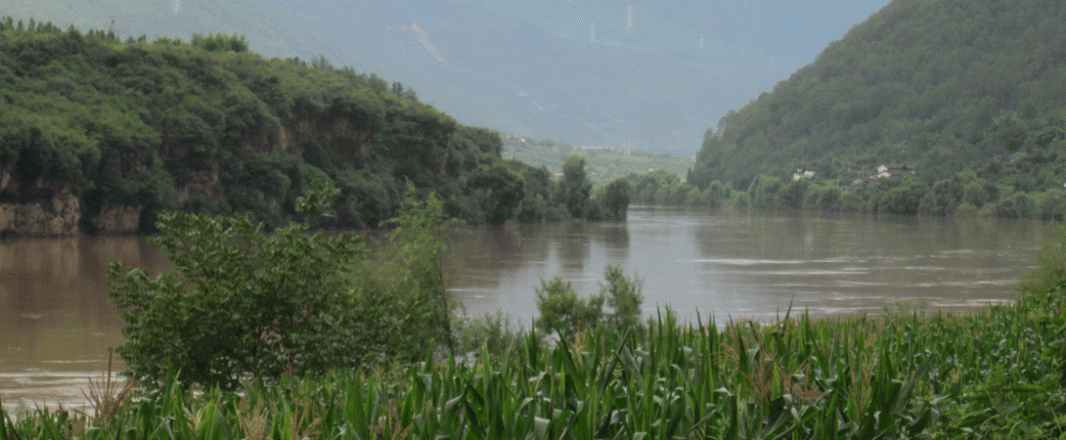
It is somewhat surreal that I should be spending the night in an adobe inn in the historic town of Shaxi, Yunnan, when just five days ago I was at the global Adobe Digital Marketing Symposium learning about how much marketing has changed.
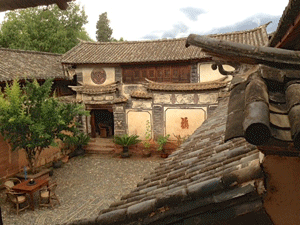
Laomadian – Old Horsse Inn
At the event in Singapore, there was a lot of talk about how today’s marketing needed not only technological change but also organisational transformation because it doesn’t make sense if marketing still worked in silos when the cloud makes it possible to bring it all together, and when it’s critical to have an integrated strategy as opposed to thinking traditional vs digital, us vs them.
In Shaxi, Swiss funding has made it possible for this old trading post on the Yunnan Tea and Horse Caravan Trail to be beautifully preserved. Walking into it, you feel like you’ve stepped into a movie set, the kind you see in kung fu films of old.
In the village square, students (it is the school break in China) gather in clusters, armed with paints and canvas as they attempt to capture the beauty of Shaxi Square in which a 316-year-old tree holds centre court.

Student painting Shaxi town
Tourists wander along the alleys, breathing in the atmosphere of this trading post and imagining the merchants and traders of old as they stop by in Shaxi with their horses and goods on the way to Lijiang and Zhongdian (Shangri-La) and onto Tibet.
Its adobe houses have been restored, some of them converted into inns (like the one I am staying in called Laomadian – Old Horse Inn), some into cafes, shops and restaurants while others remain as residences for villagers who live alongside the transient visitors as they have done for 2,400 years.
And this is what makes Shaxi and the two other ancient towns I’ve visited so far on the Caravan Trail different from say, Lijiang and Luang Prabang in Laos. They are “living” villages where locals still live within the old city walls and have adapted their lives to tourism, but not surrendered or capitulated to it.
So that within the city walls, you’ll find the old trades – barbers, tea merchants, tradesmen, cobblers, medicinal halls – alongside the shops catering to tourists. And because there is this acceptance of co-existence, you as a traveler are made to feel welcome as guests, rather than as a target of commerce.
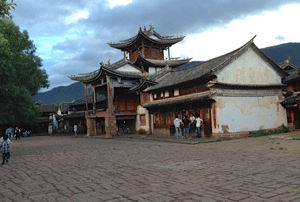
Shaxi Square
To me, these towns are fine examples of integration – where an old world comes together with a new one and there is this acceptance of co-existence because to do anything differently would not be beneficial to anyone.
Which brings me back to the Adobe Digital Marketing event. Almost every speaker was calling for integration between old world and new world, traditional and digital, and for silos to be broken down between divisions so that companies can pursue an integrated business strategy.
The biggest hurdle, it appears, is not technology – all the tools (yes, and big data too) are there (Adobe was launching its Marketing Cloud, which got all the marketers in the room drooling) – but people and mindset.
Take the example of Malaysia Airlines whose senior vice president, head of marketing, Dean Dacko, shared its new “Journeys” campaign launched a month ago, the airline’s first ever integrated marketing exercise.
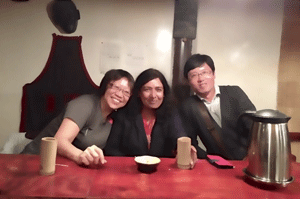
Friends on the road: (l-r) Siew Hoon, Uttara Sakar and Pangan (guide)
The biggest challenge, he said, was the way the airline was set up. Calling it a “dysfunctional structure”, he said there was a disconnect on KPIs and a digital and traditional divide. “We had to break down the silos and change mindset around traditional use of media which was much more tactical.”
And so what he did was to create a “unification of purpose” and he brought together digital marketing, direct sales, ecommerce, the IBE, advertising sales and promotions under one umbrella.
The idea then was to build an entire campaign around a core message which was that in an age where air travel has become a commodity, MAS wants to bring back the magic into the journey – hence the tagline, “Journeys are made by the people you travel with”. (see video below)
I will go into specifics of the campaign in another post and how successful it’s been for MAS, but his remarks about integration and MAS’ message about journeys resonated with me as I walked through Shaxi today.
For organisational change to happen, it starts with people and mindsets. Often, there are too many people with their own vested interests and territory to protect who don’t wish to see integration – this is why big companies struggle to implement any far-reaching transformation.
Yet the timing couldn’t be more critical and the tools more available than they are today, and smart companies know they have to make that leap of faith into marketing integration sooner rather than later.
The people of Shaxi knew that 2,400 years ago – this town would not be where and what it is today without transient visitors, for whatever purpose their journeys were for.
As for me, tomorrow I continue onto Lijiang, and then onto Shangri-La – and thus far, into my third day on the Yunnan Tea and Horse Caravan Trail, I can honestly say, yes, journeys are made by the people you travel with.