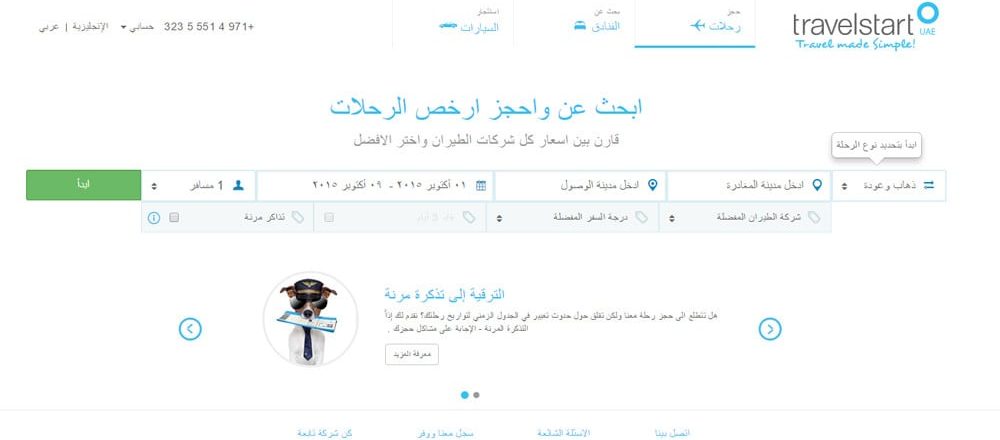
Depending on which part of the world you’re in, Travelstart is either a household name or an unknown entity. This is not unusual: most businesses begin by building a platform to cater to local markets and remain most recognisable within their native region.
But things might be changing for one OTA.
Founded in 1999, Travelstart now serves millions of customers every year from its six offices in Cape Town, Dar es Salaam, Lagos, Cairo, Dubai and Istanbul. Given its launch date, Travelstart can rightly claim to be one of the pioneers of online travel in Africa, and right now it’s bringing its expertise to bear in the Middle East.
According to marketing site internetworldstats.com, Internet penetration in the Middle East is roughly 52% of the population, almost 13 percentage points higher than Asia. Since launching in the region a little more than a year ago, the company has grown by more than 400%. The fuel powering its accelerated growth is Arabic-language websites, according to Travelstart’s business development manager Remo Abbondandolo.
This development is significant in several respects: while Arabic is the fifth most-spoken language in the world and the official language in 26 countries, there is a disproportionate lack of Arabic content online.

Remo Abbondandolo, Travelstart business development manager
Speaking from Dubai, Abbondandolo described Internet search patterns in the Middle East. “In Saudi Arabia approximately 80% of Internet users conduct searches in Arabic, in Kuwait it is 60%, and in the UAE there are fewer searches in Arabic as the market is dominated by expats and locals are accustomed to searching online in English.”
“We are addressing the lack of Arabic Internet travel content in a comprehensive manner, while ensuring our customers have access to a truly inclusive booking service supported by the established and dependable Travelstart brand,” he added.
In 2015 alone, Travelstart had four million active users in the Middle East and North Africa (MENA) region accessing the site in English. “The launch of an Arabic version will provide an even more culturally relevant experience to our customers,” said Abbondandolo.
In addition to having the option of booking your flight or hotel in Arabic, Travelstart also offers localized payment options for travellers who prefer to pay without a credit card. The OTA offers “extensive means” of payment – important in a region where nearly three-quarters of all payments are made in cash, according to a report by market research firm Euromonitor.

Russell Jarvis, Travelstart head of communications
Reflecting on the challenges of growing the business, Travelstart’s head of communications Russell Jarvis said the region is far from homogenous: “There’s no copy and paste solution for starting up. Each country has its own challenges and cultural nuances which require a unique approach.”
“In some cases, even for e-commerce businesses, the infrastructure is just not there yet to provide a good level of support. At Travelstart, we’ve navigated around this by innovating in payment solutions, having physical offices where customers can make bookings with travel consultants on a walk-in basis and optimising our websites so that they respond on outdated phones and slow networks.”
The OTA is setting its sights on continued growth in its core markets while increasing its geographical footprint in MENA. In a region beset by political turmoil, there is at least one bright spot: Travelstart’s tremendous growth story suggests the yet unrealized potential of the region.