The first time I started wearing glasses was when I noticed how many people were wearing them too. It made me less self-conscious to be called “Specky”.
So when I put on my first pair of Occulus Rift virtual reality glasses, it made me wonder if in a few years’ time, when this technology becomes more mainstream, how many people would be wearing them.
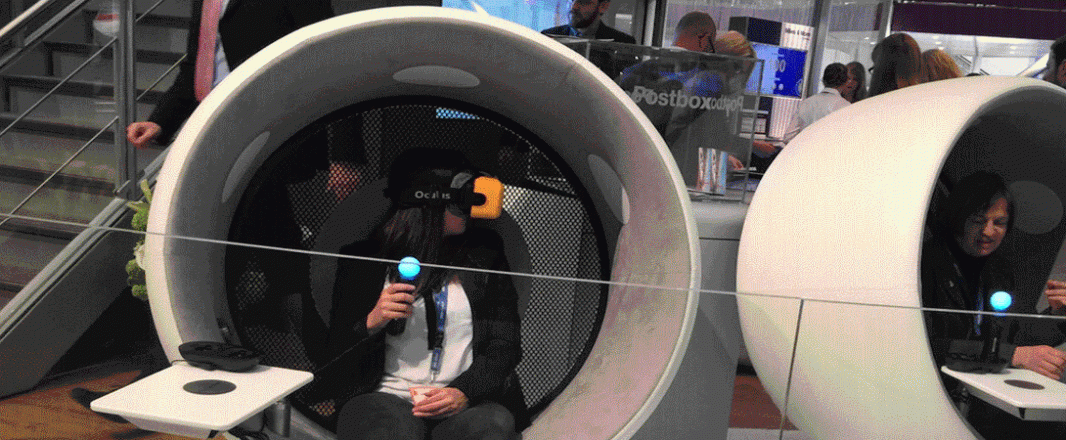
I was walking by the Lufthansa stand at ITB Berlin when I saw that the airline had set up a demo station for two visitors, at a time, to take a virtual flight to San Francisco.
I was rather surprised by the lack of a queue – I think if this demo had been in Singapore or anywhere in Asia, the queues would have been a mile-long – so I didn’t need much persuading to take the test flight.
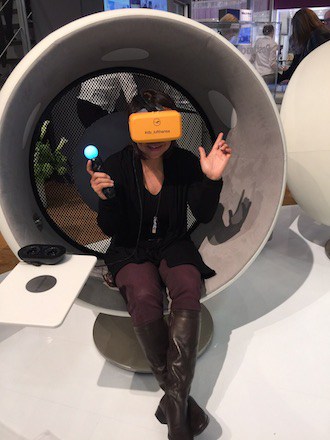
Yeoh Siew Hoon flying to San Francisco the occulus way.
First, I was asked if I wanted to fly business or premium economy. Guess which I picked? Then I had to take my real glasses off to put on the VR headset, so my vision was compromised. It’s similar to when you are wearing 3D glasses at the cinema – “Speckies” are at a disadvantage because you either have to wear them over your glasses or take them off, in which case you can’t really see that well.
Having said that, I was surprised by how clear the imagery was regardless of my impaired vision. The imagery is truly immersive, you can see right around the cabin and watch your fellow passengers being served by the crew.
The headset is rather heavy, so moving your head around can feel a bit clumsy, but you do get used to it after a while. There’s a joystick that you move around to “mimic” actions – such as drinking from the glass, although I suspect I must have spilled orange juice on myself several times. The good thing is, it’s virtual so it didn’t matter how clumsy I was.
When we get to San Francisco, the image is of a sunny beach with seagulls flying around.
The whole experience takes some getting used to although I suspect that if you are used to video games, you wouldn’t find it that foreign. It’s also not that different to watching a 3D movie in IMAX.
I am sure the technology still has a long way to go and Facebook must believe in it to have paid US$2 billion for Occulus Rift but you can imagine its applications in travel and tourism.
Travel is the one product you cannot experience before you buy. This changes things. With this, you can “experience” destinations, airlines, hotels, tours and attractions before deciding to book.
I don’t think it will replace actual travel. In fact, if we use it well, it will inspire more people to actually travel.
Virtual begets the real.
Video conferencing did not kill meetings but it does make us think more about whether we really need to get to that meeting, and when we are physically at the meeting, we work harder to make it count.
Social media did not kill communication, instead the “superficial intensity” of communications today makes us yearn for more real and meaningful exchanges.
If virtual reality is yet another tool we can use to spread the love of real travel, then all power to it.
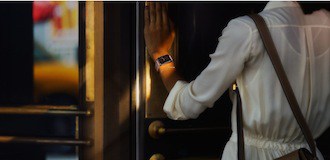
The Apple Watch – the latest status symbol. (Image credit: apple.com)
At ITB Berlin, the buzz was also around the impending launch of the Apple Watch (which was announced this week) and if it would do to watches what the iPod did for music and the iPhone did for phones.
There’s lots that have been written about the Watch – here’s a review – and I can’t wait to get my hands on one. If it tells the time (probably the least useful feature) and helps me communicate better – plus look cooler – why not add another Apple device to my arsenal of gadgets?
Some in the industry are already taking their bets on the next wave of wearable technology – the IHG Translator App is available on Apple Watch and KLM Royal Dutch Airlines is set to run a trial with Android smartwatch technology, to send specific information to their customers.
I think the more interesting development is Apple Pay and if it could become a universal method of payment, although that might be hard in Asia with its complicated and fragmented payment system, but does Apple have enough critical mass to make it work?
Marriott is the first hotel company to offer the service and guests using Apple Pay at check-in can bring their iPhone 6, iPhone 6 Plus or soon, Apple Watch, near the contactless reader at the front desk. When their device responds with a vibration and beep, the payment information has been securely captured. Imagine, no more need to present a credit card on check-in.
What companies like Apple, Uber and Amazon managed to do is bring technology and trust together – we willingly give them our credit card information for the convenience of a one-click purchase.
Why can’t we do this with hotels or airlines, in whom we trust with our safety and security on the road?