
Blended answers, by man and machine
Keith Tan, chief executive officer of the Singapore Tourism Board (STB), opened his agency’s media briefing this week by jesting, “I’d like to confirm that ChatGPT didn’t write the press release.” (See related article)
Curious, I decided to start a side conversation with ChatGPT by feeding it similar questions that the media was throwing at the STB leadership team, one of which was, “How could a destination like Singapore use technologies like metaverse, AR/VR and AI to promote its tourism offerings?” (Answers at the end)
In person, I asked Wong Ming Fai, STB’s CTO what the new AI tool could mean for travel industry players in Singapore.
“Yes, we’ve been playing with it and brainstorming internally about how it can be used in the sector,” he said. “One key area is productivity – writing descriptions and stories about products and services. The final version still has to be vetted by a human but it gives you an opportunity to create drafts quickly and having a human edit and finalise the draft. That would save man hours.”
Not to mention, costs. In speaking to tours and activities providers, they estimate that costs of content generation would drop dramatically. With the ability to select the tone and style of the copy desired, the new tool could generate content at speed and scale so that instead of hiring, say 10 copywriters, you may only need one editor if the content you require is generic enough, and updated to 2021 (for now).
“It could also be good in generating new ideas. For example, you could ask, I am creating a new attraction which will allow people to skate, slide, snowboard, what should I name it? Or what do I need?,” continued Wong.
“Or you could use for chatbots to answer questions from visitors. You could ask, I am male, 45 years old, and I love nature, where should I visit in Singapore? The problem is, it can sound very confident even if it delivers wrong answers, so the question to ask, is how do you have a human in the loop to ensure the wrong information is not given. But productivity is a good place to start.”
STB also took its first step into the Decentraland metaverse in November 2022. In collaboration with Millennium Hotels and Resorts (MHR), it launched Merlion on Vacation, allowing players to explore Singapore in the metaverse, win prizes and enjoy a Merlion 50th Birthday themed room package at M Social Singapore.
The adventure featured mini-games featuring Singapore landmarks such as Orchard Road, Sungei Buloh, Gardens by the Bay, and Maxwell Food Centre. The pilot project ended in December last year.
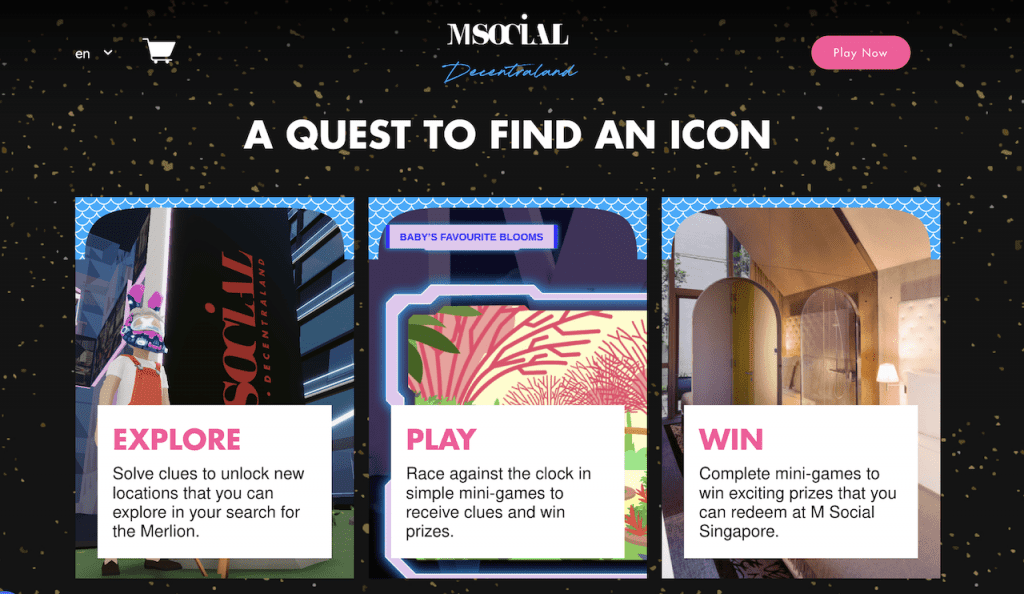
Chang Chee Pey, assistant chief executive, Marketing Group, STB, called it an experiment to explore “how do we best engage with customers in the virtual space and what activities and engagement are they looking for?”
“The key learning is game design is important, they want to be entertained and they look for games that appeal to them, we look forward to other pilots.”
He shared that sales of the Merlion package exceeded MSocial’s targets.
When launching the virtual adventure, Saurabh Prakash, group senior vice president, commercial, Millennium Hotels and Resorts, said, “M Social Decentraland may be in the virtual world but the campaign is grounded in the reality of reaching new customers and generating new revenue sources with the metaverse as the platform.” (M Social Decentraland occupies prime real estate in Decentraland as it is one tram stop from Genesis Plaza, the starting point for visitors to the virtual platform.)
By the way, here’s what ChatGPT answered to the question, “How could a destination like Singapore use technologies like metaverse, AR/VR and AI to promote its tourism offerings?”
A destination like Singapore could use technologies like metaverse, AR/VR, and AI to promote its tourism offerings in a variety of ways:
- Metaverse: Singapore could create a virtual version of its destination in a metaverse platform, allowing potential visitors to explore the city and its attractions before they visit in person. This could include virtual tours of popular tourist sites, such as Marina Bay Sands or Gardens by the Bay, as well as virtual experiences of local culture and events.
- AR/VR: Singapore could use AR and VR technology to enhance the visitor experience, for example by creating virtual reality walking tours of historic or cultural sites. This could allow visitors to experience the sights and sounds of these locations in a more immersive way. Additionally, AR technology could be used to create interactive, location-based games or scavenger hunts that encourage visitors to explore different parts of the city.
- AI: Singapore could use AI to personalize the visitor experience by providing recommendations and customized itineraries based on visitors’ preferences and interests. Additionally, AI-powered chatbots could be used to provide visitors with real-time information and assistance, such as answering questions about local transportation or providing recommendations for nearby restaurants or hotels.
- Additionally, Singapore could use these technologies to create engaging and interactive marketing campaigns which could be shared on social media, or through email marketing campaigns, which would allow potential visitors to explore the destination and its offerings before deciding to visit.
Me thinks the machine is still learning, as are we.