
Two years into Skyscanner, first as COO, then as CEO, Lisbon-born Bryan Batista is ready to take the 21-year-old metasearch pioneer into a new future in 2026 – one that involves global expansion into new markets such as India and the Middle East, as well as a packages and multi-modal future.
Catching up with WiT at Phocuswright, Batista exudes the energy and confidence of someone who believes he’s stepped into a company at exactly the moment the industry is being reshaped.
If mobile was transformative, he believes AI will be epoch-making – never mind what the doomsayers are saying about the end of meta – “they’ve been saying it for years” – and how AI will enable OTAs to become the new meta, as was mentioned by Agoda’s CEO Omri Morgenshtern during the opening session at Phocuswright 2025.
First, I asked Batista if the real threat was a world in which LLMs decide they don’t need travel specialists.
Batista answered without hesitation. “The biggest threat is that… an LLM would decide to disintermediate search for travel, and that people wouldn’t want travel specialists anymore.”
But he’s not convinced that will happen. “Their ambitions aren’t to connect to hundreds of airlines and hotels. They just want to provide the best answer and they’re very happy to use our data.”
One scenario he finds compelling is agent-to-agent interaction. ChatGPT’s “Atlas” browser, he said, is the first glimpse of this world: “Your agent will pass context to Skyscanner and then it’s talking to the Skyscanner agent. That’s the world I envision.”
How he sees it – your personal AI agent pre-loads your preferences – fare types, cabin classes, loyalty memberships, preferred stopovers – and Skyscanner’s agent responds with hyper-precise results.
Google’s AI flight deals: Validation of Meta’s role
Coming back to the subject of AI disintermediating search, and Google, in particular, with its latest release of AI Flight Deals which James Byers, Group Product Manager Search at Google had done an elaborate job of detailing at the closing session of Phocuswright, Batista had this to say.
He believes that Google’s move “only validates the things we’re working on, because we see travel evolving in a similar way, in that we can do smoother handovers for our travellers.”
Yes, he said Skyscanner could build an agentic experience that allows bookings “but that’s not our role, we are a search player, we don’t want to become an OTA”.
What he wants to do is better trip planning with recommendations. “One statistic that surprised me when I came to Skyscanner is that 50% of the travellers who come to our platform don’t know where they want to go or when they want to go, and they want us to help them decide on this stuff.”
He said, “We’re building tools, enabling travellers to not search only via regular search boxes, but in a very high context way.”
Skyscanner’s upcoming Explore experience will:
- Accept natural-language, dream-based queries
- Show visual and video-rich suggestions
- Adjust in real time (“cheaper”, “closer to the beach”, “more kid-friendly”)
- Create multi-option trip boards powered by AI
What about Google and its data superpower?
Be that as it may but doesn’t Google have much more powerful and bigger data stacks than anyone else and that would make them the superior search engine, I asked?
Batista’s answer was quick. “Maps? They’re the king. Flights? We have the richest flights demand data that exists – we meet Google in almost all other markets.”
He said that Skyscanner’s global flight dataset, built over two decades, still gives it an advantage in understanding demand, fare volatility, routes and preferences – outside the US in particular.
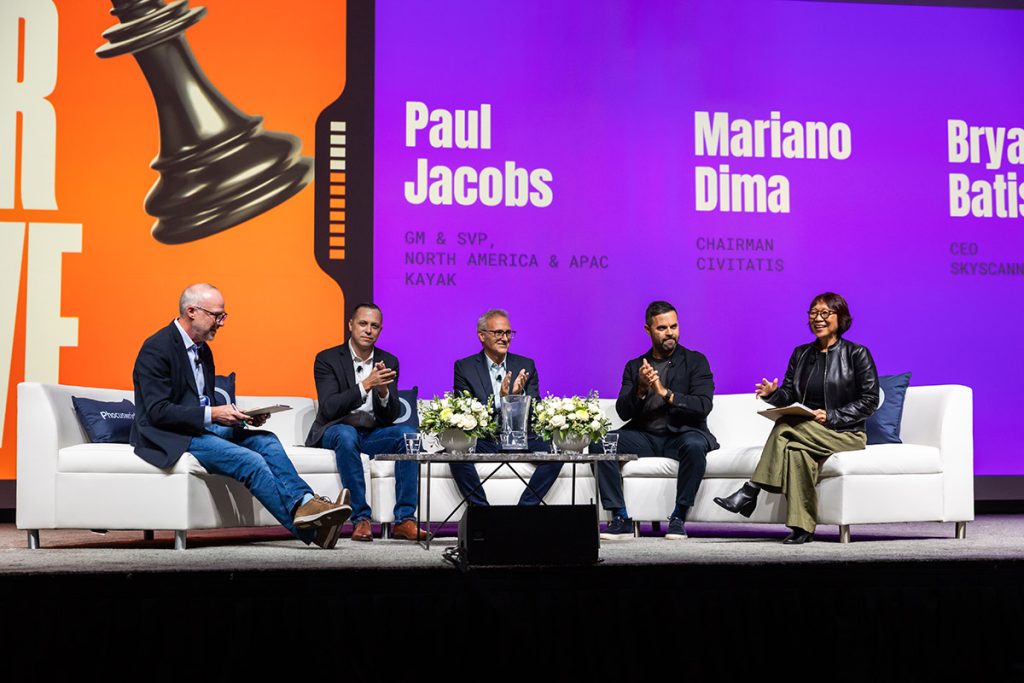
Bryan Batista (second from right) took part in a panel discussion at Phocuswright San Diego recently.
Global push to India, Middle East and Asia
That global push will accelerate in 2026. Even though the company has been expanding its footprint in the last decade, Batista concedes it is still pretty Europe-centric.
It is investing in India through strategic partnerships with airlines and OTAs such as MakeMyTrip, localising its platform with a Hindi language version and plans for more regional languages, and investing in product and technology for its Indian user base.
It’s also investing through influencers, social, and cricket partnerships, signing up Indian cricketer Suryakumar Yadav as its first celebrity brand ambassador which Batista said “is working very well”.
South Korea is another strong market. “The fact that we have a local competitor [Naver] actually helps us… people already understand metasearch,” said Batista.
Above-the-line campaigns in Canada have grown brand awareness dramatically. “We’re now ahead of Kayak in the Canadian market,” he said, adding “the US is next”.
Then there’s the Middle East, especially Saudi Arabia. “We see a ton of opportunity there with what’s happening in that market and we have good relationships with Saudia – we want to enable that.”
As for China, where its parent company dominates, Batista said, “Probably not. Meta is less relevant… Trip has such a strong hold.”
2026 Priorities: Packages and multimodal
He outlined two other priorities in 2026.
- Packages (Flight + Hotel)
Live in the UK and Ireland, rolling into Germany and the Netherlands before global expansion. “There isn’t a great comparison tool out there, we want to surface the substantial savings when you book this together,” he said.
Skyscanner wants to become the transparent comparison layer for package rates, many of which are opaque or unique to specific OTAs, he said.
- Multimodal (Rail + Bus + Flight)
He said this product was aimed at building traveller confidence in the brand. “Even if we’re not seeing a lot of click-through, it increases our redirect rate and travellers are more confident.”
He said multimodal also unlocks cities without major airports – critical in markets like the UK.
Traveller-first approach: Then, now and into the future
Batista, who joined Skyscanner from nearly a decade with Booking Holdings, recalled the early days in his new role. He had expected a classic performance-marketing machine with Skyscanner. Instead, he found the inverse.
“I was expecting a typical travel business and actually Skyscanner was the opposite so much direct traffic, super strong in SEO and limited reliance on paid search.”
More surprising was how deeply “traveller first” was embedded. “It’s truly the first, truly customer-centric organisation I’ve worked at. We always take the lens of: Is this right for the traveller? And we’ll put that ahead of revenue.”
It’s a cultural inheritance from co-founder Gareth Williams and Batista said it’s what will differentiate Skyscanner in the coming AI-powered era.
In conclusion, I asked him would he run Skyscanner differently if it weren’t owned by Trip.com Group? Does that ownership put any constraints on the business?
“No. Trip is an amazing stakeholder. They understand Skyscanner has to be a level playing field. If they want to acquire traffic, they’ve got to pay like all the others.”
Batista lights up most when he talks about this era. “We will look back and this will be the most disruptive, the most challenging, but also the most rewarding time.”
AI has unlocked things Skyscanner previously dismissed as impossible. “Now almost all of it is possible. Products we hadn’t imagined we could launch before, now we can do it.”