
A high-intensity Samurai “tate” swordfight opened the eighth WiT Japan & North Asia last week, leading some to draw a parallel with the growing competition in online travel. Certainly, the online share of the region’s market continues to grow but there’s no doubt that the intensity of the competition has risen several notches in the last 12 months.
The established Samurais have built strong defences but will they be strong enough to withstand attacks from the new Samurais with their tech, scale and frequency of use – the tech giants and superapps? Then there are those with access to newly-sharpened swords – the well-funded tours & activities platforms looking to build scale from the in-destination piece where most travel spending is done.
The WiT Innovation Stage saw new startups who are trying to solve travel’s myriad pain points. The three finalists for the WiT Startup Pitch were indicative of an interesting trend – going after new markets (geography or segment) or creating new models.
Winner Flymya is solving domestic flights in the emerging and challenging market of Myanmar, In The Hood (Japan) is a new kind of hospitality model built around local experiences in neighbourhoods while Amuse Travel is going after accessible travel (a growing market in light of the ageing population of North Asia).
On the Main Stage, discussions ranged from how globalization meant that competition is no longer local to how incumbents are competing against new models in a world of blurred lines, and how new business models are disrupting traditional sectors like destination management and hospitality.
Here are the key takeaways from the 8th WiT Japan & North Asia, which attracted more than 530 delegates from over 22 countries.
1. Let’s call it as it is – “Google is an OTA”
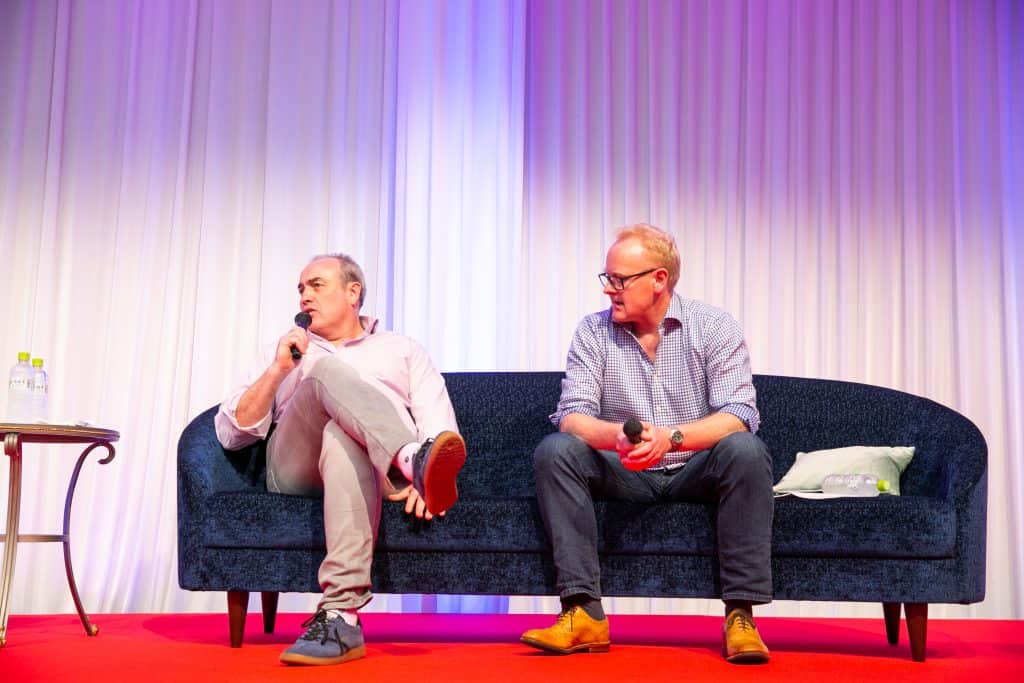
There’s no travel conference these days where the growing power of Google is not called out. Both Japanese OTAs and global brands raised the spectre of Google as a potential threat to their business. Timothy Hughes, vice president corporate development, Agoda said that while “we recognize Google as a partner, we also have to recognize it is a competitor”.
“They say they are not an OTA but I am calling them out as one,” he said, during a panel discussing the rise of global competition.
He is skeptical that consumers will stay within one superapp ecosystem, arguing that they will always want choice and nothing wins over “great product, great price”. Agoda is working on “great product” by trying to improve the in-hotel experience for its customers.
Booking.com is building out “the connected trip” to include all the things consumers want to buy in travel with Stewart Jones, regional director, strategic partnerships, picking customer focus as the key to success.
2. Superapps to become even more super – LINE ties up with Naver Pay and WeChat Pay
Ears pricked up during the presentation by Hideo Fujii, executive officer, LINE Corporation who gave the audience a look at “Inside LINE: The Rise of the Superapp”. With the mission of merging online and offline services to expand a LINE ecosystem, the company is building three pillars in Fintech, AI and O2O/commerce.
In fintech, he said LINE Pay (Japan, Taiwan, Thailand) was working on a global alliance with Naver Pay (South Korea) and WeChat Pay (China). Combine that with its 34% stake in LINE Travel.jp and you can imagine where the lines between fintech and travel might blur to create a travel and payments ecosystem within LINE.
GMV on LINE Travel.jp, he said, has seen 456% quarter on quarter growth. LINE has a total of 164m MAUs with Japan accounting for 80m and Thailand (44m), Taiwan (21m) and Indonesia (19m).
Ctrip-owned Trip.com, meanwhile, is confident its edge in native app technology will make it a travel superapp to be reckoned with. Vice president product and marketing Lynn Qu said customer service will give Trip.com the super power to compete against other travel brands as well as superapps.
It has invested in three call centres in the UK, Seoul and Tokyo, is focused on achieving operational efficiency and scale, and is growing a global team through “the internationalization of people”, said Qu.

3. The battle for loyalty and payments is exploding
One clear advantage superapps has over travel apps is a baseline of frequency of use and observers note this can be built around three pillars – messaging, payments or loyalty. Both the loyalty and payments markets are exploding in Japan.
In the Japanese payments market, there are at least six contenders – LINE Pay, D Pay, Merpay, Origami Pay and Rpay – and everyone is giving away discounts and free items – from coffee to beef bowls – like crazy. How long these players can continue subsidizing before the market consolidates is the big question.
Globally, the payments industry landscape has similarly exploded, and with APAC leading the world in mobile payment usage, and China leading APAC – epayments are 70% of online and 50% of offline – Phil Pomford, general manager APAC for Worldpay, said this region would pave the way in creating the future of payments.
In the area of loyalty, Japanese players like Rakuten and Ponta work on points. Rakuten has issued more than 1.2 trillion points to date and Ponta’s network covers four countries in Asia (Japan, Malaysia, Indonesia and South Korea) and is expanding to more than 150m members, 91m of whom are in Japan.
Japan Airlines meanwhile innovates by introducing new programmes such as “Random Destination Miles” for domestic flights and “JAL International Award Ticket PLUS” for international flights.
Frequent traveller Naoko Ohnuma, when asked which loyalty programme she liked, cited the JAL Random programme “because it took me to a place I wouldn’t have picked myself and I enjoyed the surprise”.
Indeed, Carolyn Corda, chief marketing officer, Adara, said consumers were loyal to “what they consider is valuable to them” and these are usually prestige, convenience/service and surprise. The surprise element, she said, was what most loyalty programmes should work on.
4. Growth is in the sky and air travel is being shaken up
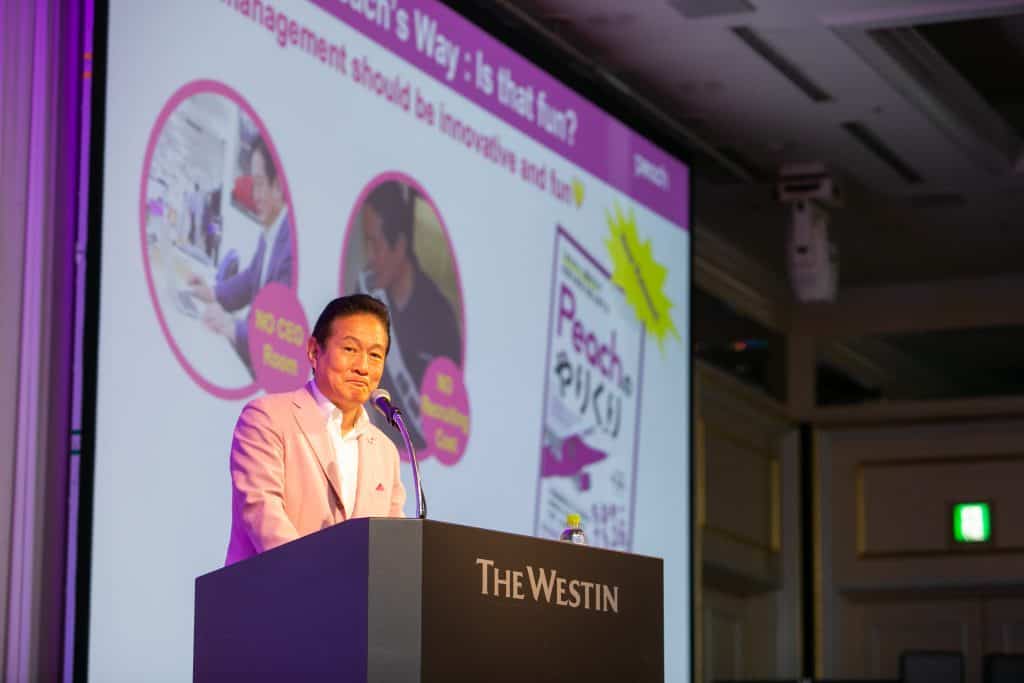
In the seven years since its launch, PEACH has managed to achieve operating profit every year and has carried 30m passengers to date. It is set to fly higher – by end of summer schedule 2019, Vanilla Air will terminate operation and be integrated into PEACH, creating Japan’s third biggest airline. In addition to Osaka, PEACH will take over Vanilla’s hub in Tokyo and become Japan’s first low cost midhaul carrier by end 2020.
CEO Shinichi Inoue is mindful that the economics of running the merged entity will be different but is confident the airline can hold on to its profitability streak. The key is to keep costs down, he kept reiterating at WiT, and “delivering affordable and joyful trips”.
He also believes B2C branding doesn’t work anymore and is investing in C2C with Tabinoco, a platform that allows travellers to share their stories. It is currently heavily used by young women, PEACH’s core market, “because women are the final decision makers for holidays”, he said.
PEACH also wants to be a digital retailer but it will not sell other airlines’ tickets, said Inoue, responding to a question on what he thought of AirAsia wanting to be an OTA.
It was a point Oliver Dhouly, CEO and co-founder of Kiwi.com, made when he told airline executives on a panel that if they ever decided to sell other airlines’ tickets on their platforms, it would “kill the meta-searches and flight OTAs”.
It is clear Dhouly loves to challenge the status quo – his virtual interlining business includes airlines who don’t even know they are on his platform. “They are, but they don’t know it,” he said when asked if Hawaiian Air and Japan Airlines were on Kiwi.com. His vision includes creating a super alliance of airlines that replaces the traditional alliances which he said have no purpose today.
His comments got a reaction from Theo Panagiotoulias of Hawaiian Air and Takafumi Maruyama of Japan Airlines, both of whom wished him “good luck” with what he was trying to create.

5. Call it internationalisation or inclusion, you need it to compete on a global level
Globalisation was a big theme – with the call going out to Japanese startups to think global from day one. Funding now knows no geographic boundaries so startups were urged to seek foreign investment and hire foreign talent from the outset.
Corporations too should no longer just talk about inclusion but act on it. “To compete globally, you have to build the best company with the best people and that means inclusion,” said Daniel Silva, head of global people operations at Japanese ecommerce giant Mercari, which employs 1,800 employees from 40 countries of origin, with over 30% of engineering talent coming from abroad.
He shared some tips on how to build an inclusive workforce – build bottom up, empower top down, focus on positive actions, not diversity quotas, and celebrate each individual’s unique diversity, no labels or group division.
Naoko Cooper, corporate planning manager, PEACH talked about how companies in Japan tended not to hire “black sheep” like her and yet how being one has helped her create her own life “because of freedom from social norms and expectations”.
She described PEACH’s culture as “crazy” enough to take on someone like her, with no airline experience, six years ago. The Osaka-based airline’s workforce of 1,142 employees come from 24 nationalities, with a 25.4% ratio of women managers, which she described as high for Japan, but not high enough for PEACH. Its staff come from professions as diverse as hairdressers and florists.
Hotelier Aya Aso, CEO, Savvy Collective, said she became an entrepreneur so that she could create her own career, acknowledging it would have been harder within the corporate world to make her mark. She’s started a community called “Ladies in Hospitality” and urged women to “step up and get your life back”.
Partha Bommatapally, regional director, business development, Asia Pacific, Derbysoft spoke about working as an Indian for the Chinese hospitality software company in Japan. The interesting thing is, 95% of Derbysoft’s business comes from outside China and thus the company had to think global from day one. He admitted it was challenging in the beginning. What helped was learning to speak Japanese and “being a fixer of people’s problems on the IT side”.

6. Tours & activities is big and bigger in Japan
There’s no bigger market than Japan when it comes to in-destination experiences. After all, this is the home of Veltra, the first tours & activities platform in the world to go public last December and on whose board veteran Rod Cuthbert (founder, Viator) sits.
When asked if Veltra should stick to Japan, its home market, rather than expand and compete with well-funded players in the region, Cuthbert said, “Partnerships are the core of our industry and the larger players outside of Japan are looking to Veltra to establish partnerships. Outside of Japan, it is a big market and we will find parts where we will prosper.”
Voyagin, which started out as both a Japan and South-east Asia play, is returning to its Japanese roots, clearly a way of differentiating itself in the increasingly competitive space . It is focusing on Japan inbound and outbound and has closed its Singapore office. Co-founder Tushar Khandelwal and CMO Jann Wong have left the company, and CEO Masashi Takahashi said some staff have relocated to Tokyo. Hesaid its Japan focus will allow it to go deep with creating experiences in more remote places, where the big players will not go.
Food seems to be the common lure being used to fan travellers out. Lu Dong, CEO and founder of Japan Foodie, which has created a payments business (TakeMePay) on top of a restaurant discovery and booking platform, said food was the key reason for travellers to visit Japan and accounts for the highest spending.
And as far as China is concerned (his business started with a focus on Chinese travellers), only 0.5% of Chinese have travelled. “It hasn’t even begun,” he said, of the 7.35 million Chinese visiting Japan a year, and with China leading the way in a cashless future, he believes combining payments with food will be the magic ingredient for Japan Foodie.
Meanwhile, as travel’s fourth biggest segment comes online, suppliers have to worry about commoditisation and discounting as distributors compete for customers, as well as battle with travel platforms like Booking.com, Expedia and Traveloka which are expanding in this sector.
Klook’s CCO Wilfred Fan believes specialists have an advantage. “It is all we do whereas for the others, it is a small revenue generating activity compared with flights and hotels, so it will always be secondary to their business.”
Cuthbert is not so sure about this advantage, saying “these big players have the ability to juggle several balls in the air” and he believes that “discounting shows a lack of imagination and it’s unhealthy for the whole industry and the fastest way to imperil the good relationship you have with the supplier”.
“If a supplier says my tour is worth $100, and you turn around to say it’s worth $80, it’s not the beginning of a good relationship.”