
FROM traditional giants like Hana Tour to local OTAs such as Good Choice, Tidesquare and MyRealTrip, travel brands in South Korea are jostling for position to catch the recovery wave. In the meantime, massive changes have taken place in the market including the accelerated digitisation of consumers to mobile, the increased strength of e-commerce and tech giants encroaching into travel and the re-entry of global OTAs into a highly saturated, competitive market.
Here are five key takeaways from WiT Seoul 2022, held November 2.
-
The big domestic leap – consolidation and rising competition
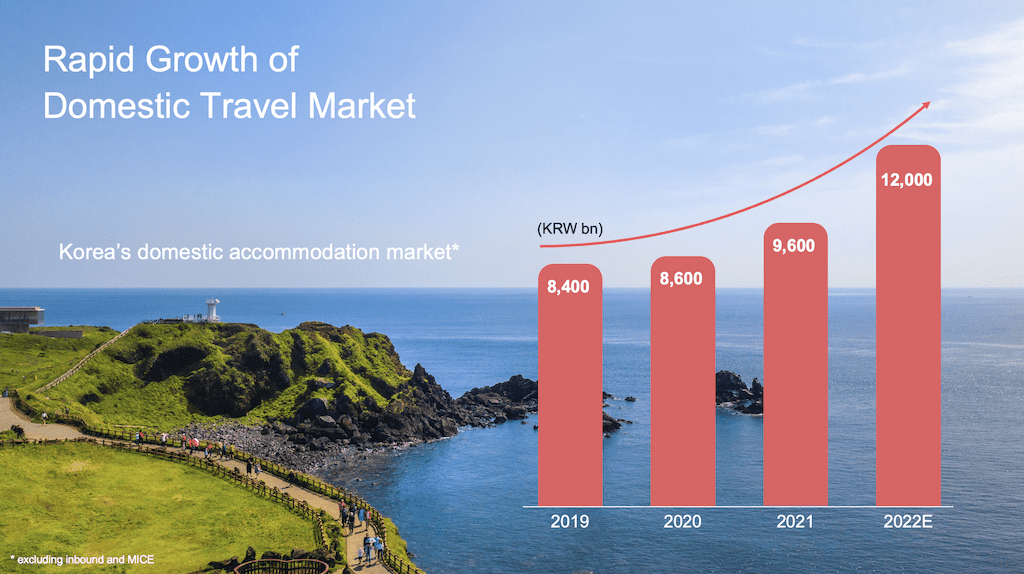
As with all markets during Covid, South Korea’s domestic market saw a massive fillip as its well-travelled population stayed home for more than two years. That led to a realignment in power between local and global OTAs, as well as consolidation in the local market.
Min Yoon, CEO of Tidesquare, said all OTAs saw shifts in domestic vs overseas sales. “During the pandemic, domestic players had big opportunities, so local OTAs in Korea had the chance to lead the market against global OTAs. From that, consolidation took place – before this, there hadn’t been much M&A activity in South Korea but domestic players, flush with cash, were able to acquire.”
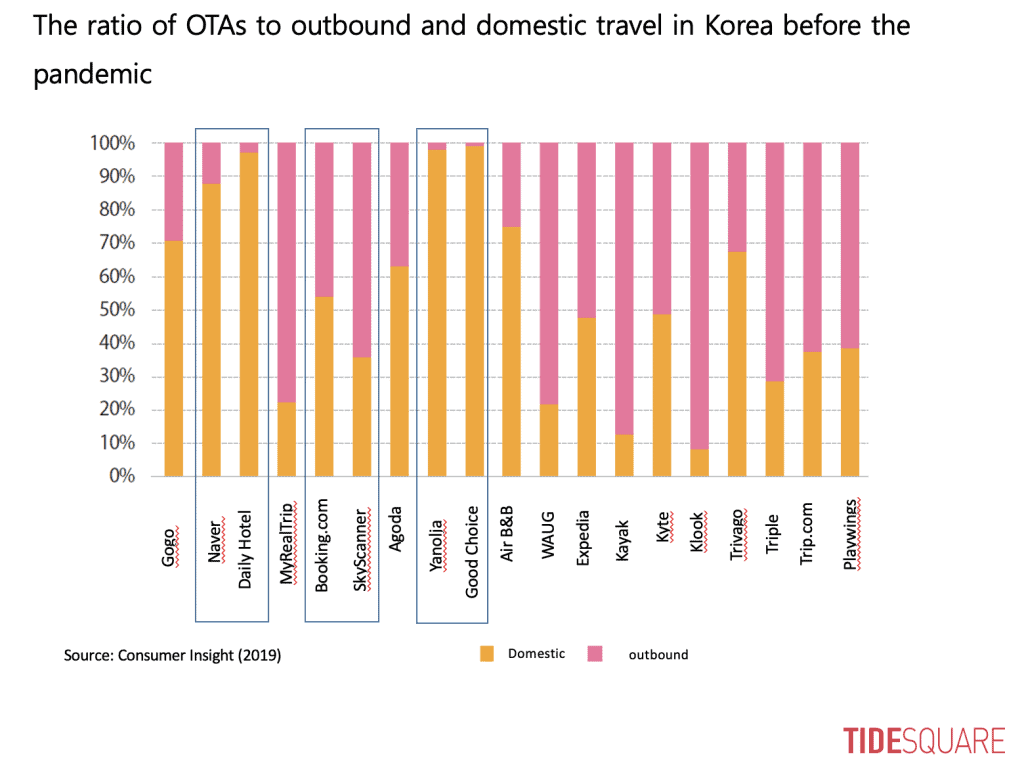
One example is MyRealTrip, which did a full pivot from outbound to 100% domestic, and did so well out of the move that it acquired/invested in up to five startups to strengthen its domestic base. (Read related article)
Myunghoon Chung, CEO of Good Choice, said domestic infrastructure improved greatly, particularly in the accommodation sector, and the period gave his company an opportunity to consolidate its domestic stronghold.
Source: Good Choice
He said the other trend to watch is the blurring between domestic and shorthaul international travel. As outbound returns, shorthaul destinations such as Vietnam and Japan are surging in popularity and he said Good Choice will be executing on the blurring of lines – “to tell customers that a trip to Danang costs the same as a trip to Jeju”. He predicted that in five years’ time, there will be “no boundaries between domestic and shorthaul international travel”.
-
The blurring of lines – everyone wants to be everything
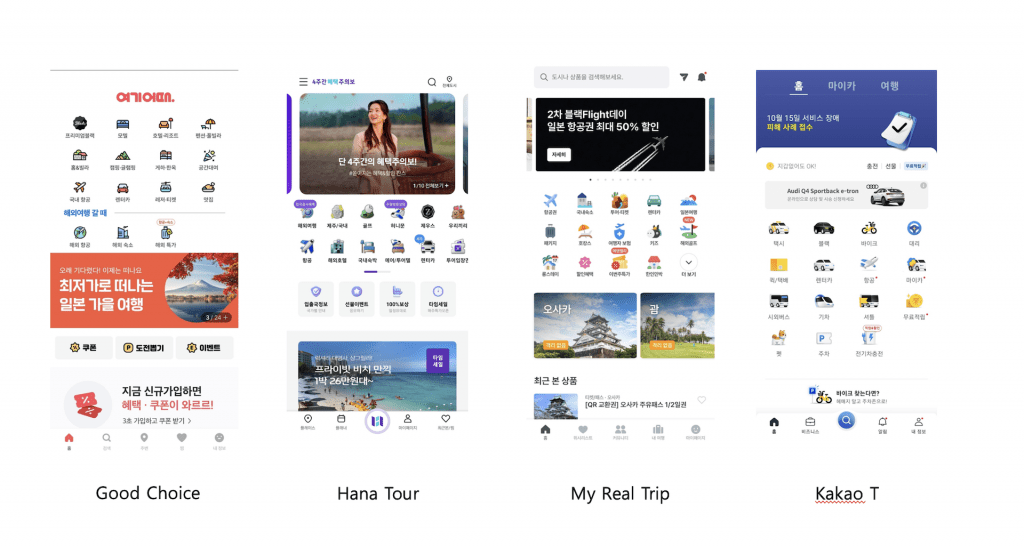
Tidesquare’s Min Yoon observed that pre-pandemic, each OTA had dedicated business areas – for example, domestic accommodation for Good Choice and Yanolja and tours and activities for MyReal Trip. “Now it seems they are all crossing the line from one area to the other, selling air, accommodation, and tours and activities at the same time. M&As have enabled and accelerated this. This is also happening with the traditional giant, Hana Tour, as well as big tech players such as Kakao and Naver.”
Source: Tidesquare
Tidesquare too was once focused on flights, but now covers accommodation as well as tours and activities. Good Choice, once focused on accommodation, is moving into flights. MyRealTrip, once focused on tours and activities, has moved into accommodation and tours and activities.
This trend follows that set by global OTAs which are all building either the connected trip (Booking.com) or the persistent trip (Agoda) or the super travel app (Trip.com).
While Min believes local OTAs have had the advantage during Covid to strengthen their domestic base and thus are better able to defend their territory from global OTAs which are returning in force to the market, Myunghoon said global OTAs would remain a threat for their scale, synergies and customer acquisition power.
“There will be huge competition,” he said. “We have an economic slowdown coming, rising interest rates, which might see a softening of travel demand. Our home market is not big enough, we will all have to go outside to expand.”
-
Local goes global, changing perception is key for Yanolja
Given the saturation and competition in the local market, South Korean travel brands have no option but to expand beyond South Korea. The well-funded Yanolja is the highest profile of all – it’s been acquiring the past three years and now faces the challenge of integration as well as changing the perception of it being a global brand versus a South Korean company.
 Jongyoon Kim, CEO of Yanola and Yanolja Cloud, acknowledged this as the biggest challenge facing Yanolja. This is why it’s set up a separate global division under vice president David Peller, who is located in Singapore. It needs to address this perception in order for it to attract and compete for global talent alongside global OTAs and tech brands.
“People don’t know how diverse our company is already, in terms of different nationalities, working within Yanolja and that number has grown during the pandemic,” he said.
The other challenge it faces is integration as it strives to bring all its acquisitions together to create its vision of “Space As a Service” concept. He sees this concept becoming a reality in South Korea where the government has launched a mobile driver’s license system, which has the same legal validity as a plastic card license and will be available on mobile devices. It can be used for identification at public institutions such as banks, car rental agencies and stores for age verification.
This would mean being able to create unique IDs for hotel customers which would then enable Yanolja to execute on two of its objectives – using data to increase customer satisfaction with an all-in-one pass and reservation management system based on blockchain and provide bespoke room service and control over major aspects of the room via mobile and AI-based communication.
Yanolja is working with Samsung Electronics to launch a “share house” (co-working space) in which its property management system will be connected with IoT devices including consumer electronics and guests will be able to use all the devices with mobile. To test this, it launched a “share house” pop-up store in Seongsu district this week.
Jongyoon sees the biggest opportunity for Yanolja in the longtail segment – unencumbered by legacy systems and thinking, he sees these smaller players, empowered by data, being a major driver of growth.
-
The Young & Restless – next generation models in the making
The 20-30 age group has become a key target segment for travel players. Good Choice’s Myunghoon said that these young customers form 70% of its customers and they are looking for more casual and spontaneous travel. This will influence product design and user interfaces.

Misun Song’s goal is “when South Koreans think of travel, they think of Hana”.
Hana Tours is also going after this segment following its digital transformation led by new CEO Misun Song, aimed at rejuvenating the brand and diversifying its customer base. It signed a brand sponsorship with Damwon Kia, an e-sports team in May 2021. “This brand sponsorship is a new attempt to interact with the MZ generation,” said Misun.
Misun acknowledges the difficulties of taking a traditional company like Hana Tour into the digital age but seems more than ready and prepared to overcome the challenge. Through the pandemic, the company has invested heavily into building an app-based travel platform for consumers and Hana Hub, its B2B platform for partners.
It wants to create a multi-product/multi-package platform, offering packages for all types of travellers, so that “when South Koreans think of travel, they think of Hana”, she said. She acknowledges the intense competition – not only from local and global OTAs, but also ecommerce giants as well as startups.
One such startup focused on the MZ generation is Tripbtoz, which calls itself a “next generation OTA”. Jiha Jung, CEO and founder of Tripbtoz, said this is the right timing for a new model. “The MZ generation is familiar with gaming, we have 5G faster Internet and more smart phones, and the pandemic has accelerated the fourth revolution. Young travellers are looking beyond price competitiveness.”
Tripbtoz calls itself a Web3 online platform which incentivises its users to share video content and in turn are rewarded with Tripcash which can be redeemed for trips and other goods.
Said Jiha, “We are all experiencing a big blur, where all boundaries between industries are getting blurred. In this transition period, I would say communication among stakeholders is key for innovation. Our team consists of experts from game, search engine, platform, and OTA. We hear what current customer needs are and we swiftly adapt it to our product.”
-
Global OTAs catching the local wave
As South Korea reopens, global OTAs are revving up their engines to capture the outbound as well as inbound markets, and they are keeping a watchful eye on customer trends. Jay Lee, country manager, Agoda believes that the “flow of information from various SNS channels will increasingly take bigger part in travellers’ decision making process.”

Jay Lee, Agoda: “Travelling is becoming part of a multi-dimensional experience and this trend will continue to grow.”
“For example, it has become much easier and more enjoyable to research where/what to eat and which concert to go for your destination candidates through various SNS channels. Travelling is becoming part of a multi-dimensional experience and this trend will continue to grow.”
He said Agoda’s hotel partners are also seeing more family traveling than pre-pandemic times. “Our customers value their time with family members and it’s great to see that it extends to traveling as well. Family traveling will continue to grow.”
Todd Lacey, area manager, Korea at Booking.com, called out two trends in – Preppers in Paradise and From Daily Grind to Great Company Escape – covered in its Travel Predictions 2023 Report. And in line with the trend towards longer stays, the OTA has also introduced long-stay rate plans for weekly and monthly rates.
Justin Hong, country general manager, Trip.com said one standout trend in South Korea is high mobile app adoption which plays well into the OTA’s app-first strategy. He said that 80% of bookings in the market come via the app.
Fred Barou, senior vice president, online travel and market strategy, Asia Pacific called out two opportunities – data and analytics to help make travel more seamless and personalised, and sustainability and the conscious traveller.
And while he said that global OTAs had the advantage of scale and network effect, Asia Pacific is a region where there are strong local players – whether it’s Flipkart in India, Yanolja in South Korea or Traveloka in Indonesia. “There will always be local leaders who know how to localise for local demands and they are not to be underestimated.”
Featured image: Min Yoon, Tidesquare, and Myunghoon Chung, Good Choice at WiT Seoul 2022.