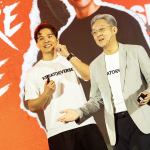
At the WIT Conference last October in Singapore, we recognised 11 individuals whom we felt have had the most influence on the development of online travel in Asia Pacific. This is the first article in a series of interviews profiling our WIT Warriors.
Kathleen Tan came from a retail and music background and joined AirAsia where she became group commercial head, building the brand, launching many innovative campaigns and influencing the online travel landscape in the region over nine years. She played a lead role in forming the 50/50 joint venture between Expedia and AirAsia three years ago and in April this year, Expedia increased its stake to 75%. Today she’s the CEO of Expedia Asia, taking the leadership role in building the brand and scaling the business in the region.

Kathleen Tan: “Just like smartphones have become a part of our lives, buying travel online will become a part of our lives.”
Q: Tell us your first memory of the Internet and what your thinking was at the time.
I remember writing my first email when I was at FJ Benjamin, Singapore. They were a local entrepreneur and they embraced new things fast. I thought email was the best thing ever – I could do everything myself. I didn’t have to do dictation to a secretary anymore.
After FJ Benjamin, I moved into the music business and I saw how the Internet was going to change everything. The people who consumed music were teenagers and they embraced technology. That was the beginning of the end of music as we knew it.
Kids were all stealing music but it wasn’t because they wanted to; it was because the music industry was run by old dinosaurs who were afraid of the change.
Those of us who worked in music wanted to be part of the change but we couldn’t be because of the bosses who were holding on to the past. That’s when Tony (Fernandes) saw that music was going to be a sunset business and he went on to set up a low cost airline and he said, “I am going to sell an airline on the Internet.”
Q: Do you recall your first email? Who was it to?
To the kids in my family.
Q: What was the first thing you bought online?
Lingerie.
Q: What was the first thing you sold online?
I didn’t have time to do any of that personally.
Q: How did you venture into online travel as an industry? What motivated you?
I got into it by default. Tony (Fernandes), whom I worked with at Warner Music, set up AirAsia. I met him at a Linkin Park concert and he asked me to join him. I accepted even though I didn’t know aviation – but I had faith in innovation and that it would shape a new world. I knew travel would benefit from the Internet. A music man started an airline and Tony learned from what music failed to embrace. Richard Branson did that too.
A lot of artistes cut their own labels and became their own bosses, their own brands – such as Beyonce. They didn’t need the middleman anymore. It’s harder for hotels though – they are physical properties, not celebrities.
I believe mobile and digital will continue to grow. The millennial generation who grew up with the Internet are now in their 30s and it’s the only thing they know.
Q: What were the earlier challenges you faced when you first entered the business and how did you overcome them? (Cite 3 challenges)
One, taking on the giants and overcoming them through influencing, lobbying and going direct to consumers. We became our own Lonely Planet – we created content for our travellers and used social media to recommend places. Today, I, as an individual, can influence decisions.
Two, learning about low cost airline models – you have to do everything yourself, there were no previous rules to go by.
Three, changing mindset of the regulators, airports and the industry. I attended WIT to educate hoteliers about low cost airlines – that just because the air fares were cheap didn’t mean the customers were.
Q: What was the first major milestone/success achieved? How did you celebrate?
When I rolled out AirAsia’s 2 million free seats campaign. I had to take on the national carrier and I had to do something bold – we ran full page ads in all the markets we flew to. We caused an Internet frenzy and brought the whole system down. Navitaire couldn’t keep up with it and we were told we set a world record – 539,000 seats were sold in 24 hours. We were too tired to celebrate at the end of the campaign.
Q: What’s been the biggest change in the online travel world in the last decade?
People travelling by themselves. The FIT trend, brought on by low cost airlines, benefitted a lot of hotels. Agoda came up at the same time too – it was the right time. People buy flights, and they buy hotels. When AirAsia flew to Bandung, Agoda had 300 hotels in Bandung, imagine. They accepted two currencies – USD and RM was the second currency. It was testament to how AirAsia opened up Bandung.
We were keen on Bandung because when we were at Warner, we were influenced by Dangdut music and there were a lot of Dangdut artists in Bandung and in those days, you had to drive three hours from Jakarta to get there, so when AirAsia came along, we said the first destination had to be Bandung.
Q: What do you forsee will be the biggest change to come in the next decade?
Just like smartphones have become a part of our life, buying travel online will become a part of our lives. Travelling will become like going to the cinema.
Q: Do you think online travel is a force for good? How does it make travel better? How does it make the world better?
Asia will become smaller – there will be Thais in Singapore, Singaporeans in Thailand. It will bring down boundaries. Asians will become more sophisticated as they travel more. Culture will be transported everywhere – for eg café culture is everywhere. Families in Asia will become closer. The silver haired generation will travel.
I also see offline travel will be forced to change their models. Outbound operators will become inbound as well. For example Expedia buys a lot of tour services and the OTA will become the marketing arm.
Q: Businesses are built by teams. Every team has a rock star and a steward. Are you the rock star or steward? If you are the rock star, who’s your steward, the one behind the scenes making things happen. If you are the steward, to whom are you the steward?
To me, the customer is the rock star. But I suppose at Expedia Asia, I have to be the rock star because I have no choice. I don’t have a Tony Fernandes (in Asia) to front the business. In Asia, trust is very important and you have to put a face to the business. I remember once when AirAsia was taking part at a travel fair, a customer came to us and said, “Oh we didn’t know there were people working at AirAsia.”
But I am a steward to the board so you could say I am both.
Who are my stewards? Every key leadership team. We are like a football team. A midfielder is as important as a striker as a goalkeeper. The person who handles the technology, performance, finances, HR – everyone is important. As a marketing company, we have to hire the best stewards.
Q: If you could give an award, what award would it be and to whom would you give it?
Key partners who provide value to us and who keep our machines going. Business partners are so important.
Q: Who were your earliest influencers, the ones who inspired you?
My mum. I learnt about business from her. We ran a coffee shop in Johore, the only coffee shop in the village, and we were always thinking of how to make money. We sold coffee, we roasted our own coffee beans, and toast. And we would upsell them cigarettes – by the sticks. I still remember the 555 brand. We made our own kaya (coconut jam) and I learnt about profit margin.
So when I ran commercial at AA, it came easy – I changed free seating to assigned seating. I came up with Hot Seat. I took over the inflight magazine and hired my own team to run the publication. I noticed inflight magazines were using “high brow” English and I hired writers who could write simple English. We created our own content, photography. We started off with charging RM3,000 for a full page ad and at the end, we were charging RM22,000.
I also learnt from my brother who was very involved in the coffee shop business. There wasn’t much entertainment in the village and he brought in pinball and billiard machines. He also allowed people to park their bicycles for free outside our shop while they to town and did their errands, and they would always return to the shop to have their coffee.
Q: Who are your current influencers?
My young staff. Their fresh minds are very inquisitive, they know about technology. I also learn from my nieces and nephews, the under-10s. You have to constantly learn. The young are fresh and not jaded. They look at you with a twinkle in their eyes, and they inspire you and you want to do more for them.
Q: One thing you feel you have influenced in the business.
Making people accept low cost; making low cost travel sexy.
Q: Who and what do you wish to influence in the next five years?
My American colleagues and my big boss Dara (Khosrowshahi). He wasn’t active in social media – he had 153 followers on Twitter, today he has 14,000 followers. During our partner event in Las Vegas in 2014, his feed was very active and the young staff were following him. He has a lot of influence and I am so proud that he’s active.
I want to influence Expedia to help me Asianise the rechnology to make it more Asian-centric. They have the know-how but how do we make it more relevant? The good news is, they are listening.
Note: Kathleen Tan will be speaking at the WIT Indonesia conference in Bali, on April 30.
.