So the big question about loyalty is whether you can buy it or you have to earn it? From what we’re seeing in travel, most suppliers just seem to be buying it with most programmes geared towards driving transactions ie “If you spend this, we will give you this.”
L-R: Yeoh Siew Hoon with Louise Daley and Craig Fong
Rather than creating that cosy, cuddly feeling within a customer that makes her say, “I like this brand because they know me, know what I like.”
Sharing their favourite quote about loyalty at WITX – Women Redefining Travel in Bangkok last weekl, Craig Fong, COO of Global Hospitality Solutions, said, “You don’t earn loyalty in a day, you earn loyalty day by day.”
“Very few hotel brands have elevated its member relations to “loyalty” status as they lack an “emotional” attachment with its customers. But many have proven successful in driving repeat business due to points and other benefits. Luxury brands which in the past refrained from introducing a points scheme relying on personalized service and brand positioning are now giving into competition driven by consumer demand and easy access to competitor content.”
Louise Daley, CEO of Accor Advantage Plus, asked, “When did loyalty become a commodity?” “Customers have been conditioned to select on price – hotels rooms are now a retail product and hoteliers discount like retailers so customers are attracted to discounts. And there is a lack of differentiation in loyalty programmes, so we need to get back to delivering on service and having experience as a differentiator.”
So back to those words – “emotional” and “experience”, words which factor very strongly with women customers.
Accor Advantage Plus, a paid subscription programme run in tandem with Accor’s loyalty programme, Le Club, and only available in Asia Pacific, has 325,000 members worldwide, 55% of whom are in Asia. Men form 60% of members with women making up the rest. Hong Kong is the only market where women are the majority, at 54%.
Asked if there was any difference between male and female redemption behaviour, Daley said, “There is a belief of course that the man earns and the woman (wife, partner, girlfriend etc) burns. For us, the stats show that despite the membership in Australia being 60/40 male to female, we have about 60% females calling in to our member services centre. So indicating the male buys, the female books.”
One area that women definitely rule is in the area of corporate bookers. WIT asked GHS, which runs the iRewards loyalty management system for hotels, to conduct a survey of its corporate bookers and the clear finding was that women form the majority of corporate bookers and generate the bulk of room night contribution.
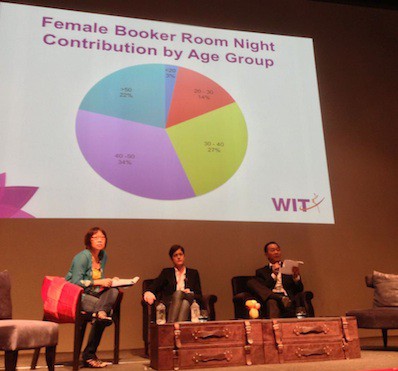
The study, which had a total sample size of 21,914 bookers, across Shanghai, Beijing, Singapore, Kuala Lumpur and Jakarta, showed that women formed almost 85% of bookers and contributed 89% of room nights.
The study also showed that older women are the most productive in room night contribution – women, aged 40-50 plus, contributed 56% of room night bookings compared to 27% by the 30-40 and 14% by the 20-30 age group.
In terms of redemption, men and women seem to show similar patterns with food & beverage, shopping, rooms, travel, health & beauty and events showing an equal split. “However this could be due more to the items being offered for redemption than it is a statement of what corporate bookers actually want,” said Fong.
Currently more corporate bookers are enrolled by hotels using online methods (59.3%) compared with offline means (43.6%). However Fong said one emerging area of enrolment is in social media. “Not many hotels are using social media yet to enroll bookers and keep them loyal but we see this as a big trend growing forward,” said Fong, whose company has developed social loyalty tools such as iRewards and Arela Club.
The emergence of social media works to the advantage of independent and smaller groups who don’t have the scale to compete with the major brands. Fong cited the Royal Plaza at Scotts Singapore as one of its customers which performs consistently well against its direct competitors which include very well established major brands.
“I believe their success is management’s willingness to be innovative and a first market mover. They’re always experimenting new ideas and business concepts and if something doesn’t work they’re very quick to change. Another, hotel is Kun Lun Beijing with very successful programmes in terms of scope and revenue contribution to the hotel.”
To earn more loyalty from corporate bookers, he said that hotels need to focus on booker engagement – the “soft” side of the relationship. “Create special events ie cooking classes, wine tasting, product update lunches, networking events, birthday/anniversary greetings/gifts – these activities help build close personal relations with the booker. At the same time, provide attractive incentives comparable to what the competition is offering but may lack the personalized engagement. The hotel can enjoy more repeat business while building its relationship over time as it slowly moves towards “loyalty”.”
Daley is a firm believer in paid programmes and Accor Advantage Plus runs 41 offices and makes 13 million calls a year.
And this is another area where women rule – women make up 80% of her workforce and her best programmes are in Guangzhou, Shanghai, Jakarta, Wollongong and Sunshine Coast (Australia), all of which are incidentally run by women.
Said Daley, “We provide some flexible part time opportunities, with no qualification requirements. Some of our most successful sales people are middle-aged women across South-east Asia and Pacific – people trust them, and they are able to hold a conversation which is important when selling over the phone.
“We have an abundance of stories where we have made a difference to women’s lives, and one comes to mind. The woman had a gambling problem and had lost custody of her young children. She came to work with us, was trained, over time succeeded, got her children back and bought her own home. There are many stories of women who came to us because they had to survive financially, and end up not only surviving but setting their sight on thriving.”
While there are challenges facing telesales to sell memberships, Daley is not yet convinced about the use of social as a means of customer acquisition. “Frankly I am sceptical as to the outcome given current practice and usage. Our innovation is around product, distribution and customer. We are 20 years old next year and so we are spending time now focusing on what our product should look like for the next 10 years, and what we need to do with the product to attract completely different segments. Watch this space over the next 12 months.”