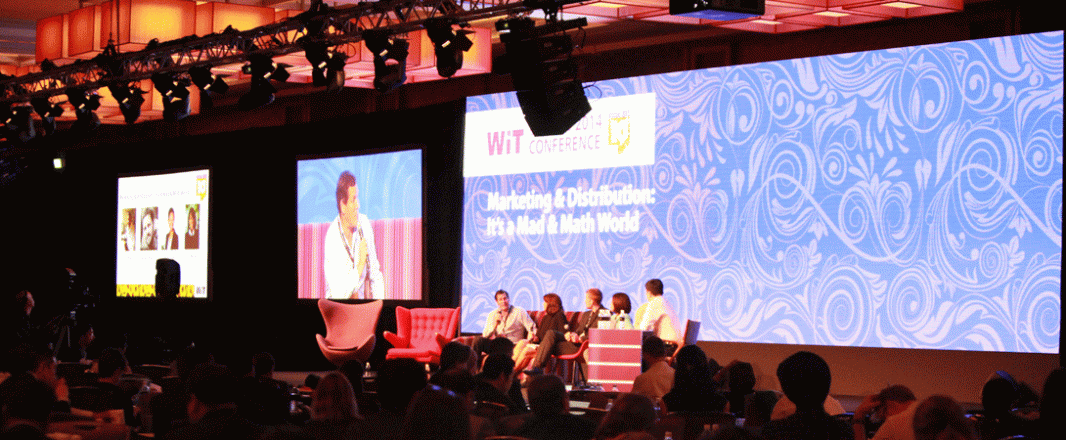
In this special edition of The Wrap, I share 10 takeaways I took away from the WIT Conference, which celebrated the “Little Big 10” theme in line with its 10th edition.
- Infusion of new ideas
Talented young people are invading the online travel space, judging from the array of start-ups which presented at the WIT Bootcamp 2014 – from a booking platform for rides (Jayride) to an OTA giving back to the local community (localalike) and changing the way people meet (spacebase), which won the competition.
- Metasearch is even hotter
And it’s getting hotter and bigger – also evident from the largest panel at the conference. However it’s also getting more competitive with global players entering the region and regional and local players having to defend their turf.
- Mobile forever
Mobile is a permanent platform change, it will change the way consumers behave and the way suppliers need to display their product offering – in 2011, there were one billion bookings made on mobile with OTAs, three billion in 2012, and eight billion in 2013, Gillian Tans, chief operating officer, booking.com, said in her session.
- Mobile & hospitality
Mobile will also change the way hotels operate, example “apart from just for making bookings and payments. Example, “Opening the door to your hotel room with a mere tap from your mobile will soon be a reality,” said senior director, digital marketing for Starwood Asia Pacific, Janice Chan
- Follow Facebook and you’ll see the same trend
Lee McCabe, head of travel for Facebook, said, “Everything Facebook is doing now is mobile.” And its acquisition of Occulus Rift could have applications for travel.
- New tactics needed for loyalty
Loyalty programmes are still relevant in capturing and growing customer base, but new strategies are needed to draw in new age groups, specifically the Millennials, which OTAs appear to be better at doing than hotels and airlines, according to PhoCusWright data. “Hotels have not caught up in the tech game to capture Millennials for loyalty programmes. Once we do we can catch up,” said Louise Daley, CEO, Accor Advantage Plus.
- The travel brand is still alive
Despite the age of disintermediation and the choice consumers have over indirect platforms vs brand.com, the travel brand is very much alive too, as shown by the overwhelming response from the voters who voted in the debate, “Everything has changed. The travel brand is dead” between Timothy O’Neil Dunne of T2 Impact, who argued for the proposition, and Hermione Joye of Google, who argued against.
- Entrepreneurs need to be naive
Real entrepreneurs need to be risk takers. “You need to be naive and you need to make things happen,” said Stephan Ekbergh, CEO and founder of Travelstart, South Africa in his panel on “The P Factor: The Ultimate Differentiator”. And that means taking risks on people as well. His take is that “superstars” are over-rated and it’s best for start-ups to hire those with warrior spirit – soft hearted but hard headed.
- More acquisitions and mergers ahead
Look out for more acquisitions and more mergers. A revelation was made at WIT 2014 when IHS Group chairman Steve Rowley disclosed that the group, which owns Trust International and Worldhotels, is in “exclusive negotiation” to buy fastbooking.com, an announcement that was made to staff last weekend. The group acquired Innlink in the US as part of its bid to achieve geographical reach and Fastbooking’s strength in Asia Pacific is clearly the carror.
- In today’s age, influence rules
WIT recognised 10 WIT Warriors who were the top influencers in online travel in APAC in the past decade. But the biggest warrior of all is WIT founder Yeoh Siew Hoon, who was surprised when Stephan Ekbergh of Travelstart presented her with the WIT Warriors award.
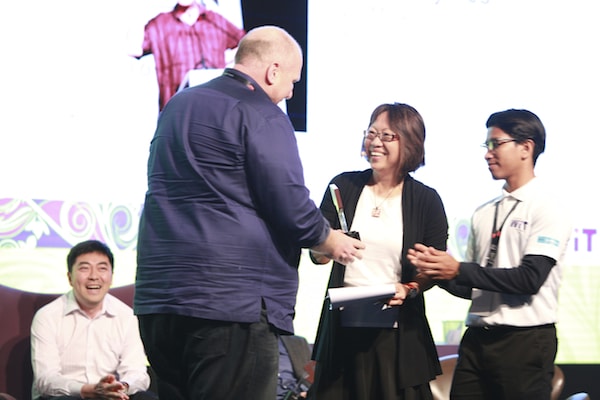
Siew Hoon gets a surprise award from Abacus’ Martin Symes.