
In the news: Airports investing for the “connected traveller”, 7 million landmark number for Tune Hotels, meetings trends in 2015 from CWT Meetings & Events
Airports investing in IT to get ready for the connected traveller
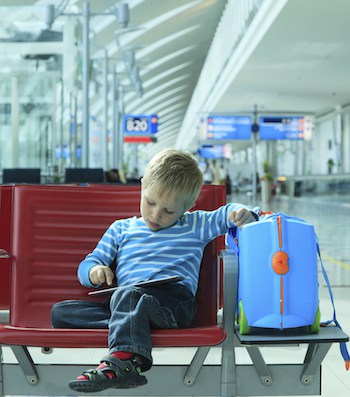
This is the age of the connected traveller with even the very young carrying mobiles devices. (Image credit: Nadezhda1906/iStock)
Airports around the world rank improving passenger processes as the number one information technology (IT) investment priority, with nearly half (47%) putting passenger and airport security on the top of the list, according to the recently released 2014 SITA/ACI Airport IT Trends Survey.
This annual survey of the world’s airports shows the focus on the “connected traveller’ with investments in IT infrastructure and services, which give passengers more convenience, control and a connected experience. It is based on responses from participants at airports across the world through which 2.35 billion passengers travelled last year, representing 42% of the total global passenger traffic.
According to the report, the key areas of investment are in self-service and mobile options, with more than 80% of airports planning a project in these areas over the next three years.
The good news for passengers is that airports also have more money to invest in IT. About 63% of CIOs expect to spend more on technology in absolute terms in 2014 compared to last year, and their total spend is estimated to reach US$6.8 billion.
Francesco Violante, CEO SITA, said: “This is the age of the connected traveller with nearly all passengers carrying mobiles, tablets and other devices. It is vital that airports invest in the infrastructure to support the changing expectations of these passengers. This year’s survey shows that the majority of airports globally are investing more in new technologies and mobile services for passengers in an effort to improve passenger processes and satisfaction.”
Some key findings of the survey:
- Airports continue to invest in self-service to help manage growing passenger numbers. Over the next three years more multi-service kiosks, self-bag drop and self-boarding services will be at airports around the world as 86% of airports plan investments in this area. By 2017, nearly three-quarters of airports expect the majority of their passengers to use self-service check-in. Common-use kiosks continue to be popular, with 60% of airports planning to increase their numbers for check-in and other uses.
- Geo-location technology, which allows an airport to provide services in relation to where the passenger or staff is at a particular time, is one of the initiatives popular with airports; 60% plan geo-location programmes over the next three years. Newer innovations have caught the eye of some airports too with 49% investing in near field communications (NFC), 33% planning iBeacon programmes and 16% investigating wearable technologies during the same period. It is the airports in Europe that are embracing these innovations the most. By 2017, 76% of them plan programs with geo-location, 55% with NFC and 23% with iBeacons.
- Mobile investments continue to be a major part of airport IT strategies with 84% investing in mobile applications for passenger services over the next three years. The most common mobile service currently available is flight status notifications, with 50% of airports offering it now and 90% planning to offer it within the next three years. Mobile is going to take hold in other areas too. By 2017, the vast majority of airports plan to expand services through mobile apps including Customer Relationship Management (CRM) (78%), way-finding (72%), security wait time notifications (73%) and retail services (65%).
- For the connected traveller, airports will increasingly offer CRM via social media. Already 30% do so, but this is set to jump to 70% over the next three years. Overall, the performance in social media for airports is mixed. Of those airports that measure social media usage, 13% have found that it has exceeded their expectations while nearly 18% report passenger usage figures lower than expected.
A milestone for Tune Hotels – 7 million guests and counting

L-R: Frank Trampert, Tune Hotels COO; guests Chong Ken Vun, Ng Ang Leen, Joash Sean Chong Ruei; Mark Lankester
The 7th million guest for international value hotel group, Tune Hotels, checked into its hotel at the new klia2 in Sepang, Selangor – Tune Hotel klia2 – at precisely 7pm on 7 November, an auspicious number indeed.
The lucky guest was surprised with a 5-day/4-night stay in Tune Hotel Melbourne and return tickets for two, courtesy of AirAsia X.
Mark Lankester, CEO of Tune Hotels Group, said: “Tune Hotel’s biggest milestone would be the simple fact that guests all around the world have embraced us and our business model, not only in countries within which we have hotels but further afield where we have been an instrumental part in powering overall customer travel experiences.”
Over the past seven years, Tune Hotels has rapidly grown from a local brand to an international hotel chain, now operating 44 hotels in nine countries worldwide namely Malaysia, Indonesia, Thailand, the Philippines, England, Scotland, Australia, India and Japan.
Earlier this year the hotel group expanded into East Africa with its first hotel in the African continent in Nairobi, Kenya. Scheduled to open by Q3 2015, the 12-floor, 280-room hotel is situated in the Westlands area, Nairobi’s new emerging Central Business District.
Tune Hotels also unveiled plans to open another 25 hotels in the United Kingdom by 2020, through partners, representing an investment of approximately £200 million.
In 2015, the hotel group plans to expand its presence globally to the Middle East, West Africa and Australia. It will continue its expansion in South East Asia with imminent openings in Bandung and Jogjakarta (Indonesia).
Compliance and IT usage are key trends of meetings in 2015
Technology will be featured widely in meetings in 2015.
CWT Meetings & Events has released its 2015 Meetings & Events Forecast (download report here), which suggests compliance will remain top of the agenda for next year.
The company expects compliance to be the number one concern for companies consolidating their programmes and seeking additional transparency across multiple geographies,
New compliance regulations in the pharmaceutical industry in 2015, including the Sunshine Act in the US, designed to create greater transparency around the financial relationships between drug and device manufacturers and health care providers, will mean significant impact on regulation in the sector.
Floyd Widener, senior vice president, CWT Meetings & Events worldwide, said: “This is the third edition of our meetings & events forecast, and it’s interesting to see the renewed focus on compliance in our industry. With 2015 on the horizon, the forecast provides valuable insight for our clients to refer to in upcoming budgeting and negotiations, whether they’re focused on meetings, events or strategic meetings management.”
In the foreword of the report, Widener also stated that the use of technology in events would hit an all-time high in 2015.
“Solutions that enhance the delegate experience by enabling online registration and booking while capturing budget information are fast-becoming an essential tool in meeting planners’ arsenal. By providing consolidated, centralised data, end-to-end event management is enabled; a key focus of 2015 in an industry where compliance is king.”
He added the usage of meeting-specific apps, which are becoming much more common now, are set to increase throughout 2015. Hybrid events, which mix in-person and virtual elements are expected to gain traction.”
The report contains recommendations to help planners achieve success in the next 12 months. They include trying hybrid events to save costs and involve remote employees unable to participate in person, basing events in-country or in-region to minimize costs, carbon footprint and delegate travel times, and working with an agency with strong industry relationships to get the best deals and supplier terms.