



At WiT Japan & North Asia 2025, a conversation around the B2B travel tech landscape revealed one thing: the back end is no longer background noise. It’s where real travel innovation is happening.
Moderated by WiT’s founder Siew Hoon Yeoh, the panel brought together industry leaders Eric Zhuang (DidaTravel), Brett Henry (MG Group), Kazuhisa Takahashi (Tripla), and Raphael Lanfant (Hopper Technology Solutions), who painted a picture of a B2B landscape that is fragmented but fast-moving, layered but full of latent potential, and increasingly shaped by tech, trust, and transparency.
Fragmentation is fuel, not flaw
Asia remains a fractured puzzle of domestic systems, currencies, languages and regulations. While that sounds like a headache, for the panellists, it’s a growth engine.
“This kind of environment is where middlemen could really thrive,” said Brett Henry, President of MG Group. “You’re seeing hospitality B2B being pushed into innovation by VC-backed companies like us and Dida Travel and others who are adding value through tech.”
Kazuhisa Takahashi of Tripla agreed: “Japanese hoteliers often have no idea which OTA actually sends them customers. We’re bringing transparency to that with B2B dashboards that trace the flow of bookings and empower localized marketing.”
From specialist to platform: The new B2B muscle
All the major OTAs – Expedia, Booking, Trip.com, MakeMyTrip – are flexing their muscles in B2B. Why? Because it’s profitable, sticky and still under-penetrated.
Lanfant of Hopper explained how HTP (Hopper Technology Solutions) now accounts for over 70% of Hopper’s revenue. “We’re combining travel supply and fintech into one e-commerce experience,” he said. “It’s what makes our solutions valuable not just to OTAs but to banks, airlines, and superapps.”
Even so, there’s still room for niche players—if they bring unique local supply or services to the table. “You need to be an expert in something,” said Dida’s Zhuang. “We’re building a one-stop shopping platform for B2B travel agents that covers accommodation, flights, tours because they need both tech and inventory to serve their customers.”
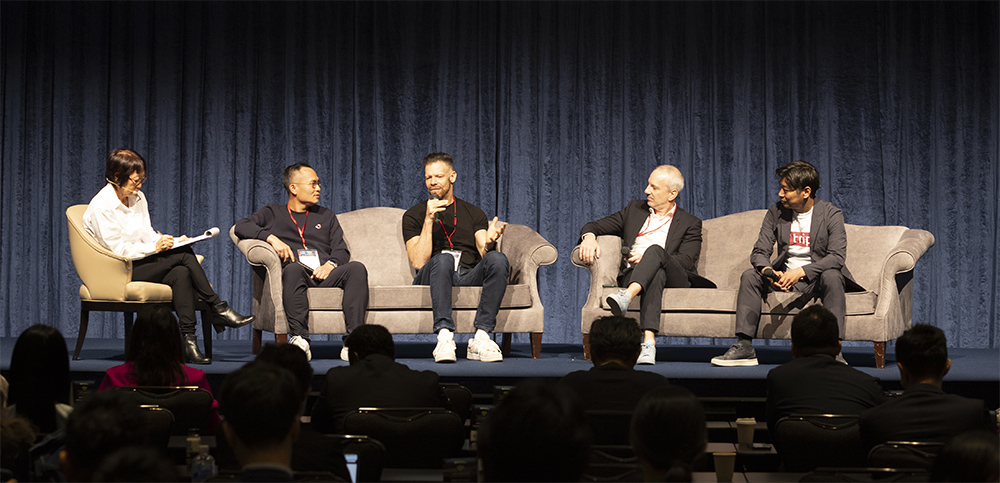
From left: Yeoh Siew Hoon (Moderator), Founder, WiT | Eric Zhuang, Chief Strategy Officer & President of Tours & Activities, Dida | Brett Henry, President Director / CEO, MG Group | Raphael Lanfant Vice President, APAC & Middle East HTS (Hopper Technology Solutions) | Kazuhisa Takahashi, CEO, Tripla
AI: Talk is cheap, application is hard
Unsurprisingly, AI was front and centre but so was skepticism.
“AI is like teenage sex,” joked Henry. “Everyone’s talking about it, but nobody’s really doing it.” He challenged the industry to move beyond using ChatGPT to write travel blurbs and instead develop meaningful automation.
Zhuang shared that DidaTravel is actively integrating AI, but the real transformation starts with mindset. “We had to educate our teams first on what AI is, how it works, before we could deploy anything. Internally, we’re using it to enhance trip planning, packaging, and operational efficiency.”
For Hopper, AI underpins pricing strategies in fintech. “It’s essential for our profitability and product relevance,” said Lanfant.
Trust, data & talent: The real barriers to scale
So, what’s holding B2B back from becoming the new face of travel tech?
“Data,” said Zhuang. “We don’t just need internal data, we need contextual data like weather, events, and competitive pricing to deliver intelligent recommendations. And we need the talent to handle that data.”
“Trust,” added Henry. “Ask 100 hoteliers and most will say they’re overpaying for distribution. We have to fix the perception that intermediaries are taking too much for too little value.”
Kazuhisa also emphasized transparency. “Hotels struggle to understand what they’ve signed up for. Better contract visibility is essential.”
The future? It’s both platform and community
In a rapid-fire closing round, the panel predicted where B2B is headed. Kazuhisa picked community, not just platforms, as the long game. “Travellers want to go where others haven’t. Community content and peer influence will shape demand,” he said.
And if Henry could launch one startup tomorrow? “A credit scoring and financing solution for B2B players, because capital access is still a huge bottleneck in this business.”
B2B’s coming of age
If B2C travel tech is all about inspiration, B2B is becoming about intelligence. Data, AI, trust, and local specialisation are now the pillars of next-gen B2B. As Henry puts it, “You win by having the best price and best room availability – who sources it matters less than who can deliver it consistently.”
From backend to front-end, the invisible infrastructure of travel is getting smarter, faster, and more collaborative. And Asia Pacific, with its complexity and creativity, might just be the ultimate testbed for B2B’s bold new era.


