A major revolution in the passenger experience is set to emerge over the next three years as airlines invest in the Internet of Things (IoT).
According to the SITA 2015 Airline IT Trends Survey carried out among the world’s top 200 airlines, the vast majority of airlines (86%) expect that the IoT will deliver clear benefits in the next three years. More than one third (37%) have allocated budget to it. By 2018, 16% plan major programmes and a further 41% plan to invest in research and development.
The airlines’ IoT investments will focus in the areas of check-in, bag drop and bag collection.

Most airline’s passengers are already part of the Internet of Things. (Image credit: SITA)
The IoT is when physical objects are connected to the internet, which enables tracking, data collection, analysis and control. As part of this revolution, more things in the airport are being connected up including buildings, equipment, bags, trolleys, tugs – basically all the “things” that could emit a status.
However, as the vast majority of today’s passengers (83%) carry smartphones, they and the airline staff are already connected, and can be part of the IoT too.
Jim Peters, chief technology officer, SITA, said: “Our whole world is becoming more and more connected and airlines recognize that investment will be needed to harness the benefits of IoT efficiently. This year airlines are beefing up their investments in both business intelligence (BI) and data centres, which are key foundations required for the IoT.”
This year’s survey, carried out by SITA in association with Airline Business, shows that airlines are heavily investing in these areas — 94% of airlines are investing in BI, 74% planning major investment programmes by 2018, 68% have a major investment programme planned for data centres in the next three years, and 14% investing in R&D or a pilot programme.
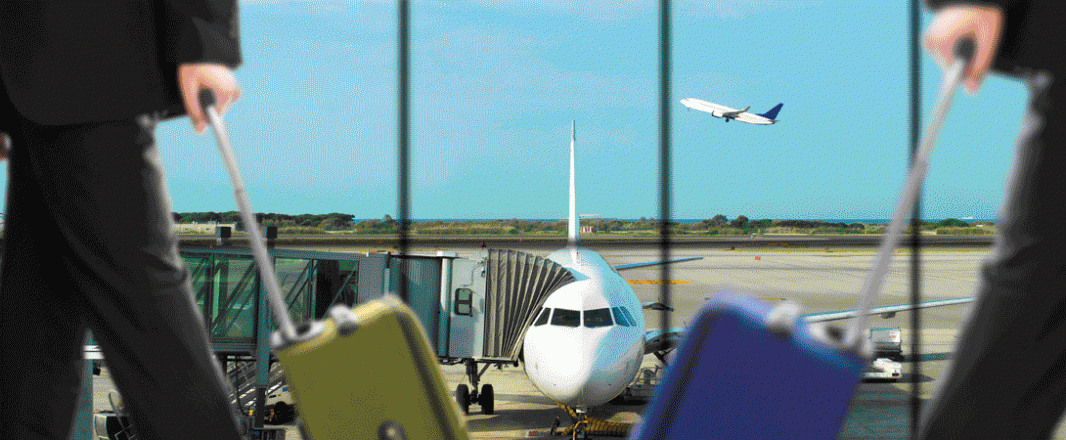
Revolution in passenger experience with the Internet of Things. (Image credit: Manuel-F-O/iStock)
The survey also highlighted the use of beacons for baggage. Today just 9% of airlines are using beacons for bag services. By 2018, 44% of airlines are planning to use them at bag drop and 43% at bag claim.
Location-based information, in many cases from beacons, will also be used to solve baggage-related issues and help passengers board on time with notifications based on their location, even before they reach the airport. This is already the number one service for which airlines are using beacons and in three years, 57% will use beacons to inform way-finding apps.
Peters added: “It is early days for the IoT but it is becoming a reality and this will be a game-changing and real-time revolution in the way we do things – not only in the air transport industry but across all aspects of our lives. Together airlines and airports can use beacons as a gateway to the IoT, creating intelligent airports and fully exploiting business intelligence and analytics to deliver a better passenger experience.”
Download the Airline IT Trends Survey 2015 here.