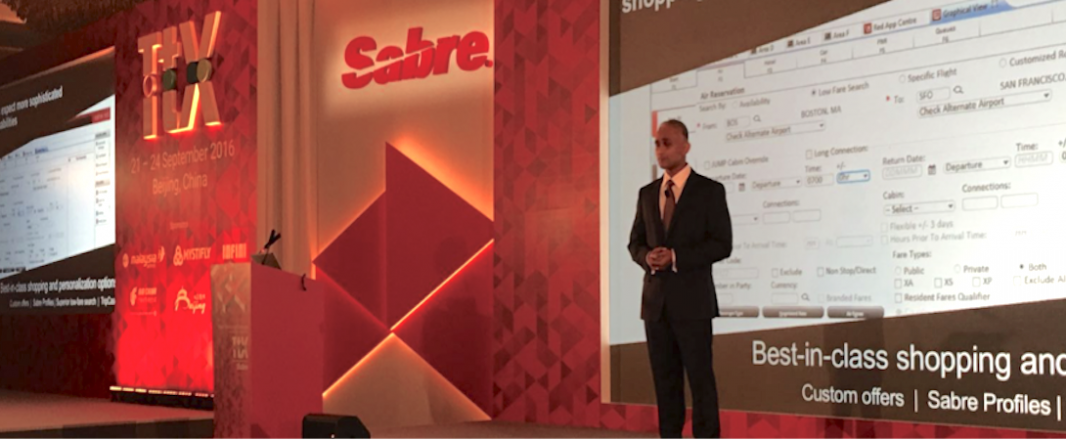
The 500+ participants at Sabre’s inaugural Asia Pacific Travel Technology Exchange (TTX) in Beijing last week were given an insight into the big trends and developments impacting travel and technology in Asia Pacific.
Sabre executives and guest speakers took to the stage to highlight the changes – from the evolution of the travel agent to space travel.
Sean Menke, president of Sabre Travel Network, shared the three priorities underpinning Sabre’s new product development to meet agency and supplier needs. These included using business intelligence to optimise customer performance, driving more personalisation for travellers and merchandising options for suppliers, and, for agents, automation and efficiency solutions to reduce costs.
Wade Jones, senior vice president of marketing and strategy for Sabre Travel Network, talked about how the business has evolved from being just a GDS to become a rich, multi-layered, modern platform company. By architecting a more powerful platform that’s compatible with additional enhanced services and applications, Sabre is leveraging beyond the traditional GDS, he said.
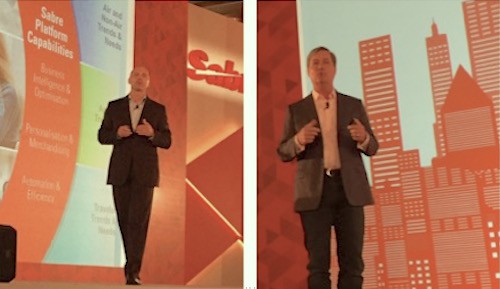
Sean Menke (left) and Wade Jones talking on the evolution of travel technology.
“The traveller ecosystem has also grown and diversified, and our Travel Network team has built an upgraded technology platform that’s modelled on this,” said Wade.
“At the heart of this platform sits the GDS. That core technology is still critically important. But now, if you look from top to bottom you also see Sabre supporting end points like mobile, new User Interfaces for agents and application services across our offerings – all resting on powerful shared platform services. In a nutshell, Sabre has created a modern, value-creation platform that’s driving the traveller ecosystem.”

Wade Jones: “Sabre has created a modern, value-creation platform that’s driving the traveller ecosystem.”
Roshan Mendis, senior vice president of Sabre Travel Network Asia Pacific (pictured in feature image), outlined the key milestones marking the evolution of the travel industry – from the appointment of Cox & Kings in 1759 as general agents, the regiment of Foot Guards in India to the opening of air travel in the 1920s and take-off of package tours during the 50s post-war boom.
He noted that the industry has a long history of change, and it continues to evolve at pace.
“Today the travel industry is on the cusp of a major technological boom. From driverless cars to virtual reality, smart watches, social media and messaging apps, the impact technology will have on travel in the next decade is going to be huge. TTX is a platform to share an update on these developments. But new technologies are only powerful if they are relevant. To be truly relevant we have to understand the changing drivers influencing travel – historically, now and in the future.”
John Samuel, senior vice president of design at Sabre, discussed the emerging technologies the company is exploring for the travel industry especially the potential unlocked value of messaging apps for the industry.
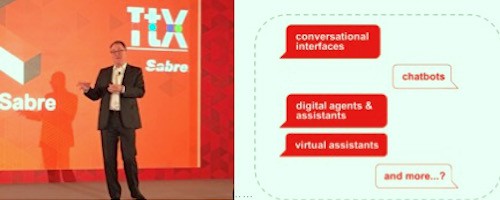
John Samuel shares an update on new technologies under review for potential development.
Since 2015 the number of active users recorded on messaging apps has surpassed the number of active users on social networks. Sabre is exploring the opportunities around adopting conversational interfaces for travel, he revealed.
“The travel industry is well-poised for the uptake of messaging apps to automate components of the travel chain – from shopping and booking, and merchandising, to service and support,” Samuel added.
“The key to a successful adoption will be creating the right mix of automation and human interaction. We are in an industry which has a wealth of human knowledge, and this directly complements the use of listening and answering engines embedded within a messaging platform for travel.”
Samuel pointed out that chatbots could handle many repetitive tasks, as well as answering questions, but at any time the model could not handle any of the tasks they could fall back to humans for support.
“The result for travel consultants is more time to provide an enhanced service to customers and, ultimately, the ability to sell more.”
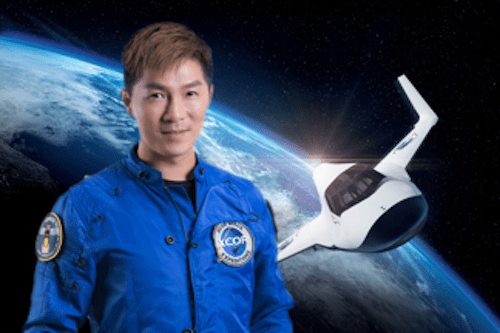
Alex Tang launches the conversation to the next frontier – space.
There was a special session on space travel by Alex Tang, Asia Pacific managing director of XCOR, a commercial space travel company. He took to the stage with the science behind space travel, observing the evolution this growing industry has seen in the last few years as it becomes more accessible, and affordable.
Roshan concluded that the first Asia Pacific TTX was all about the exchange: “That’s how we make sure our business keeps evolving in a truly relevant way. If we know our customers inside out, and we really understand their opportunities, we can develop technologies that truly enhance their business.”
• All images credit: Sabre Travel Network Asia Pacific