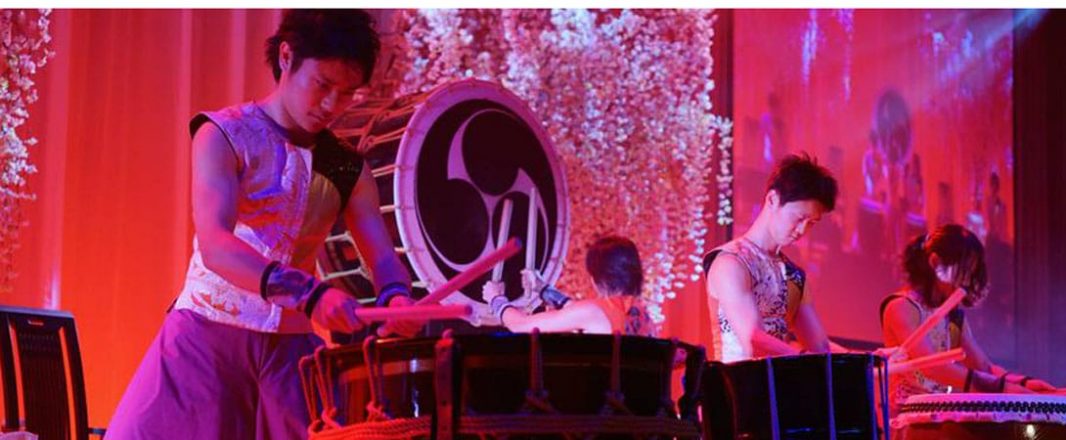
 The third WIT Japan opened last week to the personal welcome of a Prime Minister and the beating of drums, heralding what many believe is the rise of a new dawn for the country’s travel industry.
.jpg) In his video message, Prime Minister Shinzo Abe (right) told delegates that the Internet had made the world more global and that Japanese companies had to embrace this change and expand. Olympics 2020 also makes it imperative for the travel trade to prepare for the big day when by then, 20 million foreign tourists will land on its shores.
In his video message, Prime Minister Shinzo Abe (right) told delegates that the Internet had made the world more global and that Japanese companies had to embrace this change and expand. Olympics 2020 also makes it imperative for the travel trade to prepare for the big day when by then, 20 million foreign tourists will land on its shores.
Last year, Japan crossed the 10 million mark to reach 10.36 million arrivals and the momentum continued for the first quarter. Freed of visa requirements, South-east Asian markets are surging ahead, Thailand showed a 64.7% growth first quarter 2014 over the corresponding quarter in 2013, Malaysia by 61% and Vietnam by 56.2%.
Hideki Tomioka (right), director, marketing and promotion department from the Japan National Tourism Organisation, who shared these figures, also revealed plans to introduce tax-free shopping this October, a move expected to reap 260 billion yen of economic benefits in five years.
There are also plans to attract Muslim travellers by providing information on Muslim-friendly restaurants and prayers rooms and halal-friendly travel guides. Major airports and large-scale shopping centres will also be equipped with prayer rooms in a bid to go after this US$140 billion market segment.
The industry is still pinning its hopes on an Integrated Resort and the legalization of gaming to take Japan’s tourism forward – however following talks at the Japan Gaming Congress which also took place last week, it appears greater odds are now stacked against it.
In any case, many are unsure whether this development will do for Japan tourism what it did for Singapore tourism and the talk is that the IR will target the domestic market because that’s what the foreign gaming companies bidding for the project are after.
 Yoshiharu Hoshino (left), CEO of Hoshino Resorts, put it best – 95% of Japan’s tourism is domestic which is why the country has found it a challenge to cater to foreign travellers. Domestic travel in Japan is worth US$224 billion, almost half the volume of the car manufacturing sector.
“This could be a problem when we go after international travellers. When we deal with Japanese people, we don’t need to speak English. Foreign visitors also carry a lot of luggage and foreigners have different behaviour in ryokans, for example, eating their noodles quietly.
“They don’t realise that they need to slurp the noodles and that adds to the ambience of the place. So do we change ourselves or change them?”
He basically said there was not a lot of incentive for businesses to cater to foreigners especially when foreign OTAs charge higher commissions than local giants such as Rakuten, Jalan and Ikyu with their 10%. “People ask, why should we give our inventory to foreign OTAs?” said Hoshino.
Having said that, foreign OTAs such as booking.com and Agoda are seeing good growth in inbound bookings, said Adrian Currie, senior vice president of corporate development for Priceline Group, as the two OTAs expand their local teams and local content.
Hoshino Resorts and Agora are seeing healthy growth in foreign guests and making adjustments to their operations to cater to these new customers. Agora’s CEO Aya Aso (below, right) said her group’s top producing foreign OTA is Tablet, marking the success this new age hotel company is having in pursuing high-end niche business.
 At Niseko Freedom Inn (left), 95% of guests are foreigners and proprietor Clifford Bernstein uses both OTAs and his own website to access customers for his 19 rooms.
He feels Japan needs more foreigners like him to work in tourism “because we generally do a better job of selling Japan”.
Japan tourism also suffers from extreme seasonality with huge demand only during 100 out of 365 days, said Hoshino. “I’ve been proposing since 2004 to change vacation patterns.”
This, he said, would also help improve productivity levels which he said were half that in manufacturing.
If the IR were to come in, Agora’s Aso said something drastic had to be done to bring in foreign labour.
Those who know Japan know that change comes very slowly in this market but there seems to be a greater sense of urgency this time, driven from the Prime Minister’s office no less and of course, the Olympics 2020 deadline.
Can Japan make it? Well if there is one thing this country is known for, it’s execution and precision. The key is to having the will to change and from the feel of the audience and speakers who were at WIT Japan, I believe the journey has begun.