
In Amsterdam, I stayed at the Grand Amrath Hotel. It’s reputed to be haunted. I didn’t know it because unlike 80% of travellers who read reviews before they book a hotel, I didn’t do any research.
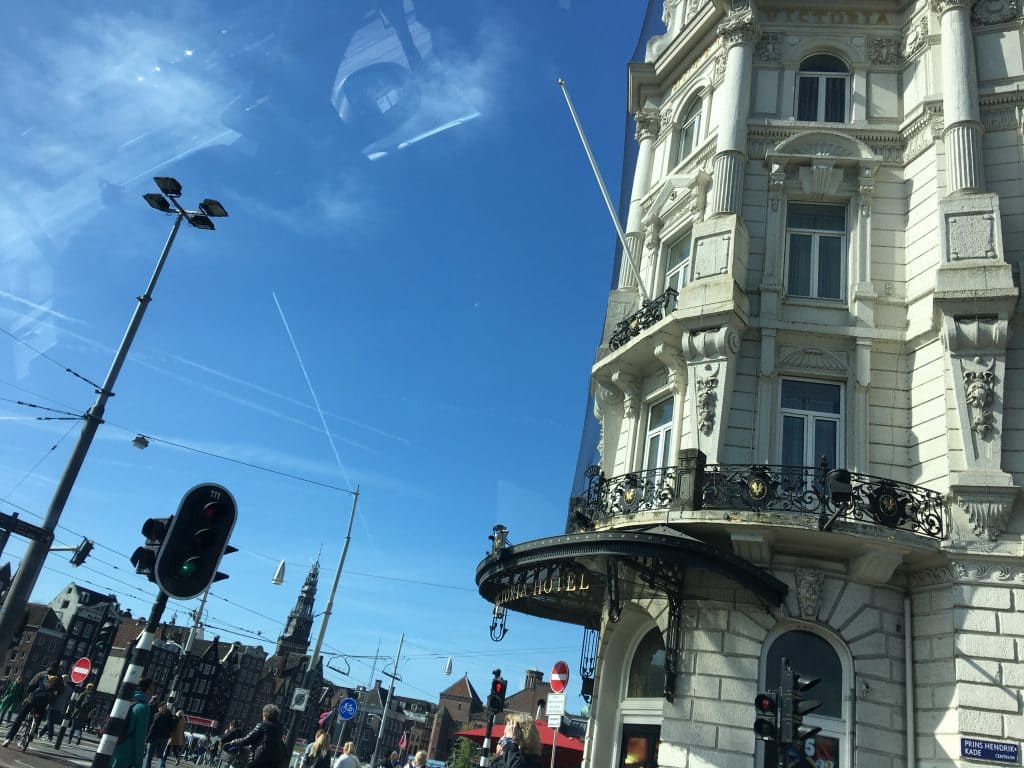
Grand Hotel Amrath – located on the historic site where Dutch sea voyages were made from in the 16th and 17th centuries
I stayed there because it was the hotel of choice for the Phocuswright team. It’s a very old hotel. Actually it’s ancient because to us in Asia, any hotel over 30 years is beyond old. The structure was built in 1912 as the head office of six shipping companies. Called Scheepvaarthuis, it was located on a site from where many sea voyages departed during the 16th and 17th centuries. I guess this must be where they departed to colonise Malacca as well as most of what is Indonesia today.
The first room they gave me looked out on a construction site and had a thin layer of dust everywhere. I asked for a change because it reminded me too much of home. My neighbourhood in Singapore is having a new train station built and I now live amid piling, digging and drilling. All the things hotels say about making guests feel at home – rubbish. We don’t want to feel at home, we want to feel like we’ve been transported to another place – it’s why we travel.
Anyway, I got transported to another room – this time, an inside facing room which means it was pretty dark all day and all night.
I am pretty fearless when it comes to ghosts. In Asia, we have a deep and abiding respect for the supernatural. I grew up on stories of Pontianaks (a certain kind of demon in Malaysia) and my own family has their stories of exorcism and possession, a few of which I witnessed growing up.
My friends are always asking me how I can sleep in strange hotel rooms all over the world, especially the old hotels, and I guarantee you if you ask any of your friends from Asia if they’ve had spooky encounters in hotels, they’ll have a story to tell you.
In fact, I remember when I first tried to write a book of fiction, my publisher told me to write a ghost story, it being the best-selling genre in Singapore and he suggested a travel book of ghost stories. I am still working on the idea.
Anyway, I have to confess at the Grand Amrath, I slept each night with the lights on – this is an ancient tactic we in Asia think keeps ghosts away. Well, one morning, I woke up with all the lights off and my wardrobe doors open – and I imagined someone had come in through the night and tried to dress in the dark.
On checking out, I met two Chinese men who asked if I would be their translator with the staff at reception. My Mandarin is rudimentary at best but because I look Chinese, I’ve found myself co-opted to be interpreter on a growing number of occasions as more Chinese travellers fan out on their air and sea voyages around the world. It’s a good way to improve your Mandarin – on the road. Anyway, we managed to make ourselves understood to each other and to the staff – they needed a taxi to the airport.
I asked how they liked the hotel. “Gui,” they said. They too knew its ghostly reputation.
At WIT Europe, held for the first time in conjunction with Phocuswright Europe, we put the spotlight on Asia and the growing numbers of travellers from our region to the continent. There’s no doubt we are changing the face of travel in Europe. In Powerscourt Gardens in Ireland, there were more groups from Asia than anywhere else the morning I was there. There’s no doubt we love our selfies – every statue, every bush, every tree is an excuse for a selfie. It’s why we stand out.

Selfie love is spreading across Europe
Here are the key takeaways from WIT Europe.
- The next tailwind of growth is from secondary cities
The next tailwind of growth will come from secondary cities whose population is young and whose first experience of the web is on mobile. Low cost airlines are fanning out to connect these secondary destinations, giving more people their first taste of travel. AirAsia, the low cost pioneer in opening up these secondary routes, now has 22 hubs across its network – and three low cost longhaul airlines in its group, from Malaysia, Thailand and Indonesia.
- Mobile will become a world from which you can’t leave
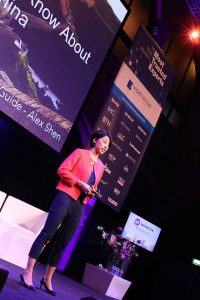
Alex Shen, GetYourGuide: Buying cherries on WeChat, sweet
Mobile has become an all-encompassing world with the rise of superapps that keep you within their ecosystem.
Alex Shen, strategic partnerships, China, of GetYourGuide spoke of how she wanted to buy cherries while out walking the streets of Beijing and had no cash. The cherry seller asked her to add him on WeChat and she paid for her cherries through the app.
Alibaba during its single’s day sales in 2016 saw 82% of the $17.8b GMV happen on mobile. China is way ahead of the US in third party mobile payments in 2016, she said, at $5,500b compared with $112b in the US.
- It’s all about the technology – if you can’t build it, buy it
Travel companies are all vying to buy the right technology to help them ride the next wave. AccorHotels has been acquiring – its lastest being AvailPro to add to its FASTBOOKING acquisition to bolster services for independent hotels.
Timothy Hughes, vice president business development of Thailand-based Agoda, said the company was acquiring not travel companies but companies offering technology especially around mobile.
- The new hot space is in tours & activities and food

Blanca Menchaca, BeMyGuest: Mobile changing the way tours & activities are booked, pad for and enjoyed.
Blanca Menchaca, co-founder of BeMyGuest, said mobile was changing the way tours & activities was being booked on services such as Handy, the mobile device being placed in hotels in Asia. Now people can book, pay and enter the BMG platform to get their tickets.
“Fifty percent of all bookings in Asia already happen on mobile even if they are advanced bookings. The behaviour in Asia is different because of language and payment barriers,” she said.
In food, a huge category in Asia, Louise Daley, deputy CEO of AccorHotels Asia Pacific, is working hard to own that space with its acquisition of concierge services such as John Paul as well as building out a restaurant booking platform called TablePlus.
- Local players still rule in Asia
Unlike Europe, where Google has overall dominance in search, Asia’s more fragmented with local giants still commanding the gates. Similarly with metasearch, local players still top the charts although global brands are definitely snapping at their heels.
Kei Shibata, CEO of Venture Republic/travel.jp, likened metasearches in Asia to hipsters who still make money and who are staying edgy by innovating to keep up with consumers who prefer to use mobile.
In South Korea, outbound travel is setting new records and new services such as Jin Air’s flight to Okinawa, Japan, is a good example of how a low cost airline can change travel patterns. Inbound is also soaring with a 30% growth in visitors to 17m in 2016 – it remains to be seen if the current diplomatic rift between South Korea and China which has meant a suspension on Chinese tour groups to Korea will impact numbers this year.
Min Yin, CEO of Tidesquare, said low cost airlines were gaining market share – from 15 to 20% – and a new terminal is opening at Incheon airport to cater to the growth – 60% increase in low cost capacity last year. While traditional players such as Hana Tour, Mode Tour and Interpark still lead in BSP sales, new players are snapping at the heels – with marketplaces like Tmon, Coupang and Gmarket coming to the fore. Global OTAs dominate in the overall hotel market but it’s local OTAs who rule in the local budget segment.
- A new giant is acquiring

Zhou Shiwei, Ctrip: New markets, new relationships, new technology
Zhou Shiwei, head of investments and investor relations, at Ctrip, has been busy the past 18 months since he joined meeting every travel company he can. When I asked him what the company is interested in, he said, “New markets, new relationships, new technology” and “if it is an industry vertical, it has to be market leader”.
- A fresh wave of innovation is happening and a new giant will emerge
Fritz Demopoulos, co-founder of Qunar and CEO of Queen’s Road Capital, spoke of the innovation that’s happening in cities like Shenzen and Beijing, that’s beyond what’s happening in the West.
He asked, “In 10 years’ time, who will be the biggest travel company in the world – Alitrip, Ctrip or Tencent?”
Meanwhile, back on the streets of Amsterdam, I realised too that tourists actually have more to fear from bikes than ghosts – there seems to be more bikes than cars (or houseboats) in Amsterdam and they have right of way.
Crossing the roads in Amsterdam is beginning to feel like Saigon.
Watch the WIT Great Debate which closed off WIT Europe on a thrilling note.
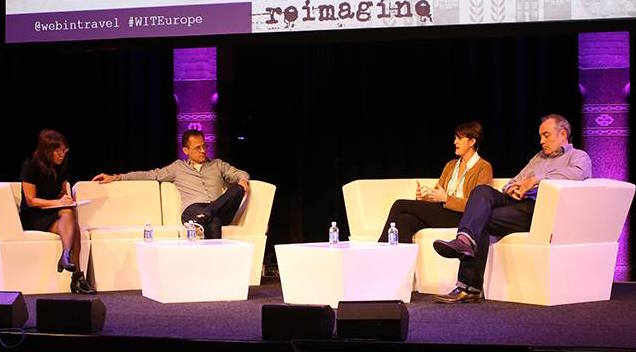
WIT Europe opening panel, View From The Top with, from right, Timothy Hughes, Agoda; Louise Daley, AccorHotels; and Fritz Demopoulos, Queen’s Road Capital