Yeoh Siew Hoon catches up with Rome2rio executive chairman Rod Cuthbert over breakfast at a café in Amsterdam where he frets about the growing power of Google and talks about the evolution of multi-modal travel as well as how the Melbourne-based “cockroach” startup intends to compete in a world of well-funded giants.
The multi-modal business of Rome2rio may be chugging along nicely – in fact, it’s considered one of the more successful startups that have managed to grow organically and independently – but that doesn’t stop executive chairman Rod Cuthbert from worrying about Google and its growing power to disintermediate travel at many levels.
“Over the last 10 years, we had a stable and healthy ecosystem – lots of suppliers, strong intermediaries, and tech companies that service those relationships. Google has done well to build itself into the biggest travel company in search and advertising but now it is morphing into an intermediary itself.
“That’s progress, I suppose, but I don’t think it’s healthy.”
Added Cuthbert, who recently handed over the CEO role to co-founder Michael Cameron, “The pie is increasing in size, more people are travelling, there are more destinations, more hotels, more bus lines so we don’t have to worry about growth but the industry has become more mono when it should be rich and diverse. I am concerned that Google threatens that (diversity).”
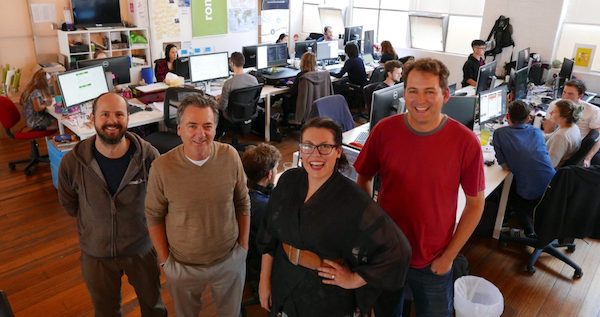
New roles for the team at Rome2rio – from right, co-founder Michael Cameron, CEO; Kirsteene Pheelan, now COO; Rod Cuthbert, executive chairman and co-founder Bernie Tschirren who is now chief architect.
While he knows there’s little that anyone can do about curtailing Google’s power, he’s determined that independent companies like Rome2rio help keep the industry rich and diverse by continuing to innovate and achieving new technological breakthroughs.
Said Cuthbert, a veteran in online travel who founded tours & activities site Viator almost 20 years ago, “Technology helps diversity and we want to develop new technology that makes it easy for people to get from A to B. Rome2rio is a strong tech breakthrough – in one second, you can figure out how to get from A to B.”
And in this next phase of Rome2rio, it’s about booking your trip from A to B, whether it be on trains, buses and boats – in line with what other meta-searches are doing.
From search to book – “it’s what consumers want”
In May it announced that users searching for transportation options between hundreds of European destinations have the ability to book a National Express coach or Renfe rail journey on its site. In Spain, the entire Renfe and AVE intercity rail network are also available, as are Trenitalia services in Italy.
Co-founder Michael Cameron, who has assumed the role of CEO from Cuthbert, called this a milestone “as we continue to layer booking capability for train, bus and ferry operators on top of our unique search engine and growing user base. By 2018, Rome2rio’s booking coverage will be more global and comprehensive than our most respected competitors, Loco2, The Train Line and GoEuro.”
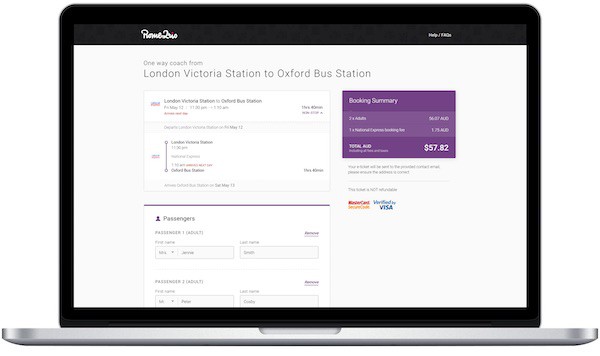
Rome2rio offers layer booking capability for train, bus and ferry operators.
In Asia, it is in talks with partners for rail bookings in japan, China and parts of South-east Asia, particularly, Malaysia and Thailand.
Added Cuthbert, “It is important for companies like us when we reach critical mass – with five to 10m users every month – that we continue to innovate and do interesting things, otherwise we just get forgotten.
“If we stop and say, yes, we have a great search engine and pass you to partners, we’re not taking responsibility for growth. We need to figure out what customers want and build the company around that. “We still want to be the best search engine but consumers want the ability to book. It’s where Google is going.”
So why shouldn’t Google do what the rest of the industry is doing? Responded Cuthbert, “I think it’s wrong – they have built a massive business in advertising and their customers are the ones that are being disintermediated.”
Expedia buying SilverRail – “I am not whistling in the dark”
Cuthbert believes this is the coming of age for ground transportation. “The industry has always looked at ground transportation as a poor cousin, the same thing I said of tours & activities 10 years ago. It was under-served by technology but now the technology is catching up, there are great systems available and Expedia buying SilverRail – it’s evidence I am not whistling in the dark.”
He added, “The purchase of SilverRail by Expedia throws the spotlight on ground transportation and presents a challenge to the big online players to develop plans for this space. Eventually each of the bigger OTAs and meta players will want to offer rail, bus and ferry options alongside their air offerings.”

“Expedia’s purchase of SilverRail throws spotlight on ground transportation.”: Rod Cuthbert (Image credit: SilverRail)
While the sector may be hot right now – its competitor Berlin-based GoEuro raised an additional US$70 million last year bringing the total raised by the company to US$146 million in five rounds – Rome2rio prefers to take the “lean company” approach. (Since startup five years ago, Rome2rio has only raised A$1.6 million from angel investors in Melbourne and abroad.)
“This means you fund your growth through profitability and do things you can make money on. Some people might call this old fashioned but we think it makes a lot of sense.”
Australia the perfect breeding ground for “cockroach” startups
Growth therefore is Intrinsically tied to the rate that it can hire people at and it takes recruitment very seriously. “For every 100 people we interview, we hire one person in the engineering role – 20 phone calls, 12 phone screens, 6 detailed screens, 3 interviews and one offer. It’s a hard process, and it puts the brakes on how fast we can hire people.”
In this article, co-founder Cameron likened Rome2rio to a “cockroach” startup – tough and indestructible – and said that “Australia’s harsh capital environment has been the perfect breeding ground for world class “cockroach” start-ups”.

“Cockroach” startup – tough and indestructible: Michael Cameron
He wrote, “Large capital raises don’t always work out well. When venture capitalists invest millions in a business, the expectations of that business grow. VCs typically make their money from a handful of knockout successes and often push start-ups to pursue a riskier, high-growth strategy with the hope of scoring one of these home runs.”
Cuthbert is clearly proud of the team and culture at Rome2rio. “What our team members like about us is the flat structure. Engineers have control of the process and it’s easy for them to measure the impact of their work on the business – website traffic.”
And everyone on the team knows what the mission is – “we want the consumer to book a bus in New Zealand, train in Thailand and ferry in the Adriatic on one website and always come back to the same website,” recited Cuthbert.
As for an exit plan, Cuthbert said it’s too early to talk about that. “There’s still a lot of work to be done in integration with transport partners, still a lot of improvement to be done. Some of the potential acquirers have vast traffic numbers and that’s very attractive – imagine 300m – that would take us to another level. But it’s hard to judge when the right day would come.”
• Featured image credit: ssuaphoto/iStock