
Twelve years in, Agoda’s CEO Omri Morgenshtern and CTO Idan Zalzberg still talk like founders. At WiT Singapore, I asked them what the next chapter looks like when the ball could come from anywhere.
I have known Agoda long enough to remember when it was the scrappy Bangkok upstart that most people did not pay attention to until it was acquired by Priceline. Twelve years on, CEO Omri Morgenshtern and CTO Idan Zalzberg have taken it from startup to global platform, and somewhere along the way it became one of the fastest-growing names in Asian travel.
So when they walked on stage for our coffee chat, straight after the Global Startup Pitch, I asked them, how did it feel, watching those founders, which they were before selling their business, Qlicka, to Priceline?
“It’s always exciting to see that innovation spirit,” said Idan. “The creator mindset. I see a problem, I want to fix it. That’s the core drive.” He recalled Mark Zuckerberg saying people misread why he built Facebook. It wasn’t to find friends. It was the need to create something. “When I see the people here, they get it. You see it coming from them.”
I couldn’t resist. Perhaps, I teased, they wished they were building something new themselves at this moment. We’d come back to that.
Two to tango
Staying on the startup theme, I referenced a remark made in an earlier session by Roger Sharp, co-founder of North Ridge Partners and chair of Technology Queenstown. He had said one of the biggest problems faced by the Asian startup ecosystem is early stage funding, especially now that capital is scarce with money being sucked out of the system by AI.
Fixing it, Sharp had said, is the industry’s responsibility. I asked Omri and Idan: whose job is it, and how?
Idan dodged the money part with a grin. “I have a principle to minimise my discussions with investors, so I can’t say I’m an expert on that.”
But he didn’t dodge the question. A tech company, he said, especially one rooted in Thailand, has a duty to build people, not just products. “To build the mindset. To build the people who will come up and say, hey, I should build this, and have the courage to do it.”
“It takes two to tango,” he went on. “If you want investors interested, you have to show how serious and dedicated you are. You have to be confident in yourself. And with the cultural differences, that’s not easy to find in Asia. So part of our responsibility is to build people up and give them that confidence, because they then have to transmit it to the investors.”
This is something I’ve observed Agoda doing the past two years – instead of just talking about growth and consumers, it has been communicating more about building Bangkok into a tech hub, reaching out to developers, running the research and the meet-ups that teach people how to build with AI – doing the ecosystem work.
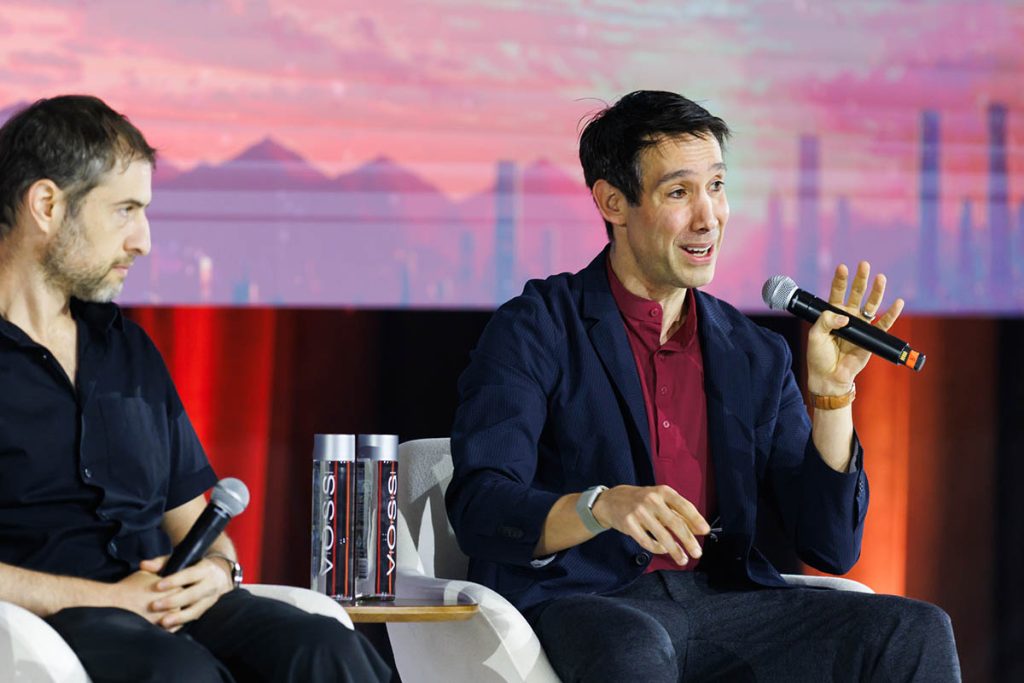
“There should be a lot we know about the present,” Omri said. “But I know less about the future.”
Twenty-one, and still not bored
I turned the conversation to our theme, “21: A New Beginning” because Agoda, like WiT, is similar vintage. In our documentary, Online Travel in Asia: The Unwritten Story, Morgenshtern had said that at 21 the world felt like a puzzle waiting to be solved.
I asked him, has that feeling changed and what’s the puzzle now?
He referenced a point made by a speaker who had stated we are living in an age of information abundance. “So there should be a lot we know about the present,” he said. “But I know less about the future.”
I turned to Idan, asking, “What were you doing at 21?”
“I was just finishing my bachelor’s degree,” he said. “I felt like I had spent 15 years training my brain, which is what we all do in school, and I wanted to create something. I really, really needed to build something.”
What surprised him, pleasantly, is that the feeling never left. “I still wake up with it. All these years, I could say I built this and that. But it doesn’t get boring.”
And he added, “My fear in life was never am I going to fail or am I going to win. My biggest fear is that I’m going to be bored. Since I was little, that was my biggest thing. My mother couldn’t stop hearing about it.
“So the fact that we live in such interesting times,” he said, “that’s the biggest blessing.”
Surrender to Poseidon, or find the T?
With Morgenshtern a fan of Greek mythology, I turned the interview to the movie, The Odyssey, where there is a moment where Odysseus, trying to get home to Ithaca, is told he must surrender himself to Poseidon. Stop trying to control the elements. Let go.
It felt like what he had said to me at WiT Japan earlier this year about optimisers: that this moment demands leaps that feel unintuitive to people like them. Does it feel like the start of an odyssey?
His answer came back to relentlessness: you don’t know exactly where you’ll land, but you keep moving towards it.
Idan then reached for something he admits he almost never does. “I’ll use a sport analogy. That never happens,” he laughed. “I play a little squash. To be good at squash, you have to do two things. You have to be very fast. And you have to position yourself in a good place on the court. If you corner yourself and the ball goes to the other side, you’re not going to make it, no matter how fast you are.”
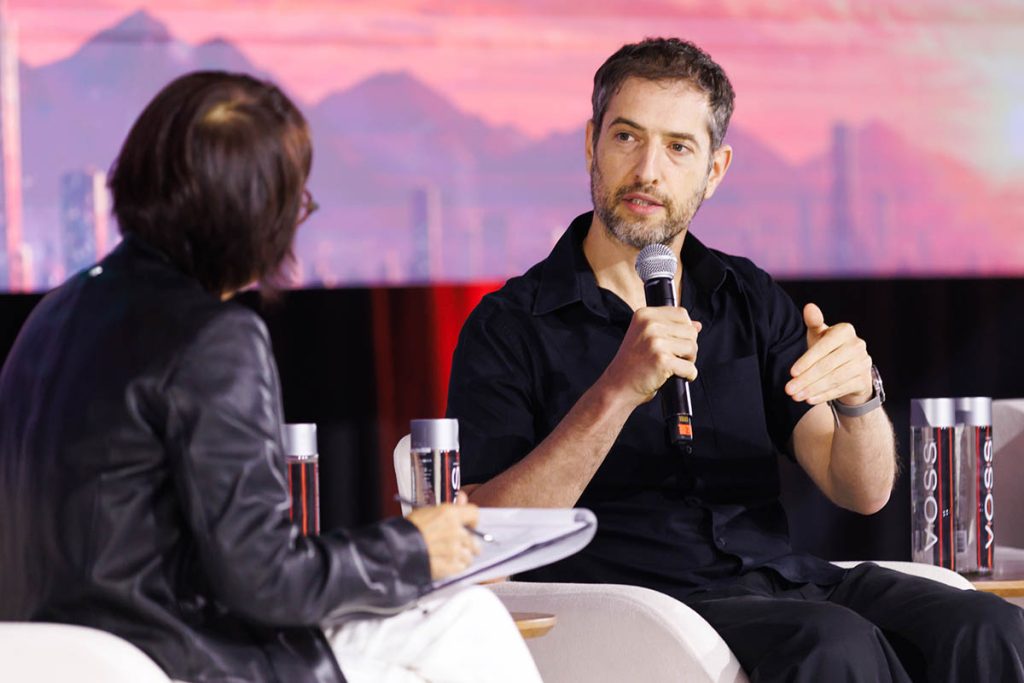
“It’s always exciting to see that innovation spirit,” said Idan. “The creator mindset. I see a problem, I want to fix it. That’s the core drive.”
That, he said, is how Agoda builds today. “We’re not trying to guess exactly what it’s going to be and build for that, otherwise the world ends. We ask: what gives us the underlying technology, the underlying platform, so that whether the ball goes a little to the left or a little to the right, we can hit it?”
Right now, centre court means AI. Will agents come to your platform? Will people use an agent on your platform? Will you advertise on someone else’s?
With all those options open, he said, you have to be “extremely AI-friendly”. That means moving away from fixed, basic APIs “that can’t really do much” and being able to talk to your own services in natural language. It means reading a customer’s needs in a deeper, more personalised way. “Eventually they might come from an agent, they might come from a user, they might come who knows where. But you’ll be ready if you have that centre-of-the-court technology.”
That sounds though like a luxury only someone your size can afford, I said, a small player can’t defend every corner of the court.
Fair, they conceded. But small players can take risks that big ones can’t, and that’s the interesting thing about startups. The analogy stretches both ways: big players have the resources to hold the centre, startups have the freedom to dive.
Opening all the windows
So what new thing, I asked, has excited them lately, in travel or out of it?
Idan’s answer revealed the physicist in him. “What really excites me is how AI is helping science now. We see it in maths, we see it in physics. Physics has been stalling for a long while. As a physicist, it’s kind of upsetting. We haven’t done anything really big in the last, whatever, 70 years.”
On a more practical level, he pointed to a flurry of new developments in just the previous fortnight. “If AI opened a lot of new doors, this is opening all the windows. There’s going to be an even bigger rush of ideas, startups and solutions.”
Travel deserves its own agent
The conversation of course then turned to agents such as Instinct and Muse, and how these general agents would affect travel. Instinct’s founder Noah Shinn has famously gone on record to say it has had $1b of transactions, half of which was travel.
I asked the two leaders how they think about these personal agents – does travel just become one more errand for the all-purpose agent, I asked? How did they see the future – a world of general agents, or one of specialized travel agents with travellers having a swarm of branded agents, or how about one that’s developed collaboratively by the industry to fend off the horizontal agents?
Well, I believe they shot down the third option pretty quickly. One thing they are clear is that travel deserves its own agent.
Said Idan. “These personal, general agents are great, and there’s a lot of day-to-day stuff they can help with. But we all know here how complex travel is in its own right. It’s a problem that deserves its own solutions.”
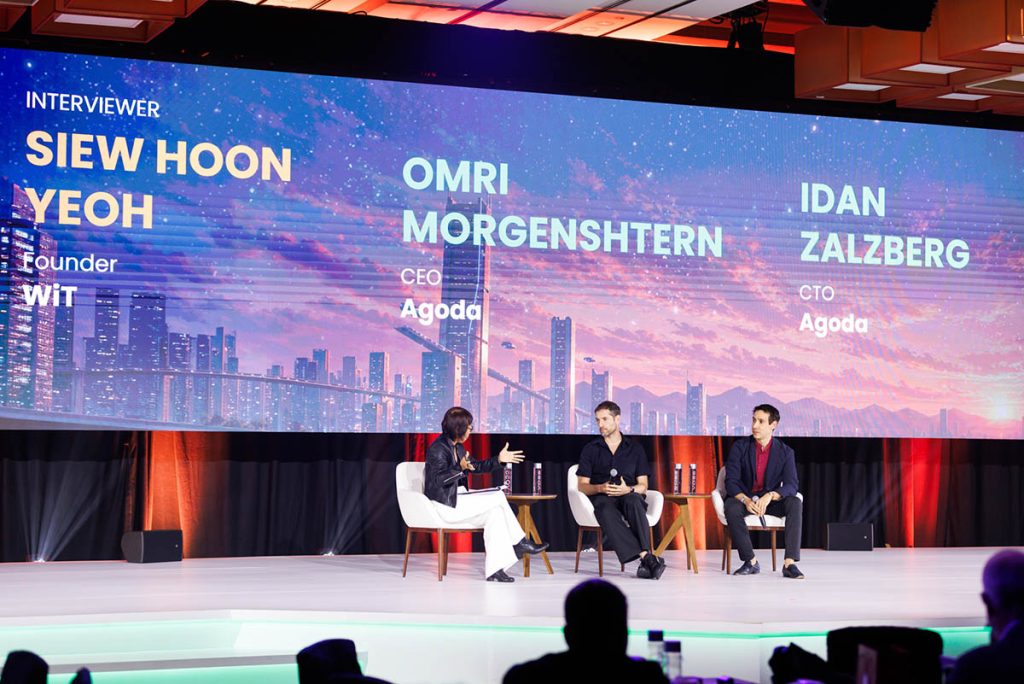
I shared my own experience with one of these personal AI agents, where I felt it had crossed the line between useful to annoying when it wanted to organize my schedules and meetings without me asking. I felt it hadn’t earned that right yet, and that’s context only humans could appreciate.
Idan nodded, saying, “When you come to me to talk travel, I’m not going to say, oh by the way, do you want to buy a new gadget? If you work with an actual human travel agent, you appreciate that that’s the interaction you have. It’s not also your therapist sometimes.”
Specialised agents, they argued, make more sense in the long run, both for focus and for managing the relationship.
Then there’s the matter of approach. Some of the new agents have gone for a pushy, simple interface: hand over your credit card and let it book your flights. “We saw cases where it sometimes makes mistakes. We want a much more careful opening.”
The reason is scale. “When you do millions of transactions, even if you make a mistake one in a million times, those are still actual people who get impacted. We have to think about those numbers when we build things. So we build very carefully. Trust first, and visibility after.”
In travel, the transaction is big and so is the trust required. You go carefully, they said.
And travel, we agreed, is a visual experience. How you carry that into a text-first, conversational world is a problem Agoda is still working through.
Complexity for breakfast
My last question went back to something Etraveli Group CEO Mathias Hedlund had said on stage, with reference to Omri taking on the new role of running B2B for the Booking Holdings Group. He had said that velocity was Agoda’s superpower: small teams moving fast, doing their thing without much interference from headquarters, and distinct from other brands in the group.
The new role requires stitching everything together and working with different brands. How do you keep the velocity while managing all that complexity? Is that the biggest challenge, I asked.
Their reply: “Complexity and velocity is what we eat for breakfast. That’s everything we do. You cannot separate us from it.”
Added Idan, “Look at what we do today. All these pricing options, different products, different languages, different regulations. That’s what we did for the last 20 years. We built a machine that can handle all of that, with an exponential number of cases. So when you add B2B, it’s just adding to the pile we already have.
“We like that complexity. When we do something hard, we feel we’re not doing something anybody can do. If we win there, we actually did something. If we do something easy, what’s the point? Anyone can do it.”
So you thrive on complexity, I said. Yes, came the answer. Omri admitted he took on the role precisely because it was the hard one.
The ball could come from anywhere
We opened WiT this year with 10 questions about what a new beginning in travel looks like. I closed our coffee chat by handing them to the two Agoda leaders.
Their answers:
- Is it Asia’s time to lead? Asia has a chance (Omri)
- What does a new beginning look like? Empty page (Idan)
- What does a new beginning look like in the age of Agentic AI? Terrifying and seducing (Omri)
- Is the OTA model, as we know it, over or is it the beginning of a new chapter? Both (Idan)
- Can tech make travel more human? Very little difference between tech and human (Omri)
- Who owns the traveller’s data? The traveller (Idan)
- Will travellers pay a premium for the undigitized? I hope so (Omri)
- How do we build for the traveller of 2035? We build for tomorrow and continue … (Idan)
- What’s the new social contract between tourism and places/communities? Human senses (Omri)
- Where will growth come from? Asia (Idan)
At the beginning of our interview, Omri confessed: he knows less about the future than he ever has. What struck me is that neither he nor Idan seemed troubled by it. What they care about is being in the right position when the ball comes – miss that and you get squashed (pardon the pun).