
India, China and Indonesia have the most digitally dependent travellers, according to a recently-released “Digital Traveller” report by Travelport.
The research, which identified trends and insights into how travellers use digital tools differently around the world, and what providers can do to serve evolving needs, covered roughly 11,000 respondents across 19 countries – including Australia, Japan, Indonesia, India and China.
APAC dominated the top three spots in a global ranking of the most to least digitally dependent traveller, with India at number one, followed by China and Indonesia.
Yet, digital habits are definitely far more commonplace globally and have a different role to play at each phase of travel, according to findings based on four main areas – planning, booking, the in-journey experience and in-destination.
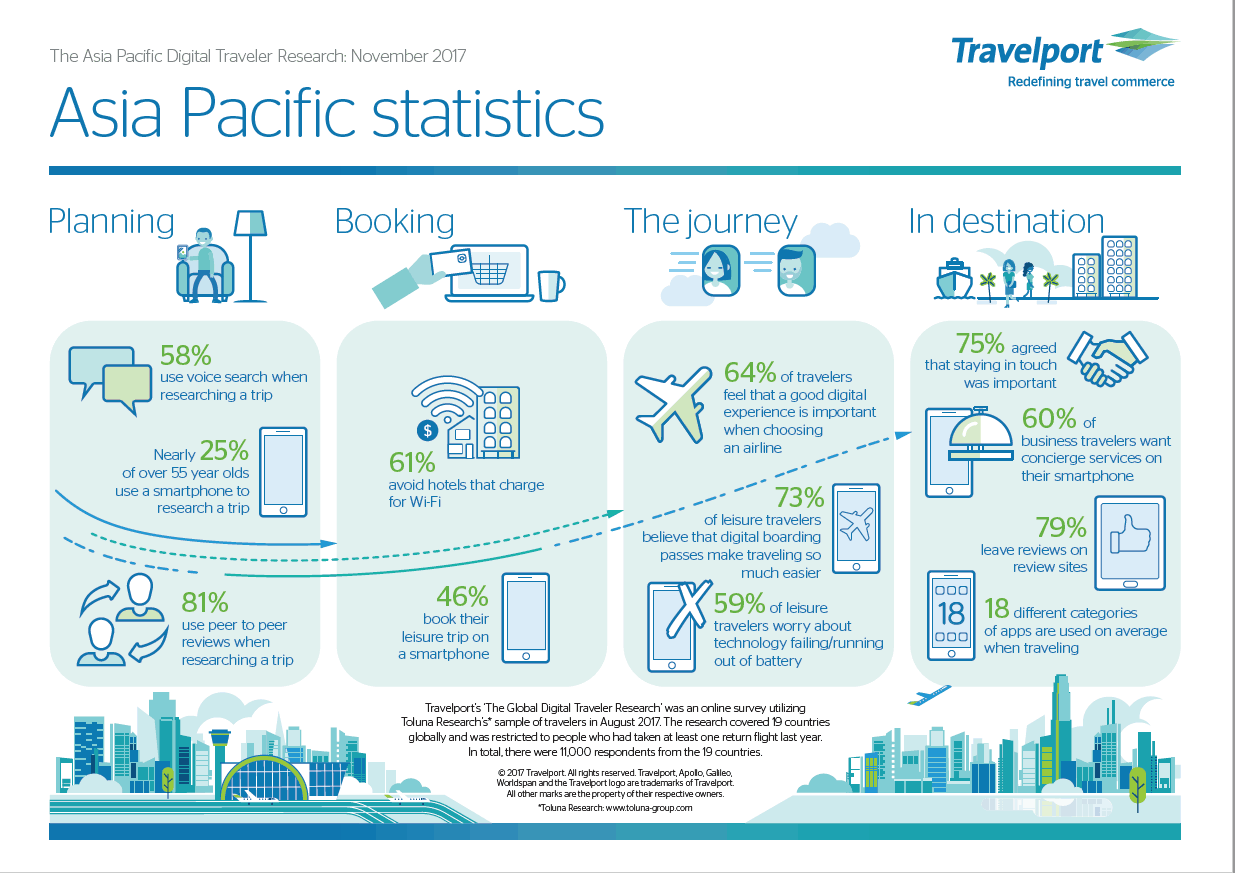
Results indicated that voice is on the rise in travel planning, with 47% of respondents globally reported using voice search when researching a trip. APAC ranked significantly higher at 58%.
Mark Meehan (managing director, Travelport APAC) commented that this finding is not indicative of a wave of adoption or revolution in voice technology. More simply, it reflects how voice search is becoming far more commonplace generally speaking.
However, as voice becomes increasingly ubiquitous, providers must prioritise “speed and relevance”. The quicker a provider can give relevant information into the hands of the consumer, the more likely they are to take action. “That’s when a look becomes a book”, said Meehan.

Mark Meehan, Managing Director, Travelport APAC
In APAC, it was found that 80% still prefer to consult travel professionals when planning a trip. It demonstrates that there is still a reliance and value in seeking out specialised expertise through a travel community. Nevertheless, APAC is at the forefront of online travel and “it is critical that travel professionals, irrespective of channel, embrace this” and develop their digital strategies as well.
When it comes to booking, internet connectivity is a major factor affecting how travellers choose their travel options. For example, the majority of respondents stated they would consciously avoid hotels that do not offer free WiFi (61% in APAC).
“[Internet connectivity] in this day and age is essentially akin to having hot and cold water,” said Meehan.
In the realm of corporate travel bookings in APAC, unsurprisingly, 35% of business travellers use mobile, but 53% identify complicated Terms & Conditions as a common pain point. 39% said they didn’t understand what is included in travel packages (e.g. luggage, meal choice) and 36% said they’d like to speak to someone about clarifying common ambiguities. APAC has the highest level of global dissatisfaction in the space, indicating a pressing need for better service and support from providers.
Meehan says that Travelport’s clients are now developing FAQ chatbots to tackle these requests. Furthermore, they aim to integrate travel advice into the point of sale, to make expertise available and relevant at the time of conversion.
During the journey, globally 60% felt a good digital experience of an airline is important (e.g. quality of their website or app, mobile bookings, notifications, online check-in etc.). In APAC, this was important to 64%, reflecting perhaps the greater prioritisation of digital features. Mobile is especially critical, as Travelport anticipates that at least 70% of its bookings will originate in a mobile device by 2020.
Nevertheless, “it isn’t just about the booking experience,” said Damian Hickey (VP, Travelport APAC). In the last few months, Travelport launched what is known as Travelport Fusion across all carriers, which provides not only the core booking functionality but also “end-to-end, from pre-planning to destination arrival” services.
It also launched Travelport Resolve this year, to handle irregular operations and travel disruptions. It allows travellers to use their mobile to “self serve” after they receive their new itinerary e.g. booking overnight accommodation, if necessary.
Airlines can then advise and alert passengers when there are disruptions and make procedures as clear as possible through a mobile device, helping to reduce stress levels and increase customer service levels dramatically.
“You can do that through a mobile platform, integrating with the backend capability we have at Travelport.”
Staying consistent with the desire for end-to-end digital travel tools, 52% of business travellers want concierge services on their smartphone, with a priority on staying in touch.
The report found that on average, travellers use 16 different categories of apps when travelling (18 in APAC, and 20 in China alone) to get all their information and needs via mobile.
In response, Travelport developed Travelport Marketplace “which is an open platform which allows developers to create and market apps directly to travel agents,” said Meehan.
“The sort of apps that would have much more usage for when a person would reach their destination… no surprise, weather apps and foreign exchange apps” are often considered most important.
Ultimately, the study concludes, brands that are winning in digital travel are those that offer a seamless, mobile-first experience. Providers that can strategically plot out contact points and remain engaged with the customer at the most critical times will undoubtedly take the lead.
“We need to recognise that shift from transaction to engagement, about adding and creating value at every touch point in that engagement for our customers and for the traveller,” advised Meehan.
“Mobile provides those micro-moments throughout the entire trip lifecycle… [presenting] opportunities to engage, deliver experiences and deliver value to the customer. Critically, that builds loyalty, but the quality of that engagement is critical to the brand because the first impression of the brand is likely to be the last,” he concluded.
Image credit: iStock