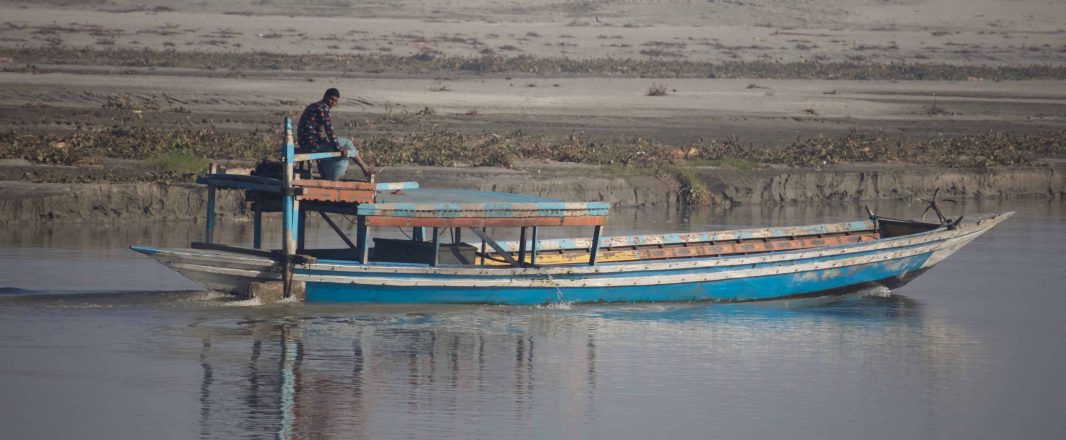
The final leg of our Assam Tea & Wildlife Adventure takes us on a five-hour drive to the city of Guwahati where we board a river boat, our home for the next two nights. On this cruise on the Brahmaputra, I learn about time, silk and breathing in the moments.
On our way out of Kaziranga Wildlife Park, we spot a rhinoceros in a field by the road. It’s clearly strayed out of the buffer zone. We were told that this year, five elephants have been killed on the roads.
In this part of Assam, not only dogs, cows and goats share the roads but also animals from the nature reserve. A sign says “Animal Corridor” and drivers are reminded to drive carefully and be mindful. But like the sign that says “Horn Prohibited, Silence Zone”, they are blissfully ignored.
We have more than 200kms to cover to get to Guwahati, the largest city in Assam, where we will board a boat to spend our last two nights, cruising and sleeping on the Brahmaputra.
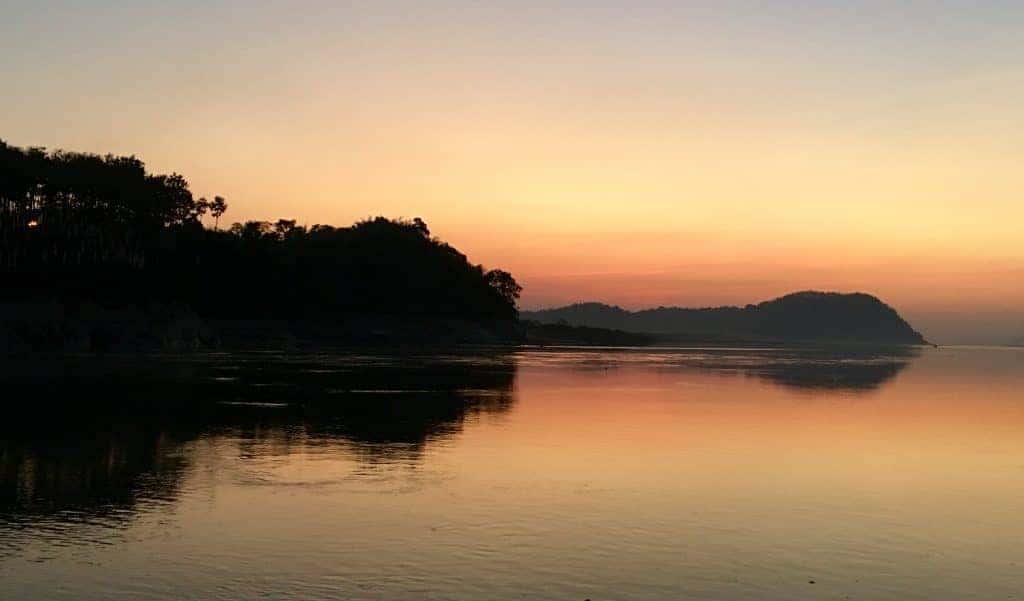
Sunset on the Brahmaputra
This is one of the better roads in Assam, it’s part of the planned pan-Asian highway that will link India (from Delhi) with Bhutan, Myanmar and onto China and there’s lots of building work going on.
When I asked Prakash, our guide, how long the road will take to complete, he said, “It will take time.”
Driving in India takes time. On this trip, we’ve crossed stretches of roads that have more potholes than paved parts. There are also no rules – none that are obvious to us in any case – but somehow it all seems to work. Cows and goats sitting in the middle of the road? Just go around them. Most importantly, honk. Not that the cows care but it’s just the thing to do.
It takes us nearly five hours to get to Guwahati. On the outskirts, big billboards advertise services from education to medical (cancer and diabetes seem to be the big two concerns here) and astrology.
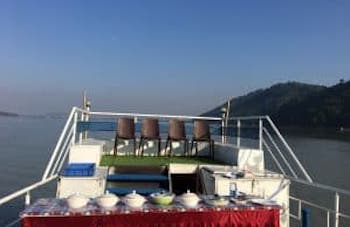
A great spot from which to watch the scenery
Assam is one of the less developed states in India but you can see rising affluence and growing consumerism in its cities and that brings with it the modern ills of urbanization.
Behind the orderliness and tranquility of the tea plantation landscapes, there’s also a battle for better working conditions. On one of the days we were in Assam, a general strike was called by tea workers and we had to delay our departure to avoid protests on the road.
Guwahati, the largest city in Assam with a population of over a million, is polluted and dusty. A constant haze hangs in the air. It’s not a city made for lingering and so we headed straight to the port to board our waiting vessel.
Our boat, MS SB Argam Assam 751, is operated by Alfresco Grand which also runs regular dinner cruises on its bigger vessels. It has a sun deck and a parlour on the top deck and three cabins below. We are introduced to the crew of eight men who will be looking after us, from the captain to the chef, engineer and service staff.
They’ve got lunch ready for us on deck. Food on this trip has been good and the meals on this cruise are no exception. We’ve had nothing but Indian food for the last 10 days and we’re all quite happy.
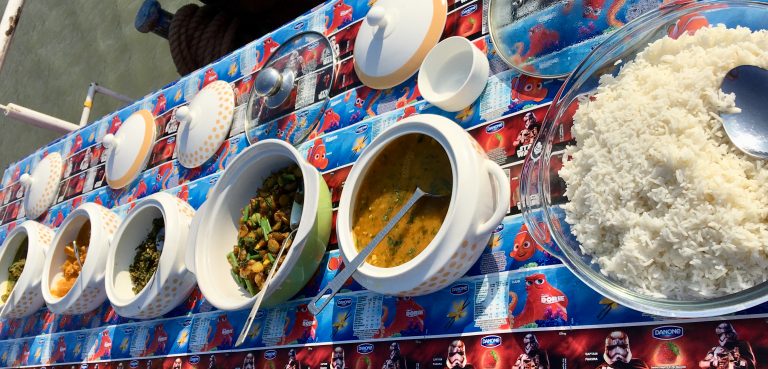
Assamese food is flavoured with lots of spices.
Assamese food is flavoured with lots of spices, the vegetables are varied and fresh, and they love their fish – little fish that are either fried or boiled or cooked in curry. Chicken is the main meat staple here and there’s nothing better than a chicken masala to finish off a day of travelling.
For Melinda, a vegetarian from America and in India for the first time, it’s been a discovery. “I never knew vegetarian food could be so flavourful and varied,” she says, as she tucks into rice, bread and curries with gusto. “I will never look at food the same way again.”
Dhall and roti is a daily staple and the luchi aloo that was served for our last breakfast onboard was easily the culinary highlight, leading me to conclude that after I return to Singapore life will be dull without dhall indeed.
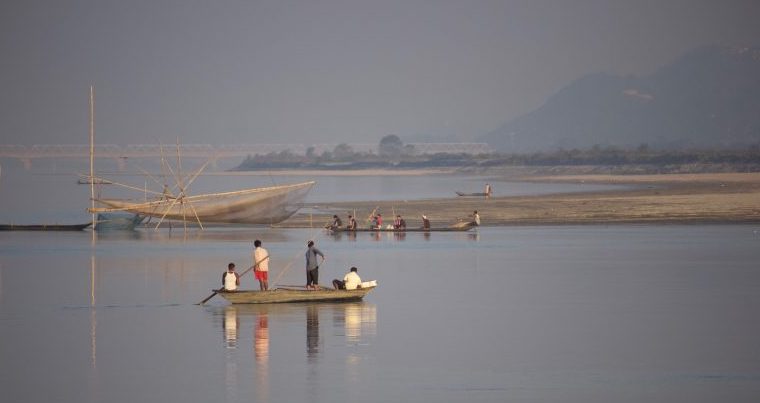
Fishermen on their bhut bhuti out for their daily catch
The Brahmaputra is not only India’s longest river but also the most significant and important. With its source in Tibet near Mount Kailash, it begins as the Yarlung Tsangpo, crosses through Lhasa and carves its way between two mountain ranges to enter Assam, and then joins the Ganges before they both fan out into the Bay of Bengal.
Cruising on the Bhramaputra is tranquil. Villagers and fishermen go about their daily lives. The silence is punctuated by the sound of the bhut bhuti (motorised boats). One evening, we spot a pod of dolphins and there’s excitement among the crew as well. It’s a rare sighting clearly.
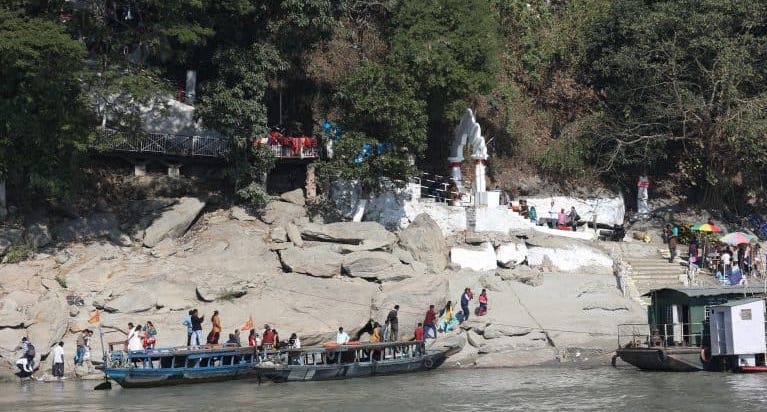
Boatloads of devotees visit a local temple on a Sunday
We were offered two shore excursions, one to the Pobitora Wildlife Sanctuary and the other to the silk weaving village of Sualkuchi. We opted for the latter. We couldn’t imagine anything else topping Kaziranga and yes, we wanted to do some Christmas shopping for local silk.
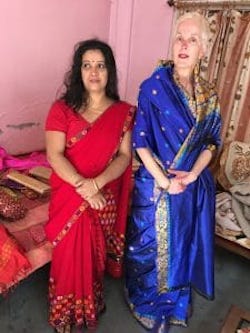
Melinda, right, trying out an Assamese silk saree
As our motorised tricycles weave their way through dusty roads, local villagers emerge to look at us with curiosity.
Assamese silk is regarded as among the finest in India and when you see the weavers at work, you understand why. The work is laborious and pains-taking. I will now look at woven silk the same way I drink tea after this trip – new-found appreciation and respect for the people who dedicate their lives to these crafts.
Each evening, we dock by a dry river bed and we breathe in deeply as another Assamese sunset unfolds gently before us. Meanwhile, the crew is busily preparing our campfire and barbeque.
Sipping Sula red wine, made in western India from grapes grown in Nashik region, and chicken tikka and pokara, by the fire, in the cool of the evening and with the clear night sky above us, you can’t help but reflect on the mysteries and meaning of life. It’s like we are in the middle of nowhere, yet we are in a teeming, developing country of more than one billion people.
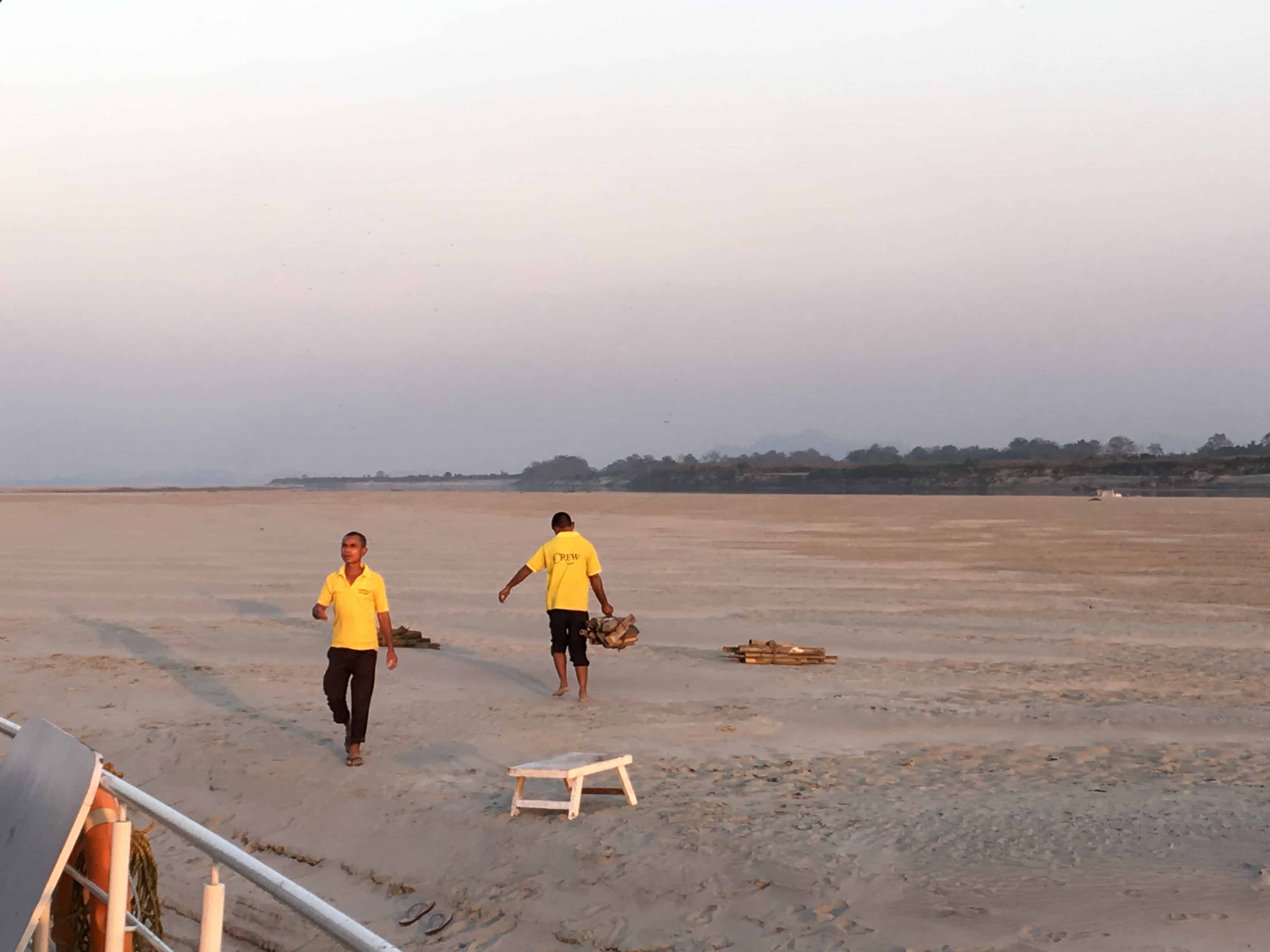
Getting set up for our evening cocktails and barbeque
In his book, “When Breath Becomes Air”, the late Paul Kalanathi quotes a friend who says, “There is a moment, a cusp, when the sum of gathered experiences is worn down by the details of the living. We are never so wise as when we live in this moment.”
It’s taken us 10 days of travel to get to this point – a journey that’s taken us from tea estates to river islands and nature reserves. Uttara Sarkar Crees, my tour operator friend from Shangri-La, China, who’s designed this holiday for us, has clearly saved the best for last.
This moment on the river bed on the Bhramaputra will remain in me until my breath becomes air.
Note: This concludes the four-part series of my Assam Tea & Wildlife Adventure. Here’s to the next trip
Part 1: Of tea, monsoons and learning to be a guest
Part 2: Breakfast with the birds, lunch with monks and dinner around the fire
Part 3: Creatures great and small, and sunsets to make you weep in Kaziranga