From tea estates, this second part of my travel through Assam takes me to Majuli Island, the world’s largest inhabited river island, and home to rich birdlife and devout monks who express their faith through art and dance. It was also there I met a hotelier of a different sort.
The Dekasang Resort in Majuli Island is built to look like a buffalo’s head. This is because the owner, Kaushile Nath, built the resort as a tribute to his grandfather who had a buffalo farm when he was growing up, only to lose them all when the family was forced to move to Bangladesh.
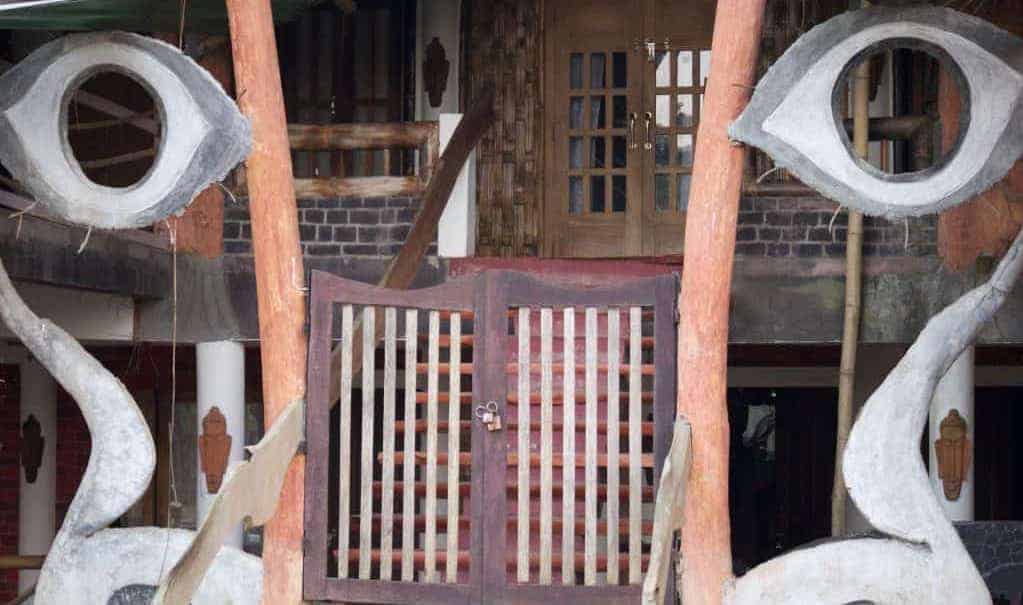
Dekasang and its homage to the buffalo
Before he turned hotelier, Kaushile was managing director of Praz News, an Assamese TV channel in Guwahati and “the highway was my home”, as he travelled the world. After suffering two cerebral strokes, and seeing a friend and business partner, a medical doctor, die prematurely, he decided that “I should change my life or die like this”.
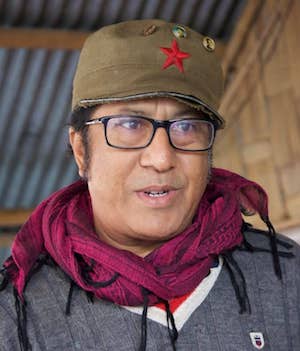
Kaushile: “Nothing is permanent. I satisfy my soul in the service industry.”
“The bigger you get, the harder it is. Nothing is permanent. I satisfy my soul in the service industry,” he told us over a luchi and dhall breakfast one morning.
He chose Majuli, the world’s largest inhabited river island with a population of 160,000, for his first resort five years ago and he aims to have a total of five resorts in Assam. He plays convivial host, chatting with guests, making sure we enjoy our stay and gets involved in everything, from taking orders for meals, organising campfires for dinners and ensuring things work in the resort. He wears a Maoist hat proudly proclaiming his social leanings.
It’s clearly a challenge running a resort in a remote place such as Majuli– electricity is temperamental, so hot water is a hit-and-miss affair. Temperatures plunge as soon as the sun sets in these parts. I re-discovered the joys of cold showers – most invigorating in the mornings before you set off for the day’s adventures. There’s no WiFi or television, rooms are basic, short on frills, the bed and pillows are hard, they clearly lack a woman’s touch but hey, this is the outback of India and the service from Kaushile and his team of eight boys who do everything between them – cook, carry bags, collect wood, clean rooms – is from the heart.
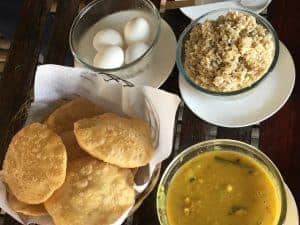
Breakfast of luchi and dhall at Dekasang
My American friend describes Kaushile as “the Citizen M of his generation”.
It is its remoteness that is attractive. Dekasang means “a community for youths” and Kaushile clearly wants this to be a gathering of like-minded souls who want to escape the stresses of urban life, like he has, and gather around the campfire to tell stories and sing songs. One evening, we heard an Indian family singing around the campfire and as their sweet voices rang out in the dark, with only the moon and stars for illumination, it felt like we had been transported to another place in time.
Indian domestic travellers make up the majority of the guests, indeed, we felt like we were the only foreign visitors on the island.
Getting there is an adventure in itself. The drive from Jorhat to the ferry terminal where we will take the car ferry over to the island is bumpy and noisy. By now, we’ve gotten used to the honking and five vehicles coming at you at once, and we’ve become familiar with our driver and guide, Prakash. At the point where we are supposed to board the ferry – it would be stretching it to call it a terminal – it’s total chaos as cars, bikes and humans get in line to board. There doesn’t seem to be a system – there’s lots of shouting and shaking of heads – but somehow it seems to make sense to everyone else but us.
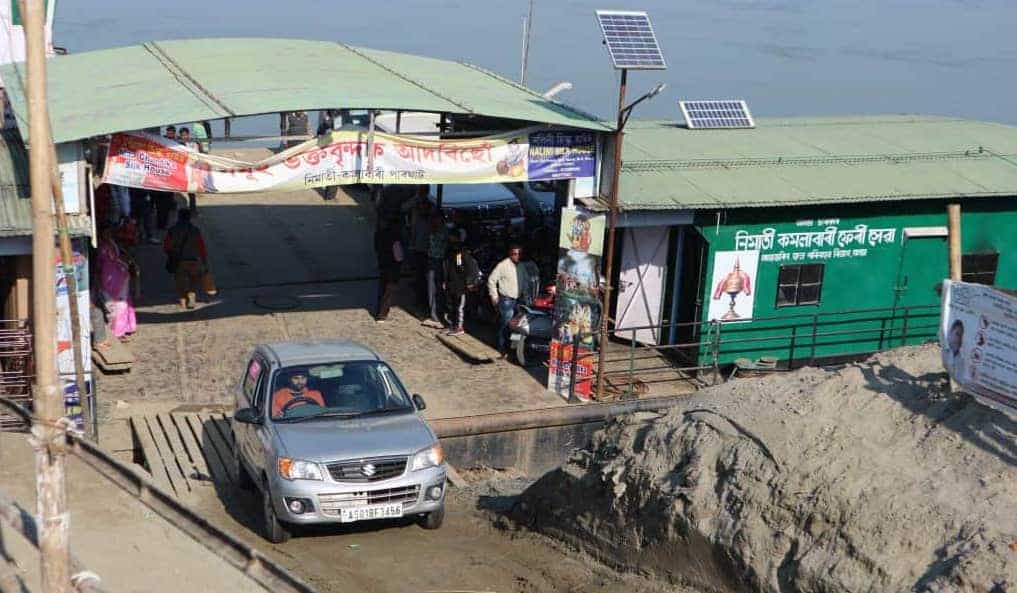
The ferry “terminal” to go to Majuli Island
We got out of the car to watch the disembarkation – the gradient from ferry to river bank to road is steep. I watch as a car gets stuck in the mud, its wheels grinding in protest, and everyone chips in to help and push the car up onto the road. We are not allowed to sit in the car during the one-hour ride, and so we take our seats in the packed cabin. It’s a Sunday and it seems all of Assam is on the move, along with their pots and pans.
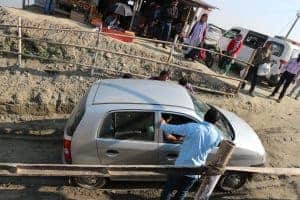
Heave-ho as a car gets stuck and people chip in to help.
The only seats we could find were by the engine room which looked like something out of the Industrial Revolution. There’s a kitchen for the crew to cook their meals over a wood fire. The best spot though is outside on deck where you watch the mighty Brahmaputra, India’s longest river, flow and experience the life that revolves around it in Mother India. Fishing boats and car ferries constantly criss-cross the river. There’s some excitement on deck because someone has spotted a pod of Ganges dolphins. I only saw the ripples that day, dolphin-sighting was for another day.
There’s a bucket on deck which the crew fills with water to wash their plates and clean their mouths. A young man, watched by his mother, throws his water bottle into the river. There’s clearly a long way to go to stop people from littering in these parts. Litter is everywhere and is piled up in heaps by the roadside. Uttara Sarkar Crees, my friend whose family hails from Kolkata but now lives in Yunnan, China, cannot help but comment on why India has not made the same strides in anti-littering as China has.
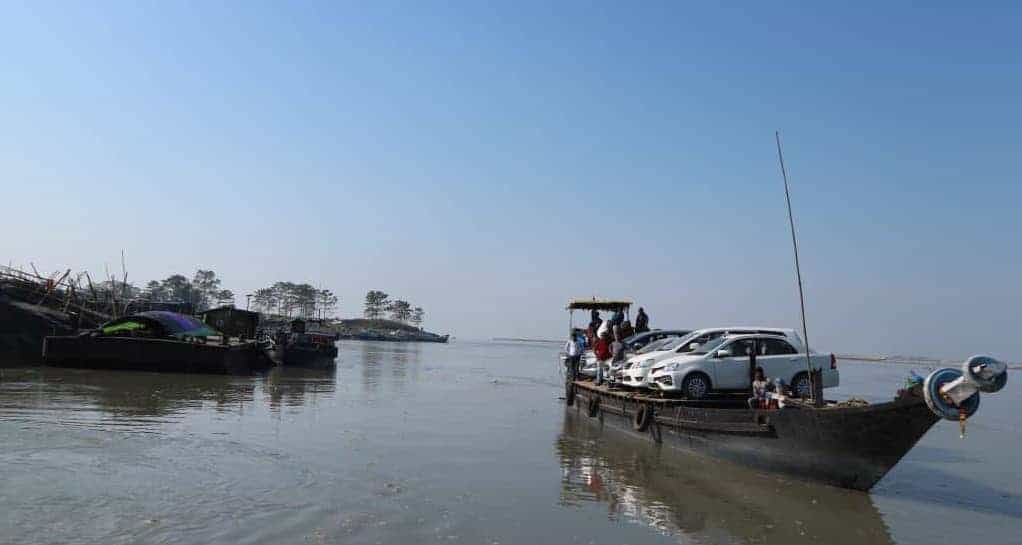
The Brahmaputra River, around which life revolves
There’s an equally mad scramble to get off the ferry and into their respective cars. But first a drive across the dry river bed which sends clouds of dust up in the air. During the summer monsoon, this stretch of river is filled with water. In dry season, it becomes a very dusty road.
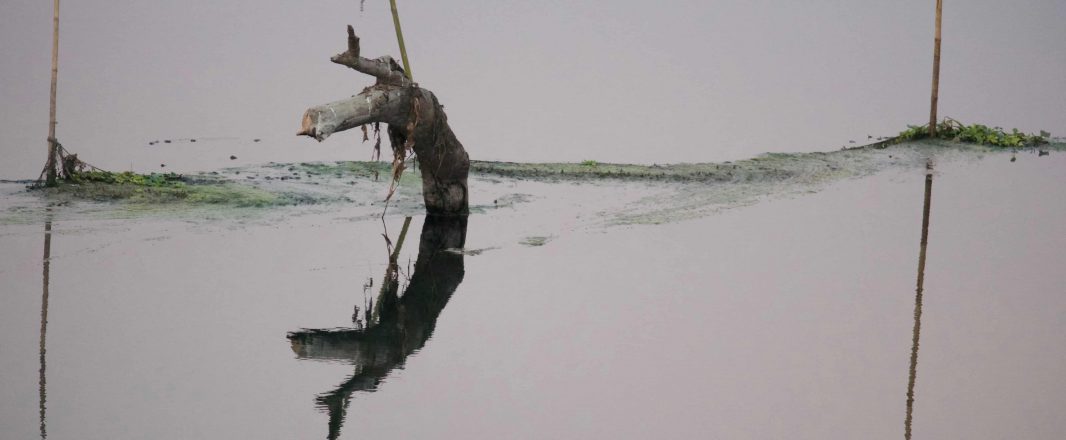
Arriving at Dekasang Resort after this journey is reward indeed. It’s a beautiful setting, Kaushile could not have picked a better location for peace and tranquility. Situated on the banks of the Lohit River, a tributary of the Brahmaputra, the area is teeming with bird life and an early morning walk in the mist to watch birds and fishermen at work is a good way to start the day.
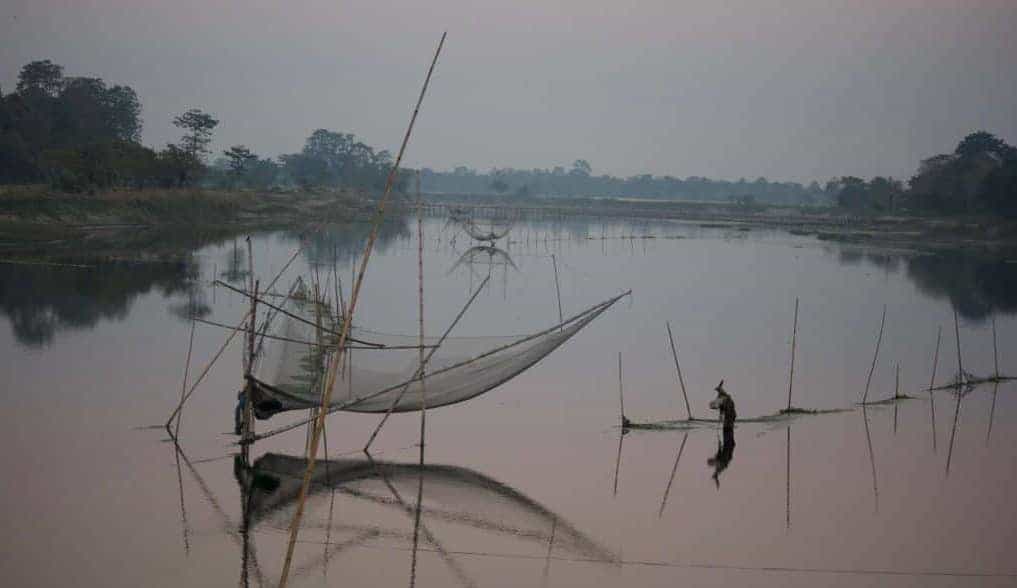
A walk by the Lohit River is a great way to start the day.
It is also a great spot from which to explore Majuli Island. Shortlisted for World Heritage Site-Culture status, it is known for its satras (monasteries) where devouts express their faith through the arts, be it singing the scriptures, dancing or mask-making for performances.
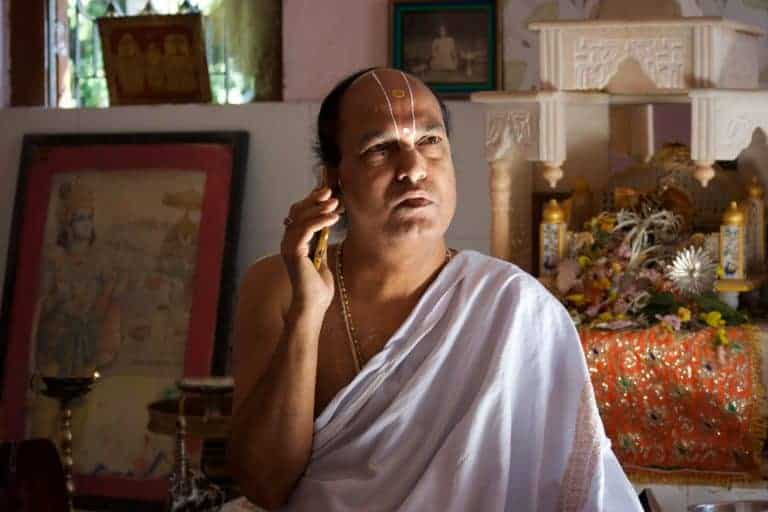
The Auniati Satra guru taking a phone call during our audience with him.
Our first stop is the Auniati Satra where Natuli, the designated bhakat (monk), shows us around. Born to a family of eight (three boys), he was sent to the monastery when he was six.. His eyes have an intensity and clarity to them that clearly comes from 37 years of a devout, celibate life.
That doesn’t mean no modern trappings though. During our audience with the guru, a very young-looking 59-year-old, he receives a call on his mobile and has an animated conversation, before continuing to tell us that the numbers of boys coming into the satras are dwindling. Families are getting smaller, so fewer boys to spare, and modern-day distractions and temptations are getting in the way.
At the next satra, Uttar Kalambari, we are treated to a Gayan Bayan dance performance with drums (kohl) and cymbals (bortal) which is as hypnotic as it is rhythmic. It almost feels like the men are in a trance as they go through the agile and graceful movements.
For lunch, we sit on the floor eating off banana leaves and bamboo plates. We are joined by a pussycat who is clearly after the fish and, in stealth mode, he picks one off our banana leaf plate. He is reprimanded and picked up by a young borkat who tells us he’s got two cats, three dogs and 11 cows living with five men.
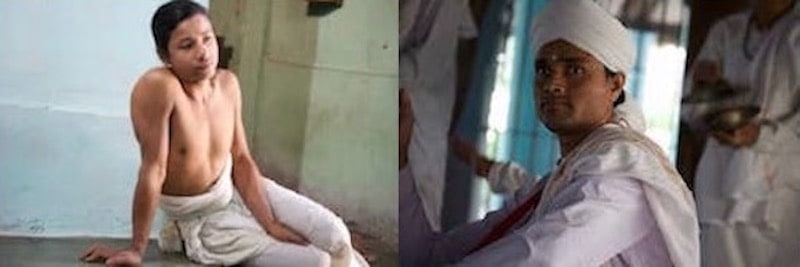
A young borkat watches us while we have our lunch in the satra (left) and the Gayan Bayan dance.
I love their ease with nature, animals and strangers, something we’ve lost in the urban world.
At the third satra in Samaguri Village, we learn about mask making from the chief who’s been creating these works of art for 50 years. His son, who’s studying for an MBA in European art studies, explains the five-stage procexs and animates each mask, making them come alive. A trained dancer, he is due to perform at a cultural festival in Delhi in the new year.
Outside, a group of young boys are taking lessons which are offered free to the three villages in the area.
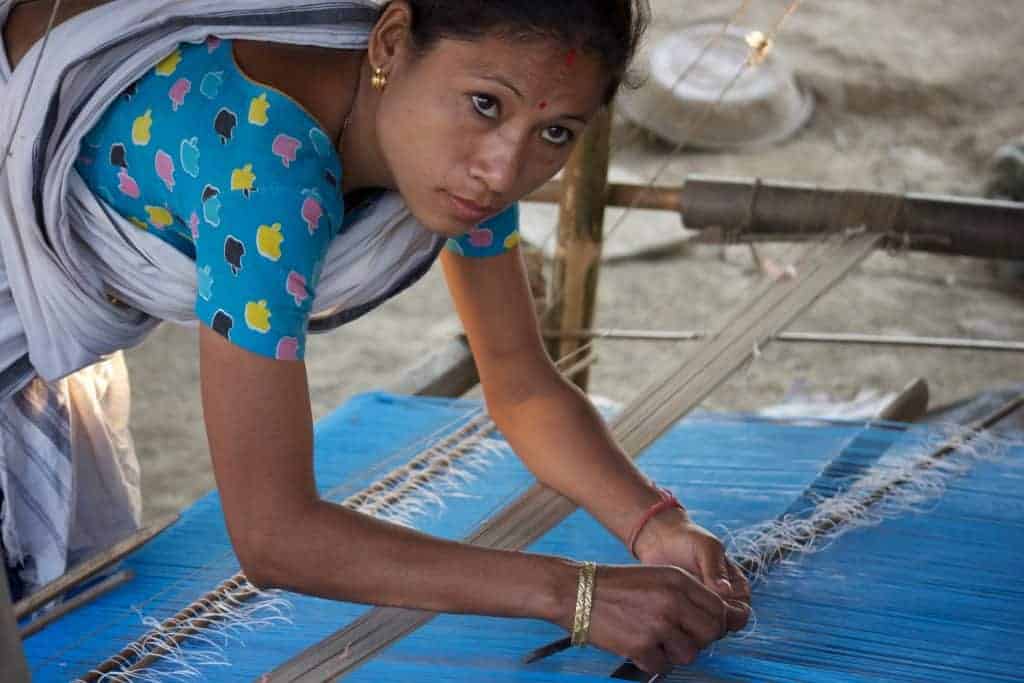
The Mishing tribe forms 60% of the population of Majuli Island.
Majuli Island is home to the Mishing tribe, who forms 60% of the population on the island. They lead simple, agricultural lives. At one village, two young women were weaving cotton vests for their husbands for an upcoming agricultural festival, with their children gathered around them.
Majuli Island prides itself on “no dengue, no malaria, no industry’. There’s little pollution, and the night skies are clear and lit with twinkling stars. It’s a perfect place to bring out the Star Chart app and learn about the galaxy above us. That, and eating freshly-fried pokara and drinking Sula Indian wine by the campfire and pinching ourselves occasionally to remind us how lucky we are as travellers to have found this little spot called Majuli on Mother Earth.
Part 3: Onto Kaziranga National Park & Tiger Reserve