In the news: Airlines and airports look to AI revolutionise baggage management; videos to facilitate searching and booking travel; an airline on quest to make customers happy
ARTIFICIAL INTELLIGENCE: Lost or delayed baggage a thing of the past with AI?

Using AI to revolutionise baggage management (Image credit: SITA)
One of the biggest nightmares of most travellers is to lose their luggage in transit. But artificial intelligence may come to the rescue and make mishandled baggage “an increasingly rare event for passengers globally” according to SITA in its recently released Intelligent Tracking: A Baggage Management Revolution paper.
The report states that the smart use of technologies, such as AI, is expected to revolutionise the management of baggage over the next decade, promising to make mishandled bags a thing of the past.
According to the SITA Baggage Report 2017, more than 4.5 billion bags are handled by industry baggage systems each year. Airlines, however, will have to cope with twice that number with passenger numbers set to double over the next 20 years.
In June, the International Air Transport Association’s (IATA) Resolution 753 will come into force, requiring member airlines to keep track of each bag and share that tracking information with all involved in delivering those bags back to passengers at their destination.
Ilya Gutlin, president of SITA Air Travel Solutions, said the industry’s immediate focus was on implementing Resolution 753, explaining that the data generated and collected could be enhanced with AI tools to create greater efficiencies in baggage operations.
The report states AI will allow airports and airlines to learn what baggage routes cause the most stress on their systems and what factors are most likely to cause them. These systems could also generate insight into the patterns of baggage movements that would enable airlines to deliver bags more effectively, the report stated.
With the use of AI, intelligent machines will also enable baggage to be autonomously managed from the moment a passenger checks in their bag to when it arrives at the destination – all without human intervention.
For example, autonomous loaders could be used to transport bags between the terminal and aircraft. Baggage data will also allow airlines and airports to provide passengers more relevant information on their baggage as it makes its journey from departure to destination.
Gutlin points out the digital transformation around baggage is already happening.
“It will take time but AI will unleash the potential to make baggage operations more service orientated. This means baggage delivery becomes more secure and enables airports and airlines to deliver tailored baggage services to their passengers.”
A vision of the future that many travellers will definitely look forward to.
Read the full SITA Intelligent Tracking report
TRAVEL TECHNOLOGY: Watch, search and book travel via interactive videos

Now travellers can watch videos and buy travel all in one place (Image credit: Tero Vesalainen/iStock- Getty Images)
Did you know that two-thirds of travellers watch videos when planning a holiday, and visit more than 38 websites to get ideas? A lot of work to plan a trip. To ease this process Amadeus has launched Amadeus Video Solutions, described as the “first interactive video player” that allows travellers to watch videos for travel and book trips, all in one place.”
The solution also enables travel brands, hotels, online travel agents and destination marketing organisations to engage more effectively with their customers.
This is how Amadeus Video Solutions work: It enables brands to embed clickable calls to action and live booking details about attractions, hotels, restaurants and other destination highlights in their videos. Travellers can click on the videos as they are playing to find information about the place they want to discover, including how to get there. When they find what they are looking for they just make the booking without having to search elsewhere.
It also partners with travel influencers around the world, like bloggers with large followings, to create original video content targeted specifically to audiences who are actively planning their next holiday.
“With content created by travel influencers, travel brands can ensure their campaigns reach the right audiences at the right time, with detailed analytics to measure the impact of their marketing efforts,” said Amadeus.
Originally launched as a prototype called TravelCast in 2017, the new solution is the result of two years testing by Amadeus’ Horizon 3 team based in Nice, France.
“Until now, there were plenty of interactive video players, but none specifically created for hotels, restaurants and other travel players. Amadeus Video Solutions is a direct answer to this problem which works in the interests of both the traveller and the industry as a whole,” said Steve Kopp, the head of Horizon 3 at Amadeus.
Lindner Hotels & Resorts in Germany is one of the brands displaying interactive videos created with the solution to reach new audiences. Its videos are displayed on ThatBackpacker.com and TravelDudes.com.
AVIATION: This airline wants to make ‘Customer Happiness’ its focus
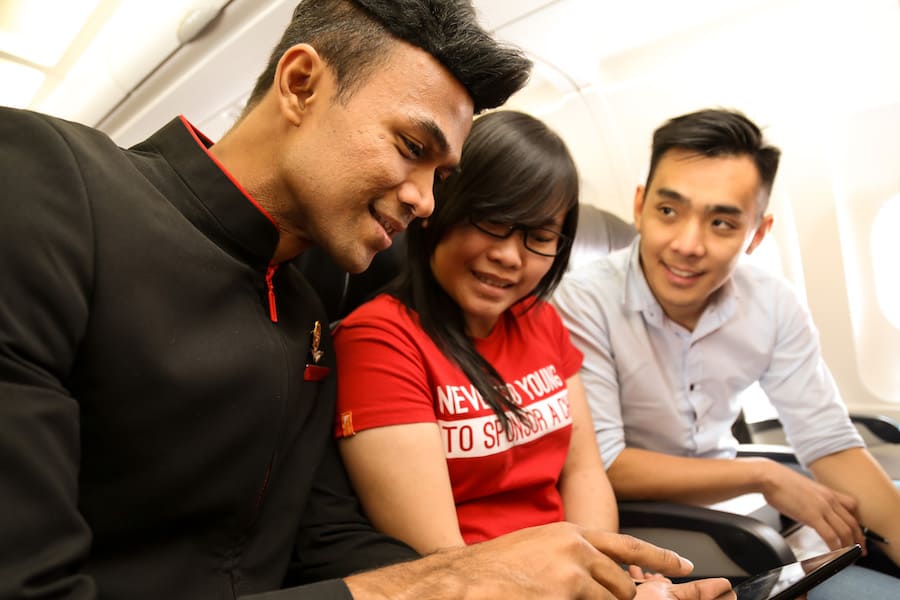
AirAsia’s focus is to make passengers happy (Image credit: AirAsia)
Low cost carrier AirAsia has enlisted New York listed Salesforce, a leading provider of customer relationship management (CRM) software, as its technology partner in the revamp of its customer care for the digital era.
On the choice of Salesforce, AirAsia group CEO Tony Fernandes said the company’s “customer-obsessed approach” gave the airline a complete view of its guests across all channels, allowing it to deliver a faster more personalised service.
“This is the year we focus on making our guests happy. This means placing customers and their needs at the centre of everything we do,” he added.
The airline has renamed its customer care team to ‘Customer Happiness’, and is deploying Salesforce Sales Cloud, Service Cloud, Marketing Cloud and Community Cloud to as part of its strategy to deliver more personalised service.
AirAsia said by utilising the CRM software its service agents across eight countries now have a single view of all cases from all support channels – web, phone, email, live chat, airport communications – and their complete history, allowing them to provide higher levels of personalised service.
The Salesforce Community Cloud powers the AirAsia support community in eight different languages – English, Bahasa Malaysia, Bahasa Indonesia, Thai, Vietnamese, Chinese (simplified and traditional), Japanese and Korean – and empowers guests to self-serve with a knowledge database.
Mark Innes, EVP and general manager of Salesforce Asia Pacific remarked that airlines need to be attuned to customers’ needs in today’s competitive landscape, and “AirAsia is a shining example of a customer-centric company constantly pushing the envelopes of innovation”.
• Featured image credit: alptraum/iStock-Getty Images