
Having built up Zanadu into China’s premier lifestyle travel platform after a tough but rewarding five years, Zan Wu, together with his co-founder, Dirk Eschenbacher, now wants to create a new startup, Atlas, into “the next generation TripAdvisor and Booking.com combined” using blockchain and crypto.

Zan Wu: “I felt I missed the Internet, I was too young. Then with the mobile Internet, I wasn’t experienced enough. Now is the moment, I have 5 years’ experience, I am 36, it’s my time.”
As Wu sees it, the big opportunity in travel is to bring together content, transactions and user data. “But the big players have taken most of those three buckets, the window of opportunity is gone and you can’t create a TripAdvisor or Booking.com or Ctrip by doing something similar. You have to be fundamentally different.”
To be different means using blockchain technology that links buyer and seller directly by disintermediating the traditional middle man and creating tokenised economies in which every stakeholder, including content creators, benefits.
Atlas, which will be launched in Singapore since there is no mandate in China yet for crypto businesses, will connect hotels and restaurants, with content, directly with customers in a tokenized economy.
Wu, who spent six years in Singapore in high school from age 14, is aware of the current skepticism surrounding blockchain and crypto projects. “There is a lot of hype around it and six months ago, it was anything goes. But attitudes are changing. Now you have traditional VCs like Sequoia getting into it. There are real teams coming out to do something. And people are looking at the fundamentals – team, execution and business case.
“I feel it is a good thing the market has calmed down and now that people are taking a more realistic view of things, we can weed out the bad projects that have given it a bad name.”
To build its platform, which will be developed in Shenzen and Hangzhou, Atlas is looking to raise US$20m by selling 35% of its Atlas token supply. Investors pay in Ethereum and “their outcome is the size of the token economy we will create”, said Wu.
Wu, who was in Singapore hosting an industry night at Straits Clan, said he’s already secured a few investors. “Who we raise the money from is more complicated and critical than just raising VC money. We want investors who can give us diversity and we will also open up to our ecosystem partners.”
Wu’s track record in having built up Zanadu into a profitable business stands him in good stead. Since founding in 2012, Zanadu has raised more than US$30m, from investors such as Tencent.

Zan Wu speaking at the Atlas event at the Straits Clan in Singapore: “Who we raise the money from is more complicated and critical than just raising VC money.”
I sat down with Wu to ask him the following questions.
Q: Firstly, why would I, as a consumer, book with you and not directly with a hotel?
Hotels are asking customers to book directly with them because then they earn loyalty points. But frankly, consumers don’t care about loyalty points.
If you buy from us and pay $200, you get a 5% rebate in Atlas tokens which will have more tangible value, it’s more liquid than points and our Atlas ecosystem will be bigger than a single hotel or airline ecosystem.
Q: It’s really tough now to build a consumer brand – you said yourself that Expedia and Booking Holdings, between them, spend $7b on advertising on Google. How can you compete?
It’s almost impossible to compete in traffic as you can never outspend the giant travel platforms and their spending has jacked up the cost of acquisition for online advertising too. Advertising is now reserved for the big players. Unless you have reached certain size and have sufficient funding, it’s hard to play this game.
You have to have your own way to generate traffic rather than buy traffic. In the past, Zanadu built brand by content and collaborations. This is how we did it.
- Content-marketing: Producing great content that travels virally as a way to build branding. We also leveraged on KOL and celebrity resources given that many of them are our customers.
- Collaboration with other established brands and channels. In order to do so, you need to have built a quality reputation and also solid core market strengths so that people outside of travel want to work with you (for example, Uber, LinkedIn, Lane Crawford, Net-a-Porter, Financial Times, China Merchant Bank and etc)
- Clear market positioning – segment the market and be the number 1 brand in a subsector. For example, #1 in luxury travel, or #1 in travel blockchain.
- Good PR is also cost effective.
But to be truly successful, you will need a revolutionary idea that is disruptive and global and provide clear economic incentive to both consumers and vendors, like Airbnb and Uber. And the disruptive and controversial nature garner strong media and public interests and provide free marketing. I think blockchain-backed technology has the same potential.
Q: Your user reviews – how will they be different from TripAdvisor or the reviews that are already being collected by the OTAs?
TripAdvisor is ripe for disruption, it’s no longer cool, it’s like your grandmother’s underwear now.
Somehow they’ve not produced recommendations based on personalization. The way we want to do it, will feel like Instagram, it will be like moments but you will need to tag location, so it will be more purposeful than Instagram, like TripAdvisor and Booking.com combined. The way you post content says a lot about who you are. Taobao, based on your posts, can decide who you are and personalise recommendations.
We wanted to launch this feature in Zanadu in 2017 and we began testing it. But it was not drastic enough to gather the momentum I felt we needed. We would also have to raise a lot of money and we felt it wasn’t disruptive enough, it was just a marginal improvement. But if we combine it with blockchain and crypto, we can create a controversial enough model to give us marketing mileage.
Q: Why do you need blockchain to build this platform? It sounds like you can do it with the current internet. And why can’t it be done without tokens since that seems to be what people are concerned about?
Yes, you can create the same business model without blockchain. And yes, you can also do it without tokens. But then investors will ask, how do you make money if you are so selfless not charging consumers and giving user data free to the users? And also how do I measure the value of what you have created?
That’s why you need both blockchain and tokens. How do I believe you are giving 100% back to the ecosystem? With its distributed ledger and smart contract system, blockchain gives you Immutability, traceability and transparency.
Blockchain enables a tokenised economy that restructures distribution of welfare, you want to get rid of the middle man and replace it with a non-profit middle man.
In the traditional economy, the platform makes money with transactions and a profit maximization entity. It’s the zero sum game of the consumer business.
In a tokenized economy, we run a non-profit driven platform. We don’t make profits or revenues that way but we own the ecosystem. Tokens become the new measurement of the economics and your economics are aligned to the token holder. The outcome is the size of the economy you create.
Q: If blockchain removes the middle man and is pure P2P, then in the case of a legal suit between buyer and seller, who’s responsible?
Customers still need service support. We will still be legally responsible as the platform operator.
Q: Why a new startup now when you haven’t yet made an exit from Zanadu?
As an entrepreneur who dreams big, I want to build a business that can make a bigger dent, change the ecosystem. The realisation that Zanadu, because of the nature of its business, cannot scale the way Booking.com can, bugs me. I can’t be completely satisfied until I do that.
Having said that, Zanadu is a great business and we are so proud of it. With the brand and groundwork we have done, we are in the position to take advantage of the consumer upgrade and the arrival of the luxury travel market in China. I think it is one of the best segments to be in for travel and the growth will be a lot higher than general market growth. And the barrier for entry is there.
Zanadu has 80% growth year on year, without spending on marketing, just by maintaining what we do. We have expanded on the B2B side and we have raised the funds to fund it beyond profitability. It’s no longer taking all my time and we have a strong team of 800. I am still CEO of Zanadu but we have an MD for the travel business and an MD for the content business.
Atlas is not competing with Zanadu, it’s complementary and it gives us a legitimate entry to bring blockchain into the conversation.
I also felt I missed the Internet, I was too young. Then with the mobile Internet, I wasn’t experienced enough. Now is the moment, I have 5 years’ experience, I am 36, it’s my time.
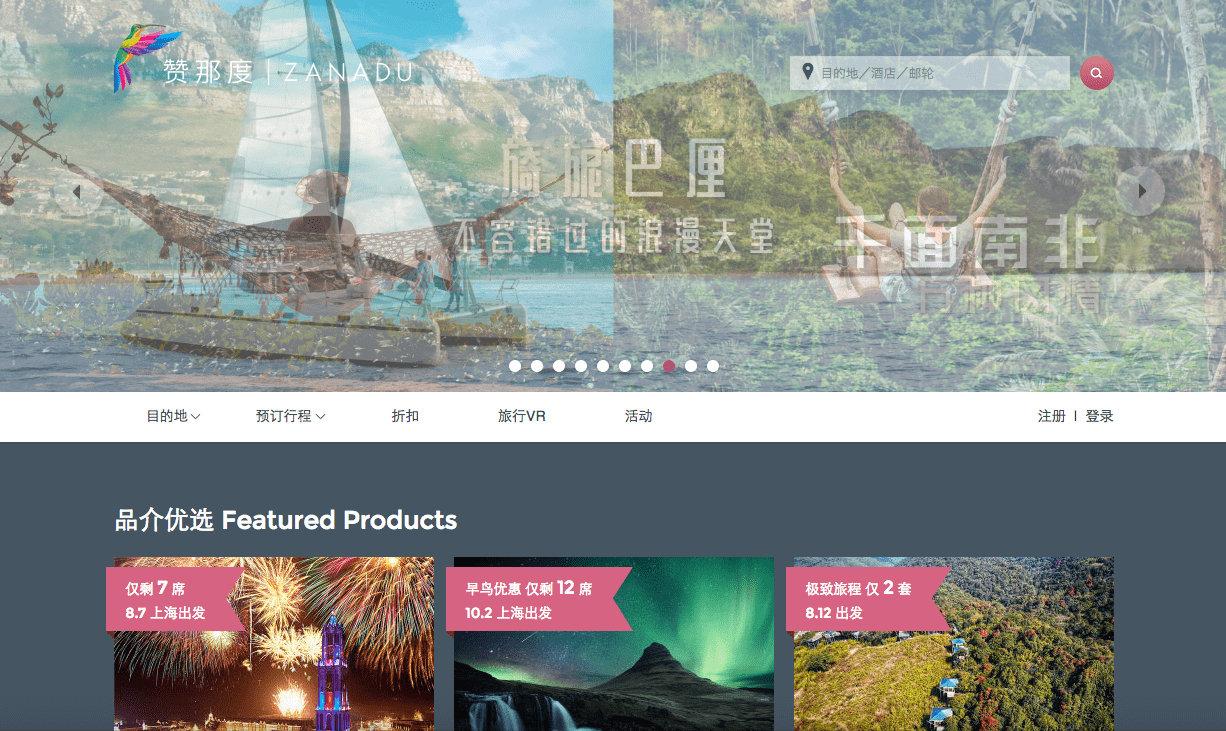
Zanadu: Luxury travel is starting to segment – customers are segmenting, as is supply, and so will channels, says Wu.
Q: Why did you start Zanadu in the first place?
I did my internship with Morgan Stanley in Hong Kong in 2005. There was a lot of euphoria in the market then about China and nobody from Morgan Stanley wanted to work in China. I moved to Singapore and later to Shanghai, that was in 2009. I knew I wanted to be an entrepreneur and two things occupied me – consumer upgrade and the Internet. China had the biggest luxury goods market and as people got wealthier, they went from materialistic consumption to experiential especially in travel and health care.
Travel was dominated by mass market players, Ctrip, eLong, Qunar. Our angle was to build a premium consumer brand in travel.
Q: What were the early lessons?
It was a slow start, the first 2-3 years were challenging. I am not from travel and there was a romanticism about this industry that I didn’t know. It’s also very low margin, even for high end products, it’s hard to get 30-40%, which limits what you can do. It’s also a low frequency transaction – even the most loyal travels only 3-4 times a year.
This makes travel different from other ecommerce. The supply chain and service chain is so long as well and there are many things you need to do well to complete the loop.
We also knew the luxury market would take some education and we needed to build a brand for the longterm. As recent as five years ago, Chinese couldn’t get visas to Europe. In 2016, half of Chinese travellers were travelling for the first time – you’re not going to be a luxury traveller the first time.
When we started, we focused more on high end hotels. Then we realised if it was pure hotel booking, we would have no advantage over the big OTAs – there was no way we could challenge them.
That’s when we started to go with the consumer need – they need services, hand-holding, packages. Today hotel-only booking is 5% of our business, the rest are tour groups, packages, tailor made holidays. The average transaction is US$10,000. We have created an Internet brand and all our products are sold online. 90% of bookings are standardized packages.
But it’s not a platform business, but more like a travel agency business, just more Internet. Using social content, we have lowered the costs of customer acquisition.
Q: When you realized how hard it was, you didn’t think of quitting?
I am not a quitter. I persevered. Now I have a more realistic expectation of this business.
Q: What are the trends in Chinese luxury travel?
Now markets are starting to segment and suppliers are too – you now have six star, boutique, experience/adventure hotels. Channels will segment too
The needs of the mass market and high end are not so diverse. Everyone started from “I’ve never been out of China before” and all you needed was one supermarket. Now you have City Super, Whole Foods.
We want to position Zanadu as the #1 leader in the premium sector and that’s something money can’t buy. Be profitable, be patient and keep our position and as the premium space grows, so will we.
Q: What books have influenced you?
When I came to Singapore in my teens, I couldn’t speak English so before 1995, I only read Chinese books. One of the first English books I read was Donald Trump’s The Art of Negotiating in 1995. That had a big influence on me. But since then I have read lots of entrepreneurs’ books such as those of Richard Branson, Steve Jobs, Elon Musk and Robert Kuok . I love books about entrepreneurs.
Watch video on Atlas Travel Blockchain below:
• Featured image credit: dalebor/iStock-GettyImages