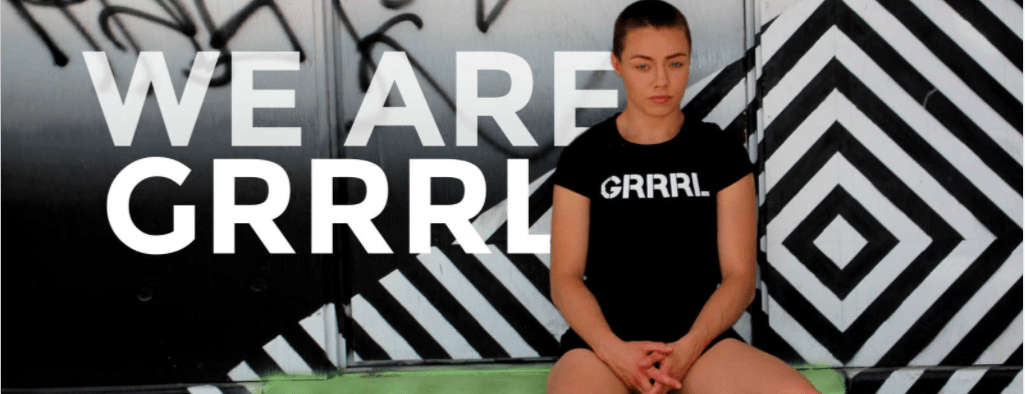
In our continuing series of articles around our WIT Singapore Conference theme of “Through The Looking Glass”, where we look outside travel in search of different stories and lessons, we look at how Kortney Olson built a women sportswear brand out of a social movement around giving women self-confidence, how she turned traditional sizing on its head and her plans to expand GRRRL power in Asia.
It’s hard to miss Kortney Olson – she’s the “girl with muscles”, as she described herself in her message to me when arranging our meeting. But as impressed as I am by her muscles, it’s the tattoo on her right arm that catches my eye. “Why Prince?” I asked, singling out the one among the several she sports.
“He changed my life, inspired me to play music, saxophone, drums, guitar – his lyrics, his range, his capabilities and his personal story,” she said without hesitation.

Kortney Olson: “I wanted to do away with traditional sizing – that system was started by a man in the 1940s who worked in the agricultural business. How can it still be applicable today? Women want to be different sizes and want to relate to what looks like them.”
Olson, born in Eureka, Northern California, arrived in Singapore two years ago via the Gold Coast, Australia. At 36, she’s got her own personal story – eating disorders, drug addiction, alcoholism – but today she’s overcome those problems and now runs GRRRL, a women sports clothing brand whose sizing is based on athletes’ names and sizes.
Women shopping on GRRRL are asked to take their own measurements with a tape measure and then choose sizes based on the athlete they identify with or aspire to be – ranging from martial artists at the lower end (Brionii Cuskelly) to USA weightlifting stars (Ali Ludwig) at the other.
“I wanted to do away with traditional sizing – that system was started by a man in the 1940s who worked in the agricultural business. How can it still be applicable today? Women want to be different sizes and want to relate to what looks like them. With us, you get your real measurements.”
Despite the extra hurdle her shoppers have to go through, Olson said most women do it willingly and surprisingly, she reports miniscule return rates of approximately 1% in comparison to an athleisure industry standard of 15-20%.
According to Olson, 95% of active wear are made for Size L and below, yet 50% of women who are getting active are Size L and above. As a young girl, she herself struggled with wanting “the ideal body” featured in magazines and media. That led her into a dark downward spiral which she only got out of when she got into competitive body building and that’s when she realized the world was not just made up of skinny girls but strong women.
The idea of GRRRL did not start out as a clothing line, rather it was around events, and community building, which then led to a social movement around women and self-confidence.
Olson said she got into body building in 2008 “before it became a thing with Instagram models” as a way to overcome her drug addiction and through that, “I realized there was this world of men who’d pay hundreds of dollars to see me arm wrestle men or carry men around. It was so strange. My entire life, I wanted to fit into Calvin Klein jeans.
“I was couple of years into body building when the realization grew that women everywhere have been lied to our whole lives. Beauty is not what’s on the cover of a magazine, we have to work together to build each other up, and stop being so negative.”
She started a series of “Konfidence by Kortney” videos and Kamp Konfidence programmes to teach girls about body image, self-love and self-confidence, and then started thinking about how to take the mission and scale it.
In November 2015, the UFC (Ultimate Fighting Championship) featured Holly Holm against Rhonda Rousey in a world title fight n Melbourne and she saw a chance to piggyback on the event. “I spent our entire marketing budget sponsoring Holly Holm,” she said, confessing it was “$8,000, every cent I had”.
When Holm knocked out Rousey in the second round, “it felt like I had won a lottery,” said Olson. “Holly then posted a picture on Instagram titled ‘fight like a GRRRL’ and that engagement went through the roof – from 200,000 to 1m followers and 60,000 likes. She’s why we blew out of the gates.”
From there, Olson organised a GRRRL Live event, launching it in Las Vegas 2017 and next year’s event, its third, will be from July 1-3. It was that event which gave her notoriety as “the woman with the world’s deadliest thighs”, a term coined by Marvel Comics legend Stan Lee on his US TV show Stan Lee’s Superhumans (a programme dedicated to people with extraordinary physical gifts) on account of her ability to crush watermelons with her legs. She’s also performed the stunt on Jimmy Kimmel Live on National Watermelon Day.

Marvel Comics legend Stan Lee calls Olson “the woman with the deadliest thighs” on account of her ability to crush watermelons with her legs. Photo Credit: GRRRL.com
“You want me to show you?” she asked. Given we were in a Starbucks, I said, “Another time.”
Currently, its customer base is predominantly American, with some customers from Canada, UK and Australia. She’s now seeking Series A funding of US$1m to expand the business in Asia, using Singapore as a base. “We started out focusing on body diversity and shape but it’s just as important to have colour and ability diversity.”
As part of its plans to localize its business to the region, it is branching out from more American sports such as MMA, Roller Derby, football, rugby, arm wrestling and power lifting to embrace golf, tennis, basketball, netball and badminton and Muay Thai, Thai boxing which is gaining increasingly popularity across Asia.
She is aware of the need to find sporting heroes in Asia that women here can better relate to. “We started with six athletes, now we have 10 and will grow that.”
From a business that started with a loan from her grandmother, Olson has built GRRRL by bootstrapping into a business that currently has a US$2.3 million turnover in sales. Manufacturing is done in China and she uses third party distributors in San Diego, UK, Australia and Canada.
She’s inspired by the AirAsia model and how it’s expanded via joint ventures in local markets. “I like Tony Fernandes’ joint venture approach and I am exploring how to do something similar in Malaysia.”
She’s been observing the trends in Asia since moving to Singapore two years ago. “The gold medallist in fencing in Singapore wears a hijab, I like how everything is so multi-racial here and how mainstream sports has become.
“There’s a massive gap of women who are underserved and disenfranchised – two women told me that they are usually told by brands like Cotton On, ‘we don’t stock your size’.”
Another trend she’s noticed in Asia is “how everyone uses a beauty app. All the photos are photoshopped, everyone looks angelic”.
“This is worrying because it’s going to create beliefs that they are not good enough,” she said.
Her intention is to take GRRRL to the grassroots, starting out with free bootcamps and pop up stores and getting women to take the GRRRL pledge. “My idea is then to use technology to connect small groups – find a GRRRL near me. Once you see you are not alone, identification happens and you trigger referral behavior.”
She is also keen to take the GRRRL Live event in Las Vegas to Australia and Singapore. “Scared money doesn’t make money. Events are difficult but I believe our live events could be bigger than clothing. We are profitable with our third GRRRL Live.”
She confesses her biggest challenge “is drawing that line between a heart on wheels and a business”.
“I just want to evangelise but we have to get into the numbers and run this as a commercial enterprise, and strike that balance between profit and purpose.”
Asked if she is in a way still seeking validation from men by chasing another form of body ideal, Olson said, “I guess I still have that programming inbuilt in me, but I am more aware that I lift weights now because it gives me confidence and health and not because I want someone to like me.”