
Perhaps one of the most highly anticipated films of the summer, Crazy Rich Asians has been a goldmine for the Singapore Tourism Board (STB), which is continuing its efforts to modernise the city state’s image as a destination.
Lynette Pang (Assistant Chief Executive, Marketing Group, Singapore Tourism Board) who spoke at WIT Singapore 2017, stated the film is “a natural opening to get the conversation going about the real Singapore and pique interest in visiting the country… especially in the North American markets.”
And to be frank, the North American audience needed a little help in that respect. It hasn’t been that long since the Trump-Kim summit was held in Singapore, generating a spike in Google searches for “where is Singapore?”, in the USA.
Singapore was said to have spent $20 million on hosting the Summit; who knows what it spent on supporting Crazy Rich Asians as almost every government agency was cited as having backed the film in director Jon Chu’s list of thank-yous at the premiere of the movie in Singapore this week.
Crazy Rich Asians’ release puts Singapore is a strong position to capitalise on the rising appeal of the island as a destination, and indeed that is what it intends to do. (The director’s use of maps in the movie is clearly intended to ‘educate’ Americans exactly where Singapore is.)
“While we may not be able to immediately quantify returns from the movie, we certainly expect the exposure from the movie to help bolster greater global awareness of our destination and this could potentially attract more visitors over time,” said Pang.
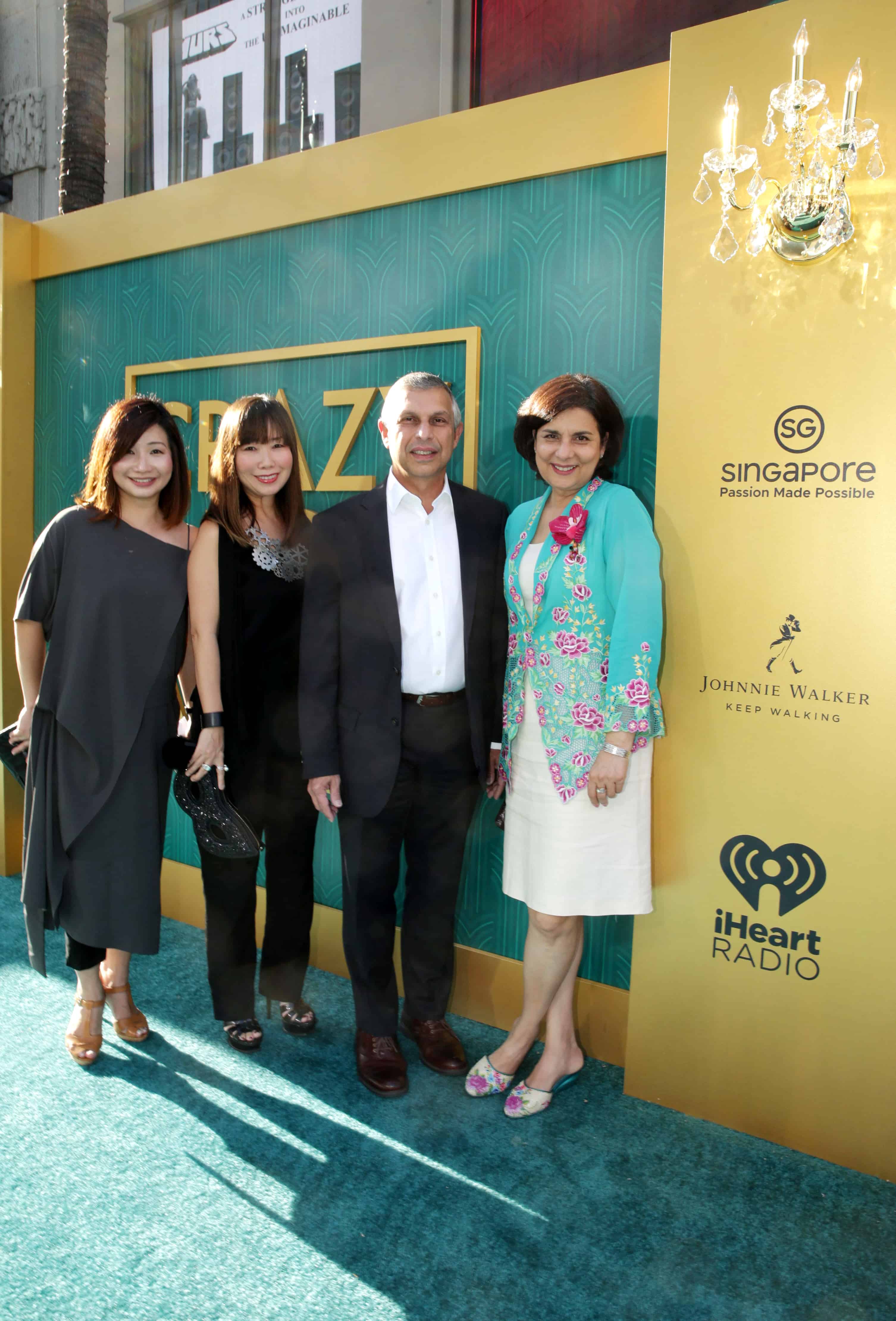
Kershing Goh, Regional Director, Americas at Singapore Tourism Board, Lynette Pang, Assistant Chief Executive of Marketing at Singapore Tourism Board, Ashok Mirpuri, Singapore’s Ambassador to the U.S., Gouri Mirpuri
Timed well to cater to any potential spike in tourist arrivals, Singapore Airlines will soon introduce two direct flights from New York and Los Angeles to Singapore. On top of that, STB plans to initiate marketing initiatives in collaboration with Warner Bros. across other markets beyond the USA, including Australia, Japan and Southeast Asia.
You don’t have to look far past the title of the film alone to assume that the destinations featured within the film are likely to inspire a cohort of wealthy travellers more than a typical ‘gap year’ backpacker.
These efforts are not to be underestimated. In anticipation of the film’s release, publications like Vogue, Bloomberg, Conde Nast Traveller, Forbes, CNN Travel and more, have shone a spotlight on the island city, each publishing their versions of a “Crazy Rich Asians Guide to Singapore”.
Nevertheless, Pang argued that “’Crazy Rich’ is not just about the opulence and wealth showcased in the film, but the richness that Singapore has as well in culture, diversity and depth and breadth of experiences for both locals and visitors.”
Yet, ‘diversity’ has been a bit of a touchy subject for the film, as the general public has both applauded and booed the production’s weak efforts to showcase Singapore as a multi-cultural society, opting to focus more on Chinese-Singaporeans as the social elite on screen.
While the STB had no direct hand in the film’s production, Pang pointed out that its only duty was to focus on marketing “the destination aspects of the movie” to pique travellers’ curiosity. Crazy Rich Asians can therefore act as a gateway of sorts to understanding “what the real Singapore can offer.”
When it comes to the actual individuals, Pang is quick to make the point that the entire production involved a large cast and crew of Singaporeans – “a key anchor of our Passion Made Possible brand…[which] shines a spotlight on them, and how they are making their passions possible on a global stage.”
Joachim Ng, director of the Singapore Film Commission, echoed similar thoughts as he said, “projects such as Crazy Rich Asians reflect how a made-with-Singapore approach can facilitate the exchange of skills and experience, and benefits local talent with the opportunity to work with international talent and companies.”
Filming Crazy Rich Asians in Singapore presented a grand opportunity for passionate young talent to get involved with a blockbuster film. In the film crew itself, Ng cited that 20 out of the 297 roles were interns and fresh graduates from Nanyang Technical University (NTU), LASALLE College of the Arts and Ngee Ann Polytechnic.
Not to mention, when the film was in its earlier stages of production, castings were held in Singapore, in pursuit of local talent with the potential to make it to the big screen. Many of the supporting roles, including the lead character’s mother, were also given to Singaporean actors.
Unfortunately, you cannot fix the diversity problem by swapping one homogenous cast for another. But for a Hollywood film catering to a largely American audience, I can understand the impact having an all-Asian cast would have. And while Crazy Rich Asians may not have done a great job of depicting any of Singapore’s multi-cultural society, with its Malay, Indian, Chinese and Eurasian communities, is it at least a step in the right direction?
Don’t forget, this is a Hollywood film – the same industry credited with casting Scarlett Johansson as a Japanese female lead in Ghost in the Shell, and Emma Stone as a half-Hawaiian character in Aloha… not forgetting Matt Damon who seems to have built a niche as China’s savior in The Great Wall. On top of all that, let us not forget the Criminal Minds: Beyond Borders episode set in Singapore that was torn to shreds by local media personality, Kim Huat for its ludicrous depiction of the city state.
It would be silly to expect one film based off a pop-culture novel to carry the responsibility of fixing ‘the diversity problem’ in cinema, but it didn’t stop audiences from hoping. Perhaps it is a one-dimensional view of one of Asian’s wealthier societies, but maybe, even optimistically, we could consider it a gentle introduction to at least one type of modern Asian society – even if it is just the “crazy rich”.
Watching the film during its Singapore premiere, I do have to say I was underwhelmed. As a mixed-race Singaporean that grew up in Singapore, it just didn’t feel like a film made with the intention of capturing any of the cultural complexities that actually make the city state interesting. For a film about Singapore, it didn’t feel like it was created to represent my identity as a Singaporean.
A BBC article written by a Singaporean author about the film said it best, “Crazy Rich Asians, in its eagerness to further its representation goals, is misrepresenting Singapore and using it as a mere “backdrop” for Asian-American fantasies.”
Portrayals of the city felt a little contrived; everything from Singapore’s hawker centres to its cityscape was shot like something straight out of a destination marketing campaign. It felt like a lost opportunity for filmmakers to really make an impact and change the narrative.
If I am honest, I went in with low expectations but an open mind, hoping to be pleasantly surprised. My issue wasn’t with the clichéd and painfully thin plotline or the fact that it focused exclusively on the ultra-rich (the hint was in the title), it was that the film failed to try to break even the simplest of stereotypes that have shaped Western perceptions of Asia as one homogenous group.
While Crazy Rich Asians’ production, release and success are a major victory for Asian representation in Hollywood in general; it is just the first step in a long journey to championing Asian diversity.
Lead image courtesy of Singapore Tourism Board