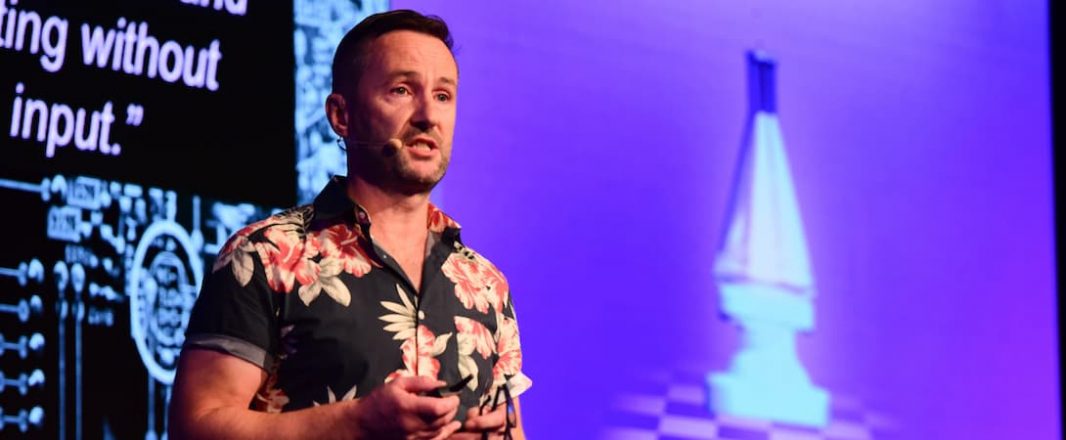
Tech futurist and CTO of CarTrawler Bobby Healy gave the WiT Singapore 2018 audience a glimpse into where travel tech is headed and what the future of travel might look like in the next 10 to 20 years.
The first thing Healy noted was that the biggest thing beyond mobile is still chatbots, but not necessarily for the reasons you might think. In his view, technology like chatbots has been instrumental in transforming businesses at little to no cost.
The sort of tech previously required significant funding and a fairly competent R&D team two years ago, can now be bought off-the-shelf at little to not cost. Companies can harness bots, AI and machine learning to solve big problems exponentially faster, allowing for faster growth.
On that same trajectory, Healy said that the rise of autonomous tech will spread far beyond bots and into the vehicle space. He made an example of out of Tesla, pointing out that “everything is cheap except its battery” and its autonomous capabilities were a big step towards getting consumers “to trust their lives with tech.”
In parallel, drones have all the same base technology as a self-driving car, with the key difference being it has four propellers instead of wheels. Healy predicted that its major use will be in passenger transport.
“This is where it gets exciting… you see companies experimenting with drones with logistics for delivery… but the really interesting one is passenger transportation and how it will impact daily lives and this industry.
“Technology safety is improving so much that there’s going to be passengers travelling on autonomous drones within two years, there’s already demonstrations going on… over the next 10-20 years, people will fly on autonomous drones instead of commercial aircraft.”
A range of a drone on a single charge is currently still quite limited but once you apply rapid battery charging, a drone could feasibly travel fairly long distances at virtually any speed – say 300 miles per hour for any distance you want… it’s a far more efficient way to travel.
Yet Healy recognised that virtually no one would be daring enough to pursue drone potential with a basic understanding of its underlying economics.
“The cost to fly a drone with an electric-charged battery instead of kerosene is about a tenth per mile of a commercial airline.”
“If you really forward-wind to 20 years, this will change the nature of leisure travel because people will travel shorter distances much more frequently. The drones being designed are also hotel rooms, which will transform the hotel industry.”
“There are people already building business plans because the technology is available today.”
NASA, for example, has developed a UTM system that would allow real-time on-demand allocation of airspace below 500 metres, enabling thousands of drones to be able to fly without risk of collision.
This will be a key enabler to making drones a more mainstream transport method. In fact, Healy quoted PWC’s prediction that by 2030, there could be upwards of 85,000 drones in the air in the UK alone.
“There’s already technology standards and aviation authorities around the world that are implementing systems that will allow drones to fly within 40m each of other at 300 miles per hour.”
“Everyone should have a drone plan.”