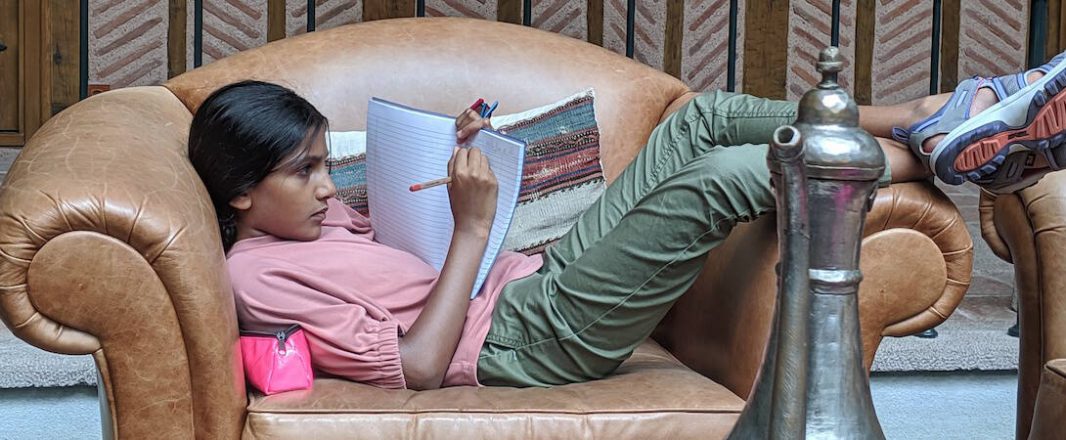
The future of coding is in the hands of the next generation, and they’re starting younger than you might think. Meet Zara Khanna, a precocious young girl of 10 with big plans to change travel through technology.
At just eight years old, Zara built her first chatbot, Octa, to help fellow children find fun things to do whenever they travel. Currently, it holds data for over 200 cities, offering recommendations on attractions, local events and playgrounds suitable for kids of all ages.
“I’ve been to about 70 cities now… sometimes your parents take to you places you might not like and I thought, ‘I’ve got to change this because I’m a coder and a traveller… We basically find the best places to go… some of it is based on my own experiences.
“Octa has three values. It should be fun. It should be sustainable. And it should help you build connections, with people but also the environment… Travelling connects people, and shows them different cultures so we can be friendlier together in the future.”
At 10, Zara considers the biggest pain point in travel to be the fact that children don’t have their desires taken into enough account when on a family holiday.
“Octa should be a chatbot for parents to use together, so kids have a say in what they get to do… if your parents take you somewhere you don’t want to go to, the whole travel experience is broken!
“Even if you appreciate it later on, it’s better to have fun in the present.”
Octa is only the first step in Zara’s big plans to shake up travel. Zara distinguishes Octa from other travel technologies by arguing that it is a product, not just a project. “A project is like a line segment. It has a beginning and an end. A product, like Octa, is like a ray, it just keeps going!
“Next we want to look at geo-location and figure out where the person is. We’re looking forward to more partnerships with hotels and airlines. We want to put Octa in different languages, we’re aiming for Mandarin first… if you can conquer one language, you can conquer the rest.”

The future of technology is in their hands
Getting Zara to make the connection between technology and travel was more intuitive than one might think.
“I found that they were both very interesting and my mum’s always said that the arts and the sciences should go together, so I thought, ‘why can’t I use technology to make a better change in the world but also influence my love of travel?
“I thought, ‘why not fix one thing I love by doing another thing I love?’”
And while it might be too early to tell what Zara will consider to be travel’s pain points in the next 10 years, she emphasised that technology must be built to achieve good in the world. She described how science fiction movies depict dark, dystopian futures but argues it shouldn’t have to be that way. “So long as we keep building things that do good, it will be okay!”
Zara’s two biggest influences are naturally her parents. Her father, Parag, is the managing partner of Future Map, a strategic advisory helping companies understand globalisation and its forces in business. Her mother, Ayesha Khanna, is the CEO of ADDO AI, an artificial intelligence advisory firm based in Singapore. So in many ways, understanding technology was already in Zara’s blood.
Despite growing up totally immersed in technology, Zara is still unique amongst her age group in her ability to read and write code. She attends coding classes every week to develop her technological literacy further, but believes that it should be included in mainstream school curriculums everywhere.
“My classmates all have talents of their own but sadly none of them include coding.”
To get the ball rolling, Zara leads a student coding club for girls titled – GREAT: Girls Resilient, Enterprising and Amazing at Tech. “I hear a lot of breakthroughs in technology but it’s always males, and I think that girls can also make good changes so I want to encourage girls.
“Technology is everywhere you look nowadays and you don’t learn to work with it, then you’ll be at a disadvantage… I’m not saying it’s easy, I’m saying it will be worth it.”