
When Stephen Taylor, chief revenue officer, was going through the results of Sojern’s 2019 Report on Travel Advertising, one finding stood out for him. “Driving direct bookings” was the biggest challenge cited by travel marketers in APAC (Asia Pacific) while globally, the biggest challenge was “delivering personalised ads and offers in real-time”.

Stephen Taylor said getting Asia right would prepare the company for the future.
The report, which interviewed more than 600 travel marketeers, was clearly skewed towards hoteliers in Asia (the bulk of Sojern’s clients) but it showed up the stark difference in the APAC market versus other regions. In Asia, hoteliers clearly struggle against OTA dominance.
Said Max Ueno, vice president, Asia Pacific, of Sojern, “This is true on the ground. When we speak to hotels, we rarely come across a hotel that has over 5% of bookings coming direct. And we have to address that concern.”
That difference is the reason why Sojern is taking a more localised approach to Asia, and why Ueno is now leading the charge for the region.
Said Taylor, “We are now a business of 600 people with more than $100m revenues, we cannot run all that from San Francisco. We now need leadership in each market and we want this region to have real autonomy, real leadership to enable faster decision-making.”
Ueno, former Criteo executive and CEO of BuzzFeed Japan, came onboard earlier this year. Since then, he has been making changes to the organisational structure in APAC and implementing a new strategy for the business.
“The US speaks one language, in APAC, there are 3,000 languages. We don’t have to cover every language of course but it’s a sign of how different the market is here,” said Ueno.
The other difference is in the landscape. “Athough Google and Facebook do have strong presence in many countries in APAC, they are not super dominant in South Korea, Japan and China. I have started to access platforms other than Facebook or Instagram, and these decisions have to be made at a regional level.”
Ueno has reorganised teams by geography rather than verticals, and created smaller pods around regions such as Hong Kong/Macau/Taiwan, Australia and New Zealand and South-east Asia.
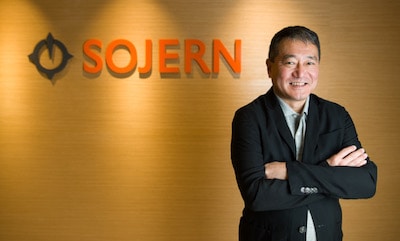
Max Ueno has been making changes to the organisational structure in APAC.
He’s also identified markets where Sojern needs to get better at with data coverage. “We are good in certain markets, not so good in emerging markets such as Vietnam and Indonesia.”
He also wants to expand reach to publishers such as Kakao Talk, Naver and LINE given the huge role messaging plays in the Asian markets. Japan is a key market Ueno is keen to enter.
Taylor, who was in Singapore to speak at a Sojern customer event, said getting Asia right would prepare the company for the future. “Things are happening here and often, they are happening here first.
“If a company has to operate multi-lingual, multi-currency, it has to adapt more quickly and that makes the company healthier. The US is an amazing market, it drives many things but it’s a real shock when you want to go elsewhere. Getting good in smaller countries helps you to focus on the details.”
Taylor and Ueno, who used to work at Yahoo together, recalled a time when “if you wanted to know what was happening, we went to Japan and South Korea”.
“We started mobile search in Japan,” Ueno reminded Taylor.
The two executives had just hosted a client party in conjunction with the Singapore Formula 1 weekend and I asked Taylor if in the travel advertising race, it was about having the fastest car.
“It’s about having the right car,” said Taylor. “You have to focus on the things you are good at. Competition makes you sharper – we are in the data driven performance marketing space. It’s a very clear proposition – so we don’t have to worry about what our competitors are doing, we just have to be good at what we are doing.”
I asked though if he felt data-driven advertising was working as well as it should given the high ratio of irrelevant ads I am targeted with in the course of a day, leading to consumers like me getting annoyed and tuning out.
“It is true – it is said we are bombarded by 5,000 to 10,000 ads in a day and people just screen them out. But companies like ours – our profitability is driven by delivering ads that work for clients at a performance level, that business model forces us to get more and more relevant.
“Do we get it right every single time? No. But we are getting better.”
Ueno said one trend that would help travel marketers get better is the rising quality of creative. “In the past, top creators who were making commercials and films, were resistant to move to the digital side because it was all banner ads and search ads. But in markets like US and Japan, we are seeing top creatives move to the digital world with the change in platforms – the connected TV, stories …”
At BuzzFeed Japan, where he worked, he said, “The blend of creativity and data is very powerful to produce quality and relevance.”
One lesson he learnt is the speed of change in platforms from the user standpoint. “Facebook was popular among teens five years ago, now they are on Snapchat. User behaviour switches really quickly, and the algorithm of these new platforms, they change really quickly too. Before, they wanted short videos, now they want longer video – and the talent to create short videos vs long videos is very different.”
Of course, there is concern over the new privacy regulations – the GDPR in Europe and the California Privacy Act – but Taylor believes there is too much hyperbole and panic around it.
“If you start from the principle of – is there a user benefit/value on why I am collecting this user data or does that user have the ability to see and exercise choice and control over the way you are holding and collecting data – and you understand this is what’s underpinning the new regulations and yes, you should protect users, then there is no need for panic.
“If your company does it properly, then it can only drive the industry forward and also, it will take certain people out of the market.”
• Featured image credit (Kaoshiung, Taiwan): hxdyl/Getty Images