
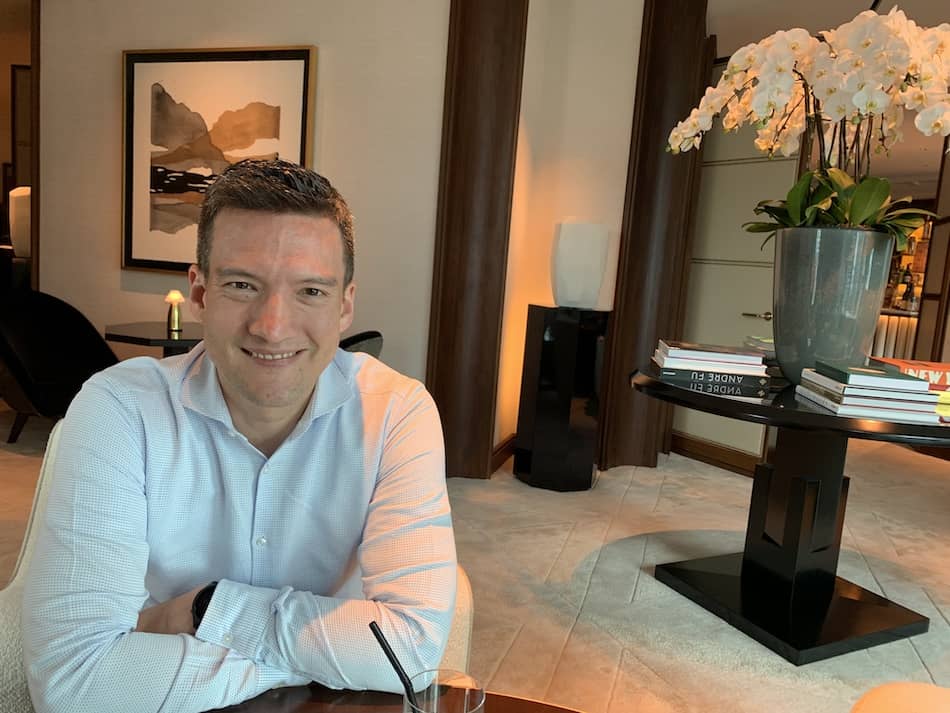
Oliver Rippel, co-founder and partner of Asia Partners, believes South-east Asia could yield between 20 and 30 tech unicorns. And he believes there are only certain sectors that can have global network effects, the rest, which includes online travel, is where local heroes can win over global players. He should know, he was part of the eBay China team that failed. Yeoh Siew Hoon catches up with this tech investor who successfully led Naspers’ exit out of Flipkart when it was sold to Walmart and who’s no stranger to online travel – he was on the founding team of the Ibibo Group, with Goibibo acquired by MakeMyTrip, and his new fund recently led the $70m round into “affordable accommodation provider” RedDoorz.
Q: How long have you been involved in the tech space?
I personally have been in tech for two decades.
Q: Can’t be – you look way too young.
It’s my half-Asian side (Rippel is German-Korean), it keeps me looking younger than I really am. I spent a decade with eBay in Germany, China and South-east Asia. Then I joined Naspers for over a decade. My passion comes from not only tech but also emerging markets and the inspiration from working with founders.
Q: Why Asia Partners?
It’s a continuation of what we have been doing but exclusively focused on South-east Asia. We want to help tech and tech-enabled companies at the growth equity stage – companies that have product market fit already and about to scale across the region. RedDoorz fits that to a T. Headquartered in Singapore, successfully expanding to emerging markets – it’s a playbook being adopted by more upcoming companies. You had the first generation of unicorn companies like Grab, and now you have the next gen of fast growing companies like RedDoorz.
Q: You’re not new to online travel, so you recognise the opportunity in the sector.
Yes, I’ve had a lot of exposure to online travel the past 10 years. Ibibo Group was not an investment into an existing business but a green field project with a local team. We tried many business models but two really stuck – payments with PayU India, one of the largest online payments in the country, and online travel with Goibibo – hotels, ticketing, bus ticketing.
Q: What were the lessons you learnt from that?
Online travel is a big addressable market in any emerging country, especially in the early years of market development, significantly larger than the rest of the eco-system. Online travel plays a pioneering role to get customers used to transacting online. There’s also a big societal need to travel which coincides with the rise of a middle class.
Travel is also a standardised and digital product that can be delivered in a seamless way, unlike a physical product that must be delivered, well, physically.
So often online travel is the first big vertical that emerges – MakeMyTrip was the first real consumer tech IPO from India. We saw an opportunity to scale Goibibo in the market, especially the hotel segment, which led to the acquisition of Goibibo by MakeMyTrip.
Q: So if you take a bird’s eye view of the tech landscape over the last two decades, what phase is it at right now in South-east Asia?
Looking at it from top down, and studying Internet models, markets develop through various phases and based on data, you see four different stages – basic infrastructure, telco players; horizontal Internet platforms; vertical platforms; and the last step – O2O, offline and online, where China is today.
South-east Asia is on the cusp of the third stage. Most of the existing unicorns in South-east Asia are mainly horizontal – OTAs, ride sharing, e-commerce platforms. In travel, we see well-established OTAs – Agoda, second gen OTAs – Traveloka, and now the emergence of vertical offerings – budget hotels is one of the largest verticals. The budget hotel sector in South-east Asia is larger than the whole of India – there’s a vast pool of unbranded one- and two-star hotels facing low occupancy rates.
Q: Klook – that’s another vertical offering?
Yes, destination services. These stages co-relate with affluence. China is 11 years on average ahead of South-east Asia in affluence, so we are looking at where the gaps are here.
Q: And what are the gaps?
Classifieds verticals – jobs, cars … they are gaining significant traction. Education, health tech. Our scope is very wide, we are looking at companies that are already fairly established, not at the product market proof point but multi-market proof point.
Financial sustainability of the model is important, how well does it monetize, the competitive dynamics, the switching costs – if it’s too low and where there is no loyalty, then it’s a race to the bottom – high retention rate on both supply and demand, and time period to profitability.
Q: Do you think given the recent collapse of two unicorns – Tink Labs and Honest Bee – there’s more emphasis on profitability vs unprofitable growth?
I think it’s good to have models where you can have the option to either swing the pendulum towards profitability or towards growth. You don’t have to go down the path of growing for the sake of growing.
Q: Lessons for tech startups from these two collapses?
Think deeply of the product market fit and the resulting business model and have strong proof points before you scale. That starts relatively early into the journey, when you raise Series A or latest Series B. Do a reality check – you are not going to be the only one, assume competition will always be there. Business savviness is super important – what value do you add to the consumer and how do you capture that value?
Q: A lot of investors always say they look at the founder when they think yes or no before investing. How do you think that’s changed after what we’ve seen happened with Adam Neumann, founder of WeWork?
The founder is definitely key but not just in his form today – but can he scale? Not just the organisation, can the founder scale? Sometimes you do take a leap of faith in early stage investing but at our stage, we can look at track record and ask, is he the choke point or the enabler?
On the founder: “The founder is definitely key but not just in his form today – but can he scale? Not just the organisation, can the founder scale?” – Oliver Rippel, Asia Partners
Q: Do you have a formula – like spend 100 hours with the founder?
Time spent certainly helps, in business and non-business. Outside the boardroom helps.
Q: Do you ever talk to the wife and kids? I could say husband and kids – but there are still very few women founders.
It’s changing but yes, still few. We don’t talk to the wife and kids but we do get to know them in informal settings. Maybe there’s a point here. You get cues from the family – building a good company should be related to raising a good family.
Q: Speaking of building companies and profitability – MakeMyTrip turns 20 next year, it’s still not profitable. Traveloka says it hopes to become profitable in couple of years and then go for an IPO. What’s a reasonable path/time period to profitability?
From the time we invest in something, I’d say 20 years would not be a reasonable time. But yes, in the “forseeable future” or a timeframe in which you can say in the next three to five years, you will go for an IPO and the best way to prepare for that is to show sustainable cash flow.
Q: Let’s look at the market that RedDoorz is in – it’s competing against the very well-funded OYO, for one.
The opportunities are large, all the players have a toe hold in the addressable market. It’s been proven that in most markets, it’s not a winner takes all, but a multi-player, multi-winner market. Competition is good – at the end of the day, what value do you provide the hotel owner and customer? If we focus on playing our own game in a market that is massive, there will be a few winners.
Q: How many unicorns could South-east Asia produce in the next five years?
I’d say there’s room for 20-30 – in what time period, that remains to be seen. The market potential is certainly there – size of middle class, spending power, and also the ability of local and regional companies to compete against global players. For many business models, the proof is very clear – local and regional can win, not in sectors where there is global network effect, but in sectors where you need local network effects, local home advantage – where you need to work with local supply chain, local merchants, local hotels, local content.
Local vs global: “For many business models, the proof is very clear – local and regional can win, not in sectors where there is global network effect, but in sectors where you need local network effects, local home advantage.” – Oliver Rippel, Asia Partners
Q: Flipkart is a good example of how a local hero won.
Yes, you have to be a step ahead of your competitors that often have other priorities to think about – Grab vs Uber in the previous episode of ride sharing.
Q: eBay, where you worked, that was an example of a global company that couldn’t compete locally, especially in China.
Yes, I was part of that failure and I have to take some responsibility for that. We blew it, and the lessons from that form our thesis today on local vs global.
Certain business models are just not global network effects and we operated under the wrong assumptions that you could win the world with just one platform.
On eBay China: “Yes, I was part of that failure and I have to take some responsibility for that. We blew it, and the lessons from that form our thesis today on local vs global.” – Oliver Rippel, Asia Partners
Q: What lends itself to global network effects?
Software, social networking, search …
Q: What other factors are making the South-east Asia tech ecosystem more exciting, sustainable?
The growing markets of Indonesia, Vietnam, Thailand and the Philippines are relevant in terms of getting to scale. Vietnam is interesting – there’s a shortage of engineers and now Vietnam is emerging as a good source of engineers. RedDoorz just opened a tech hub in Vietnam.
Q: Other than helping to produce more unicorns, why are you doing this?
I would love to be an active part of shaping the ecosystem. You could argue I left regions twice too early. I left Berlin in 2004 and now Berlin is the most vibrant tech hub in Europe. I missed what happened in my hometown. Then I was in China for a few years and I left too early as well, before JD was founded, Alibaba IPO and the rise of WeChat.
Now I see South-east Asia on the cusp. Everything is lining up, upstream ecosystem of VCs, initial role models of scaled up unicorns, recycling of talent from first gen unicorns starting new businesses – it’s super exciting and I want to be part of it, I don’t want to miss it this time.
Q: So does that mean after you’ve seen it through South-east Asia, you will head to Africa where you began your career with Naspers in Cape Town which by the way will host WiT Africa next year?
South-east Asia is 10 years ahead of India, India could be interesting. (Laughs) Africa is two decades behind, there’s lots of runway still in Asia.
Q: What are you most proud of?
My family, a son, 12 and girl, 10 growing up beautifully. Professionally, the Flipkart outcome – it was a good six-year end-to-end journey.
Q: Are you raising your kids to be unicorns?
My daughter likes her unicorns but I think it’s not the same type of unicorn.
Note: Oliver Rippel will be speaking at WiT Singapore 2019 on “The Future Is In The Money Flow”, and he is also offering five hours of mentoring time in our “WiT For Good” Auction on October 15, make sure you bid for him. Sign up here.
• Featured image credit: levgenii Volyk/Getty Images