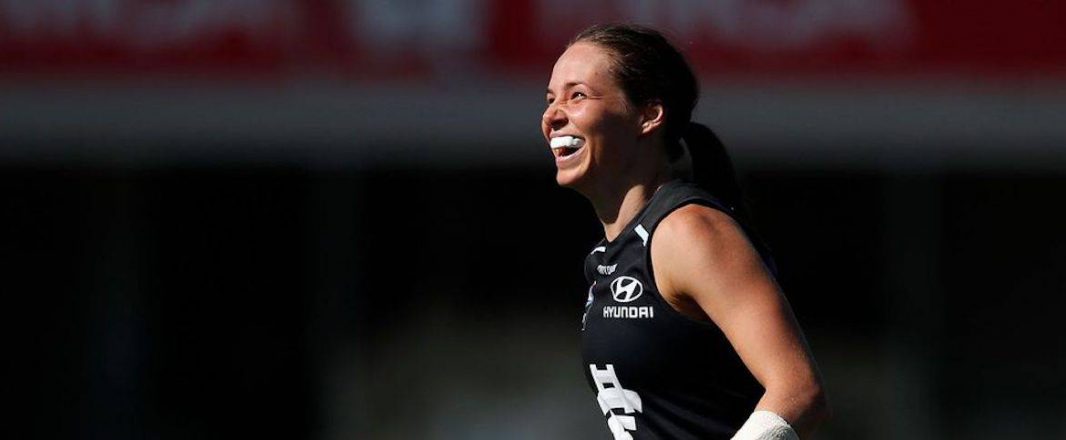
Olympian gold medalist Chloe Dalton, who has played three different sports at the highest competitive levels, addressed a travel community on WiT Virtual to talk about how having both range and resilience took her to the Olympic gold podium in the Rio Olympics in 2016.
Listening to her story, it is clear she has large doses of the latter, overcoming such odds as being a rookie in the sport (she made the switch from professional basketball to rugby just nine months prior) and a serious arm injury before the big event – and it is this quality that will get her through this Covid-19 crisis that has also impacted sports as much as it has travel.
Dalton’s childhood dream of hanging an Olympic gold medal around her neck was inspired by Australian 400m runner Cathy Freeman who got hers at the Sydney 2000 Games. But in a story probably not told by many other athletes, Chloe set her goal first before deciding which sport would get her there.
After she realised the first sport she had spent a good number of her growing years training competitively in (she made the national basketball team but was benched for two years) was unlikely going to get her to her goal, she mapped out other plans.
“I googled a list of Olympic sports and I looked through them. I had a look at triathlon because I was quite good at cross country and I wasn’t bad on a bike, but I didn’t like swimming. So I crossed that off the list. And then I looked at martial arts, but then thought that that was probably a sport that people did from when they’re quite young, so I thought that would probably be a bit too late. And then I saw Rugby Sevens was going to be in Rio for the first time in 2016. Since I’d grown up in a rugby family, I had a really good understanding of the game,” said Dalton.
And so began her first steps in extending range.

Instead of fearing change and unknown territories, Dalton sees it this way. “When I move to a new sport [she would later do it again post-Olympics, switching from Rugby 7s to Australian Football], you can be okay with not being good at things and you can be okay with asking questions about things because you aren’t expected to know the answer and you aren’t expected to be good,” she said.
“That’s the way I often try and approach it because the biggest thing that I strive to be in my career is being teachable. When you are put into a new environment or a strange one or a different one, I think it gives you a bit of liberty to be okay with not being the best at it.”
And that courage to constantly put oneself out of range is also what then develops range and resilience, she contends.
“I had a lot of belief in the fact that I had the ability, the motivation and the work ethic to get there. I willingly put myself into those challenging situations to see where I can get to. In terms of building that range, it’s really exciting when you put yourself in a situation where you don’t necessarily feel equipped and you’re able to challenge yourself to tick off small things at a time and learn a whole lot more about yourself,” she said.
For Dalton, and the majority of those polled during the webinar, the key quality to developing range is courage.
“There’s a lot of unknowns and a lot of things that you just can’t necessarily plan for. But I think it takes a lot of courage to put yourself in a situation where you can have the opportunity to grow and to learn and to build more range,” said Dalton.
Even with range and resilience in her toolkit, this period of uncertainty and sudden change, with the Tokyo Olympics now 18 months rather than just three months ahead, and with an abrupt end to the AFLW League season, Dalton admits to being rattled and needing to work through her own disappointments and discomfort of having no immediate goals to work on.
But Dalton has allowed herself to “process those emotions rather than moving on and having this really positive attitude really quickly”.
“I think it’s important to accept that feeling of loss and process that.”
“The biggest thing I’m trying to work on is being okay with not being in control, and being able to accept things that I can’t control. That’s been a really big learning experience for me,” she said.
She has also learnt that gratitude is an important part of developing resilience. “There is often a lot of talk about how experiences and challenges you go through develop resilience and I definitely agree with that. But working out how you can build resilience without necessarily having to go through a negative experiences, gratitude is a really big part of that.
“As a family each night when we’re sitting down for dinner at the moment, we have to say one thing that we’re grateful for that day. And I think that’s been a really nice thing to do in what’s been somewhat of a negative and challenging time,” she added.
You can listen to the full recording here.
Photo credits: Chloe Dalton