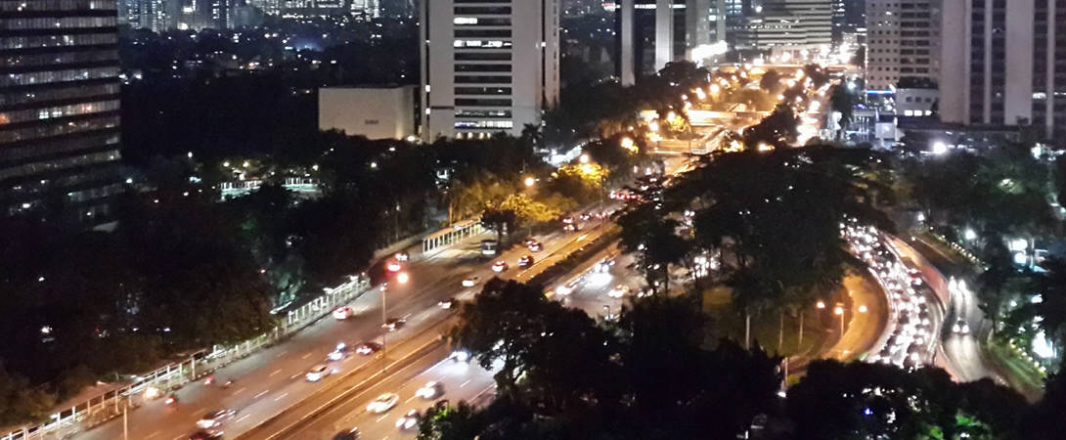
 One never zips around Jakarta – that is a fact – but I feel as if I have just zipped in and out of the city and in that short time, felt once again the pulse of a city that’s all about the possible, even though it may sometimes feel impossible.
For example, immigration was impossible on the Sunday night I arrive. Tip for future – do not arrive in Jakarta on Sunday night because it’s an off night for staff.
The counters for people like me who do not need visas were closed off to Indonesians only and as such, you had hundreds of passengers crowded around the herring-bone designed counters designated for people who need visas on arrivals.
What a mess. There were no queues. Everyone was jostling each other – for what, I don’t know. Because none of the queues were moving. In front was a big Korean group who didn’t speak Bahasa or English and an officer who clearly didn’t speak Korean except for the word “Psy”.
And so we all sighed and harrumphed in the mess for at least 60 minutes before one officer finally woke up and realized he could actually allow access to the Indonesian-only counters which had 10 officers and no customers. I was nearly trampled over in the stampede to get to these counters.
The plus point – a traveler always has to be positive otherwise what’s the point – is that traffic is good on Sunday nights and despite the rain, I was at my hotel the Pullman Thamrin in 40 minutes. (Photo Credit: Pullman Thamrin, www.accorhotels.com)
And that’s travel for you – win some, lose some.
In the Indonesian online travel space, there’ve been some winners but many more losers. My contacts on the ground, who move in VC circles, tell me that the Indonesian start-up scene is slowly maturing – which means you’re seeing a rise to the surface of the more solid models and the withering on the vines of the less solid businesses.
“A lot came up last year when things were very hot, many disappeared and some investors have left the market,” said my contact. “I think this year we will see consolidation and a reckoning in the market. Unlike Singapore, we don’t have an environment that supports start-ups,” he added, referring to the various Singapore governmental grants available to support entrepreneurs.
“In Indonesia, you got to make it on your own, and often against the odds.”
Personally, this is why I find the Indonesian start-up scene more creative and dynamic. Necessity is the mother of creativity, so it goes.
Traditional travel companies who tried to defend their patch by going online are having mixed success. New players trying to carve out their own path in a market still dominated by traditional big boys are having mixed success too – some are doing better than others.
Tiket.com and Nusatrip.com keep coming up in mentions of two companies that are having success in building traction. Money is still coming into the market with a couple of start-ups having raised fresh funding, among them Traveloka and Burufly.
Meantime, what are the trends that continue to drive travel? Definitely mobile and social continue to dominate. Up to 50% of Wego’s users are on mobile/tablet – Android commands 53% of the smartphone usage vs 35% for Blackberry. And according to Wego’s managing director for Indonesia, Graham Hills, local OTAs account for 20-30% of Wego hotel clicks from Indonesian users.
Watch out too in particular for the low cost airline boom which, coupled with a growing, aspirational middle class, will create a surge in domestic travel and the budget segment. It explains why Accor is putting so much emphasis on Indonesia for its Ibis brand.
In 2012 the National Statistics Bureau estimated that Indonesians made a total of over 245 million trips during the year, up from 236 million in 2011, while air travel has grown on average by 15% per year. Remember, it is the world’s fifth largest domestic travel market.
Skyscanner, which released a survey on Indonedsia’s top domestic destination sin 2014, also noted the construction and operation of 12 new airports built in 2013, that will be followed by seven additional new airports in 2014 and five more in 2015. The expansion of routes and domestic networks by domestic carriers has also provided more options for domestic tourists to further explore their own home country, said Tika Larasati, Market Development Manager of Skyscanner Indonesia.
And in case you are wondering, here are the top 10 most popular destinations projected to be the most favored by Skyscanner:
1. Labuan Bajo (Flores) in East Nusatenggara
2. Belitung (Tanjung Pandan) , in Bangka Belitung
3. Pontianak , West Kalimantan
4. Bandung , West Java
5. Malang and Batu in East Java
6. Pangkalpinang (onBangka) in the province of Bangka Belitung
7. Mataram, onLombok in West Nusatenggara
8. Bali
9. Tarakan, in North Kalimantan
10.Bandar Lampung in the province of Lampung.
Come WIT Indonesia time, it will be interesting to find out more how the market is changing and what are the other trends to watch.
See you in Jakarta, April 23.