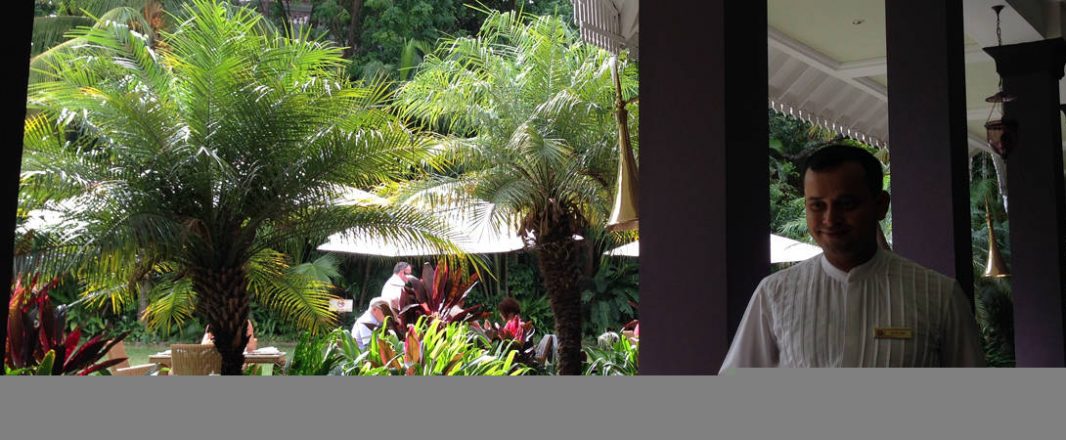
Each time I return to India, I am reminded anew of the wonderful hospitality of the country’s luxury hotels. There’s really no beating that willingness to be of service that’s the hallmark of Taj hotels.
Our event, the first WIT India, co-organised with the Singapore Tourism Board, was held at the Taj West End, a hotel built in 1905, the same year Einstein published his theory of relativity.

Oldest post box in Kartanaka state
There’s nothing relative about the English colonial feel of the property. My room is in the heritage wing. To walk to my room, I have to walk past a letter box, which is reputed to be the oldest one with the Queen’s crown in Karnataka state. It was one of 100 post boxes shipped out from Britain to start the Indian postal service.
I am told it’s a working post box and so I send off a couple of post cards, something I haven’t done in ages.
Last year, they also shut down the last remaining telegraph post in India.
In a country that’s leapfrogged the browser to the mobile device, there doesn’t seem to be much need for telegrams.
From the discussions taking place at WIT India, industry players are taking huge bets that the next disruption will come from mobile and that this will bring swathes of Indians, beyond cities to countryside, online.
All taking big bets on mobile and hotels
Aloke Bajpai (below), CEO and founder of travel search engine, ixigo, just launched six apps. “The apps we are making are not just for Tier 1 people who fly and stay at three, four or five stars but also of relevance to tier 2 and tier 3 cities where they use trains, buses and budget hotels.”
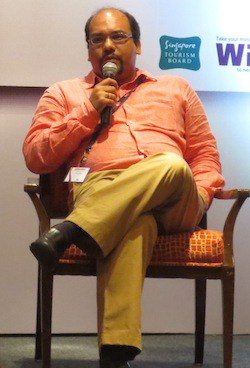
Aloke Bajpai
Cleartrip this week launched its Wallet, which gives customers direct refunds into their account. While Subarmanya Sharma, CMO, said it was early days, he’s seeing evidence that if you take away the pain point of mobile payments, something will happen. He predicts that in the next year, mobile transactions will go from the current average of 20% to 50% for Cleartrip.

From left, Subarmanya Sharma, Cleartrip, Animesh Kuman, Yatra and Mohit Gupta, MakeMyTrip
MakeMyTrip and Yatra cite similar numbers. For India’s top three OTAs, it’s not been an easy few years with the ups and downs of the market. MMT, set up in 2000, nearly faltered until the turning point in 2008/2009 when flight bookings took off, said Mohit Gupta, CMO.
The next turning point will happen when hotel bookings come online.

Expedia’s Vikram Malhi: A big opportunity ahead
Vikram Malhi, general manager of Expedia Asia put things in context when he said the “whole of India’s online hotel bookings is less than our entire hotel business in Expedia Japan. That’s how big the opportunity is”.
What this means is the Indian online travel story is just beginning, with plenty of room for everyone to be part of it, said Animesh Kumar, CMO of Yatra. Yatra recently received US$23 million funding and there is talk of an IPO next year.
Corporate travel is another segment to watch and Concur’s investment into Cleartrip with the latter’s clarity of thinking on product should produce interesting results as far as winning the SME corporate business is concerned.
From planning to in-destination to same-day bookings, start-ups giving it a go
Start-ups are appearing in the trip planning stage although Anshuman Bapna, CEO of Mygola, said solving the biggest consumer pain point does not necessarily translate into monetization. He’s had to pivot three times since starting up in 2009.
The post-trip and in-destination piece is being addressed by Niranjan Gupta, co-founder of Trip38 which is working on a B2B model and is securing distribution through partners such as Galileo and Bangalore airport. The start-up, which pitched at WIT Singapore last October, recently received US$1m funding from a Singapore-based investor.
SavvyMob is going for the HotelTonight model but allows a 48-hour window. HotelQuickly, the Asia same-day booking play, recently extended booking window to 24 hours and raised US$4.5 million.

From left, Bikram Sohal, Savvymob, Niranjan Gupta, Trip38 and Anshuman Bapna, Mygola
It is very early days though, said Bikram Sohal, who started SavvyMob this February and moved from Hong Kong to Bangalore to launch the start-up. If the large OTAs cannot convince customers to book hotels, how can an unknown brand? But he is hoping the mobile-savvy millennials will go for it.
Traditional giants to stay “high touch” while leveraging technology
Two traditional travel giants, Mercury Travels and Thomas Cook, shared their plans to leverage technology and ecommerce but it is clear they are betting more on the high-touch service that Mercury’s chairman Ashwini Kakkar said the “secluded” – the time-rich, cash-poor segment estimated at 100 million – want.
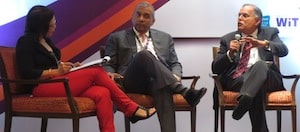
Thomas Cook’s Madhavan Menon (centre) and Ashwini Kakkar, Mercury Travels
Holiday packages remain hard to move online as the OTAs admitted. But the piece of flight + hotel is being addressed by Expedia which is seeing huge success in markets such as Japan, Singapore, Hong Kong and Taiwan, said Malhi.
Recognising the inevitability of more people going online through the mobile web, Madhavan Menon, managing director of Thomas Cook, said the company has invested in a CRM and was moving its products online.
It did away with brochures this year and is arming its consultants with iPads, and they make house calls when required to help customers plan their trips.
Kakkar said the next disruption to travel will not come from existing OTAs and he is betting on platforms – he’s invested in TripFactory, a start-up that says it is the Google of travel.
The next big thing? The Internet of services
And moving beyond the Internet of things, he said the next disruption would come from the Internet of services. Close to 70% of India’s economy is based on services. “Something will come along and blindside us,” he said.
Which may explain why Mercury Travels recently bought Kuoni Academy – he sees that as an opportunity to transform the delivery of education services to the travel industry as a first step.
Getting set to leave the hotel the next day, we spot a flock of geese, two rabbits and three turkeys in the grounds. The highway to the airport is filled with billboards advertising luxury residences, each promising dreams such as “smell the rain. Feel the wind” or “handmade luxury”. I spot a building that has the sign, “National Bureau of Agriculturally Important Insects”.
It’s a stark reminder that deconstructing the India story is never easy – that contrast of rural and urban, that conflict between traditional and youthful aspirations will always serve up contradictions – but in that half day event, I believe WIT India tapped into a new optimistic mood for travel.
And oh yes, did I mention that for the first time travel was mentioned in the just-announced India Budget which also mentioned e-visas. Now that’d be game-changing. It’d make me want to visit India more often for sure, to send post cards from historic post boxes and be served a ginger, cardamon and molasses concoction which kept me from losing my voice in Bangalore.