
BOTH international and domestic travel demand showed marginal improvements in May 2021, according to the International Air Transport Association (IATA).
However, air traffic remained well below pre-pandemic levels, while recovery in international traffic, in particular, continued to be stymied by extensive government travel restrictions, the association added.
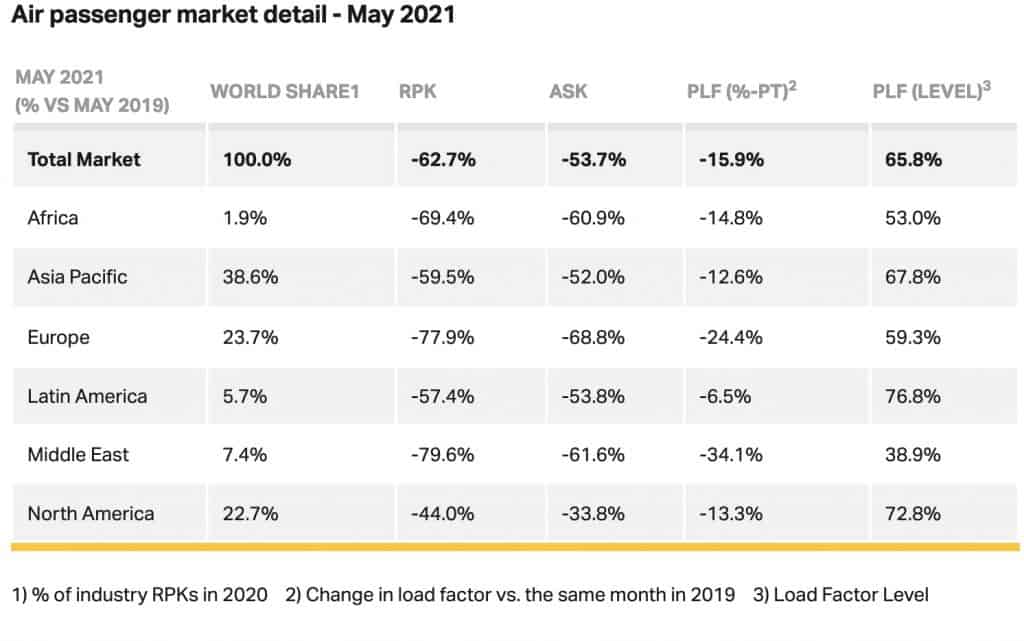
Total demand for air travel in May 2021 (measured in revenue passenger kilometres or RPKs) was down 62.7% compared to the same month in 2019. This was an improvement over the 65.2% decline recorded in April 2021 versus April 2019.
International passenger demand in May was 85.1% below the same month in 2019, up from the 87.2% decline recorded in April 2021 versus two years ago. All regions with the exception of Asia Pacific contributed to this modest improvement.
On the domestic front, demand was down 23.9% versus pre-crisis levels (May 2019), but improved slightly over April 2021 when domestic traffic was down 25.5% versus the 2019 period. China and Russia traffic continued to be in positive growth territory compared to pre-Covid-19 levels, while India and Japan saw significant deterioration amid new variants and outbreaks.
“We are starting to see positive developments, with some international markets opening to vaccinated travellers,” said Willie Walsh, IATA’s director general. “The Northern Hemisphere summer travel season is now fully arrived. And it is disappointing that more governments are not moving more rapidly to use data to drive border opening strategies that would help revive tourism jobs and reunite families.
“To paraphrase an old saying, when you think that all you have is a hammer, every problem looks like a nail. Too many governments continue to act as if the only tool in their anti-Covid-19 arsenal is a blanket border closure or an arrival quarantine.
Walsh added that research from leading medical organisations confirmed that vaccinated travellers pose very little risk to the local population while data show that pre-departure testing largely removes the risk of unvaccinated travellers importing Covid.
“It is long past time for governments to start responding to this information with more nuanced data-driven risk-based strategies. These will minimise the chance of importing Covid-19 while allowing the world to reopen to travel and all the opportunities it brings to reconnect with loved ones, to realise business opportunities, to explore the world or take a well-deserved vacation.” said Walsh.
International passenger markets
European carriers: International traffic declined 84.7% versus May 2019, improved from the 87.7% decrease in April compared to the same month in 2019. Capacity dropped 75.7% and load factor fell 31.3 percentage points to 52.9%.
Asia-Pacific airlines: International traffic fall 94.3% compared to May 2019, fractionally worse than the 94.2% drop registered in April 2021 versus April 2019. The region experienced the steepest traffic declines for a 10th consecutive month. Capacity was down 86.4%, and the load factor sank 45.5 percentage points to 33.2%, the lowest among regions.
Middle Eastern airlines: Experienced an 81.3% demand drop in May compared to May 2019, slightly better than the 82.9% decrease in April, versus the same month in 2019. Capacity declined 63.7%, and load factor fell 35.3 percentage points to 37.7%.
North American carriers: Demand fell 74.4% compared to the 2019 period, an improvement over the 77.6% decline in April versus two years ago. Capacity sagged 58.5%, and load factor dropped 32.2 percentage points to 51.7%.
Latin American airlines A drop of 75.1% demand, compared to the same month in 2019, but improved over the 80.9% decline in April compared to April 2019. May capacity was down 69.9% and load factor decreased 14.6 percentage points to 69.5%, which was the highest load factor among the regions for the eighth consecutive month.
African airlines: Traffic fell 71.4% versus May two years ago, a gain from the 75.6% decline in April compared to April 2019. May capacity declined 61.8% versus May 2019, and load factor dropped 16.9 percentage points to 50.2%.
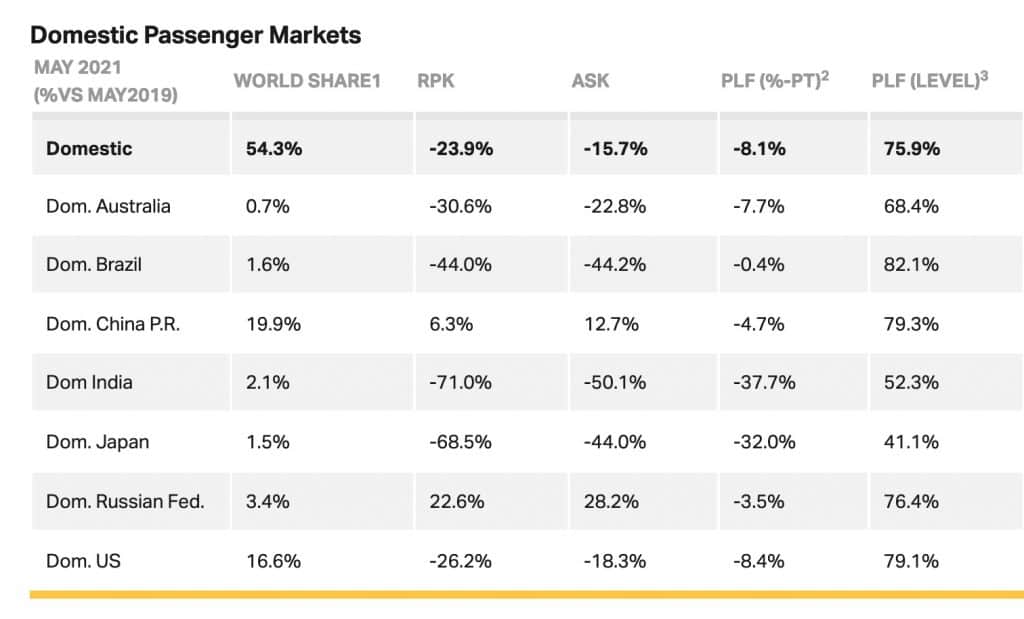
India: Domestic traffic fell 71% in May compared to the equivalent month in 2019 amid the emergence of the new and more contagious Delta variant. This compared to a 42% decline registered in April versus the same month two years ago.
Brazil: Domestic traffic rebounded from a 60.9% decline in April versus the same month in 2019 to a 44% decline in May, as travel restrictions were eased.
• Featured image credit: NORRIE3699/Getty Images