What if Apple built a hotel, streamed it like Netflix, designed it like Airbnb?
By Philip Schaetz and Martin Reiher
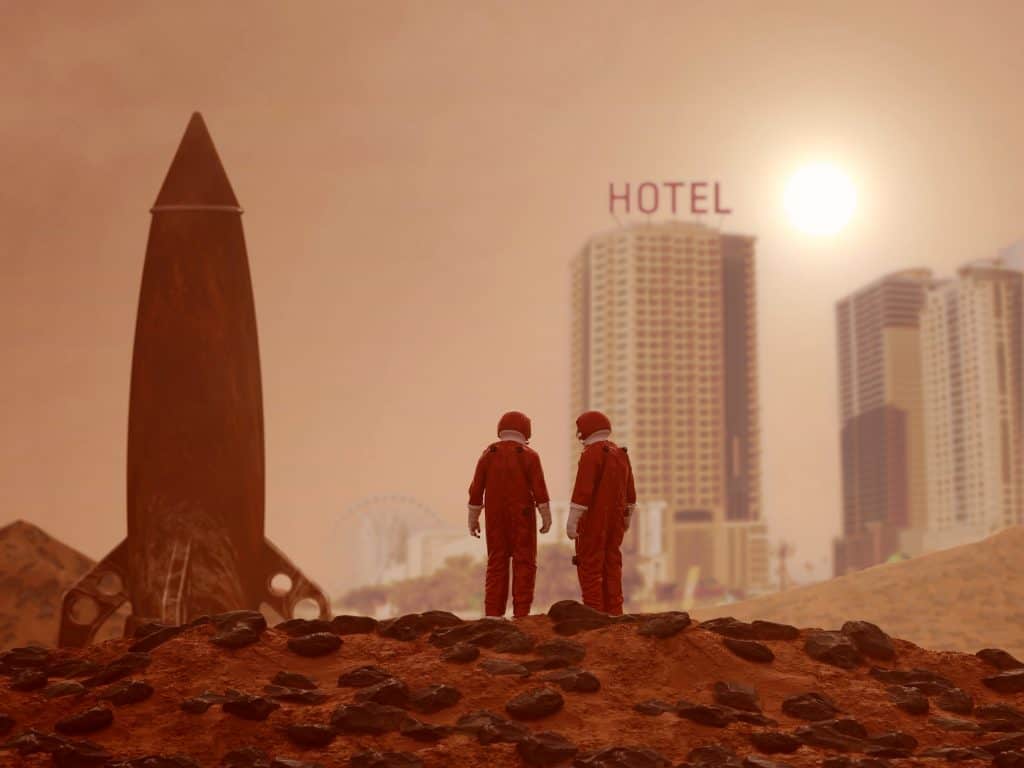
FORGET Covid-19. What if you woke up in Elon Musk’s dream? We have conquered the Red Planet. Through terraforming, we built an atmosphere and a liveable ecosystem. Shuttling back and forth to Earth is now an easy commute. After the pioneers came the residents, then the tourists.
Who do you think would be the first to open a hotel on Mars? A familiar name amongst the leaders in the hotel industry? Or an outsider like Blue Origin, SpaceX, or Apple? One thing is for sure: whoever is designing the first hotel for Mars will need to acknowledge that a different environment requires a different way of thinking and a willingness to challenge a lot of established conventions. Leading experts would put their heads together and radically rethink and design the experience, then test and try and test and try some more until their radically new concept is proven to work.
Elon Musk’s dream may still be too far away to indulge in such imaginary design exercise, especially when faced with the stark reality of an ongoing battle with the devastating effects of the global Covid-19 pandemic. The industry took on major blows and is still grappling with surviving Covid-19 long enough to resume business as usual as soon as travel restrictions are lifted.
We would like to argue that Covid-19 was an accelerator of a tectonic shift in the consumer landscape that shattered an already ‘fragilised’ hospitality industry. Look beyond the lockdowns. The difference might not be as pronounced as on Mars, but a new environment had emerged before Covid-19: Digital transformation and hyper-personalisation of customer experience. Both contain threats and opportunities that demand new ways of thinking, a willingness to challenge conventions and, this time, immediate action.
• Apple creates a delightful customer experience at all touchpoints. Why can’t travel be as easy?
Apple is rumoured to be working on a car. Could we imagine them designing a hotel? Of course, we could! We’d even be able to guess what it might look like. When Apple introduced iCloud, it redefined what we thought about customer loyalty. Once hooked up, it’s virtually impossible (or at best terribly cumbersome) to leave. It’s a trade-off for the customer, but the convenience for users to access their data from multiple devices and locations seamlessly at any time is so strong that they happily accept it. Once you are in, you can never leave.
How could thinking like Apple’s iCloud translate to the hotel industry?
When we think of the hotel as a product, we might picture a room with a bed, a lobby with a check-in counter, a spa and a restaurant. We take all of these for granted. Are these still necessary? How could they change? What else could we add?
Today’s winning brands have transformed customer journeys from a customer-centric point of view. They have designed tools, created experiences, or delivered services that made life better, easier and more meaningful in the eyes of their customers, and because of that, acquired new ones in the process.
The world of travel and hospitality still has to catch up. Creating an itinerary is still arduous—it does not need to be. The booking experience feels sales-y. Offerings look too generic. The experience is formulaic. There is little to anticipate before and after. The door is wide open to imagine new possibilities.
• Personalising it like Netflix
Netflix, arguably the champion of personalised experience, moved away from demographic segmentation very early on. They track the viewing habits of their subscriber base to create clusters that they call “taste communities”. Large hotel groups have a far-reaching database, a physical presence in almost every country on the planet, and ample service offering that entails various customer engagement points. Yet, there is little talk or use of hotels’ “taste communities”.
Imagine that you want to plan a trip. While going through the search and booking stages, images and content are personally curated to match your preferences. The same search query would look entirely different on someone else’s device. That’s precisely what Netflix does. No user account looks the same. The image on the program tiles depends on how Netflix’ AI scores your viewing preferences.
It’s not like travel has never seen such innovation. As early as 2014, Wayblazer provided an AI-based engine that gave personalised recommendations to customers. In a six-month trial period with a major industry player, they drove a whopping 10-17% uplift in conversions and a staggering 87% increase in engagement in the top-funnel stages. Unfortunately, like many start-ups, Wayblazer ran out of funding before they could consolidate their footing in the industry. But their short life had a meaningful impact: The confirmation that innovation which proves to add value to the customer by making their life easier, faster, more exciting or relevant—drives sales.
• Learning from Airbnb’s radical focus on user experience
Airbnb is strictly speaking not in the hospitality industry. They are in experience design. When you book Airbnb, you don’t book a nice bed; you book the experience of living like a local in a foreign city. The concept is community-driven, and it has a social aspect that resonates with today’s zeitgeist.
When Airbnb launched in 2008 no one in the hospitality industry took notice of their existence. By 2014, their revenue already reached US$400 million, generated by 50 million users worldwide. By 2019 this revenue skyrocketed to US$4.7 billion, which is 12 times their 2014 revenue.
Hoteliers might not (and should not) replicate Airbnb’s business model, but most certainly their mindset. There is no reason for hotels not to promote community and lifestyle experiences. With their presence in a specific location, it would be easy to foster an ecosystem of partners, creators, artists, and more. Of course, some might argue that most hotels do that already, but it seems like an afterthought and not like a core purpose.
The challenge is often buried in knowing the business too well. Transformation means breaking patterns, and that means a willingness to disrupt over the short term to secure a long-term ROI.
• Embracing change using customer empathy
No doubt, transformation is painful. Hoteliers have an astronomic cost-base and too many stakeholders to manage. Their long-established business model relies on a certain predictability in customer behaviours. The relentless focus on operational excellence is important, but it fails to accommodate the speed at which customers’ behaviours and attitudes are changing. That’s why the model needs to evolve.
Customers prefer personalisation and convenience not just because it feels nice. It’s their strategy to cope with and navigate a fast-paced information world. Hoteliers are fighting for their attention—and so is everyone else too: Apple, Netflix, their job, the economy, their friends, social media. The growing uncertainty and stress induced by the pandemic have put people’s attention on the line, making it ever more fragmented and scarce.
A world of instant gratification is also a world of exhaustion and fading interests. People don’t act loyal because they signed up for a program. They act loyal to whichever solution seems most beneficial at a given time. And that is by no means a promise.
The days of “bigger is better” are gone. Heaviness is a liability in a world that scans instead of reading; that shops instead of investing; and that values experience over ownership. People want things to be light and changeable. We can either design solutions for that or become irrelevant. Transformation is not about technology. It’s about adapting to new ways of thinking and designing for the new challenges at hand. New models will be needed as well as new talent with a diverse set of capabilities. And the time to make that investment is now, not after the lockdown is over.
The hotel of the future will be something entirely different from what it is today. A few brands will step up to take the bold risks that change everything. And they will become known for things thought of as unlikely or even impossible. Like Apple building a car or Amazon inventing space tourism. We’d love to be the first ones to book a stay in the first Martian hotel, but for that to happen, don’t tempt us with discount offers and pictures of a room with a bed.
Note: The opinions expressed are those of the authors.
• Featured image credit: Getty Images