NOW that might sound like the setup for a punchline, but if you were referring to musician-composer Daniel Chia, and Singapore’s own Glamour Vintage Songbird, Miss Lou, it could also be the start of their set.
The musical duo who are the co-founders of Loudandclear – a Creative Collective that produces music, video content, and events – spoke with WiT founder Yeoh Siew Hoon in Episode 5 of GEVME’s Virtual Experience Makers series to share how they made the pivot from live music to live streams, the lessons they’ve learnt along the way, and advice they have for their fellow musicians facing similar challenges.
In many ways their pivot was inevitable, as Miss Lou puts it, “we were very clear in knowing that we wanted the music to continue, and that we weren’t just going to sit on our derrieres and wait for things to pass by.”
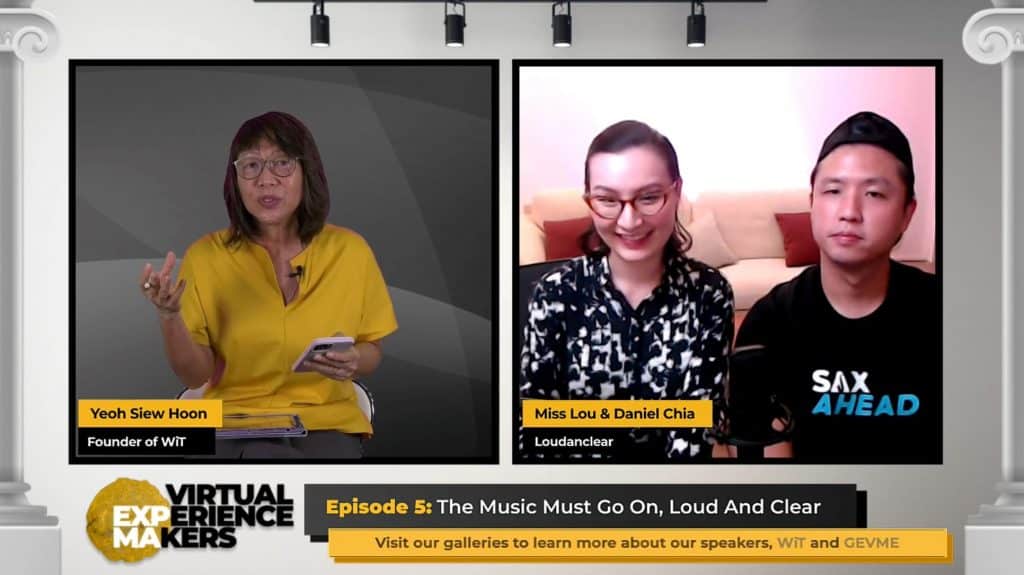
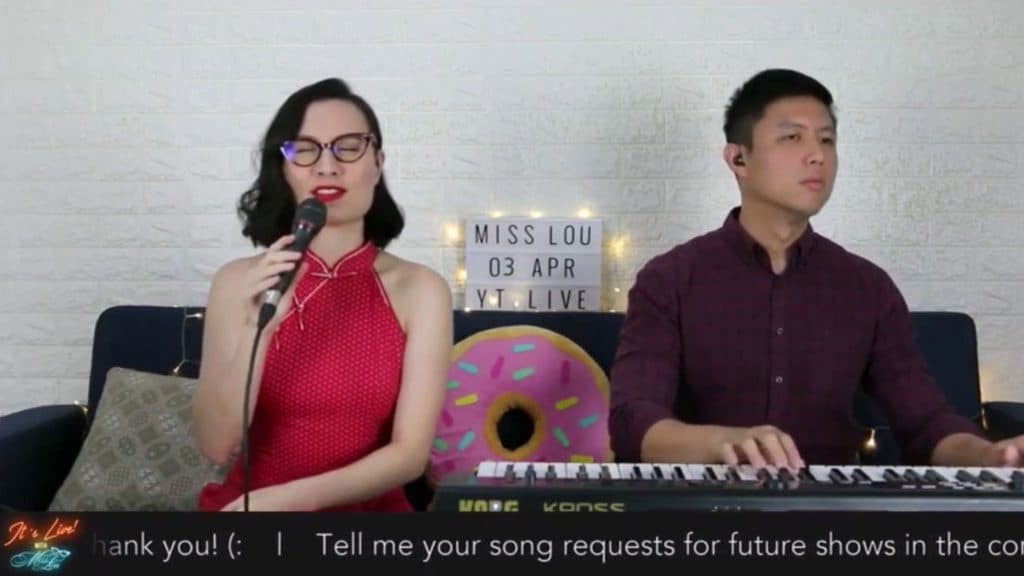
The pair, who are also husband-and-wife, certainly didn’t spend much time on their derrieres. In fact, as soon as it became clear that the country would be going into Circuit Breaker (Singapore’s version of a pandemic lock-down), they got together with their head of music production Shane Heng and decided to take the plunge into livestreaming.
Making this quick decision, and then committing to it was a gruelling process that put both artistes on a steep learning curve, watching hours of Youtube instructional videos on how to set-up for live streams.
Miss Lou tells us, “We spent one entire week of 12 – 14hour days just testing the livestream flow before our livestream even started,” but it was worth it, she reflects, because during the Circuit Breaker, when producer Heng was unable to be in the same house, both Chia and Miss Lou were able to operate their own set-ups.
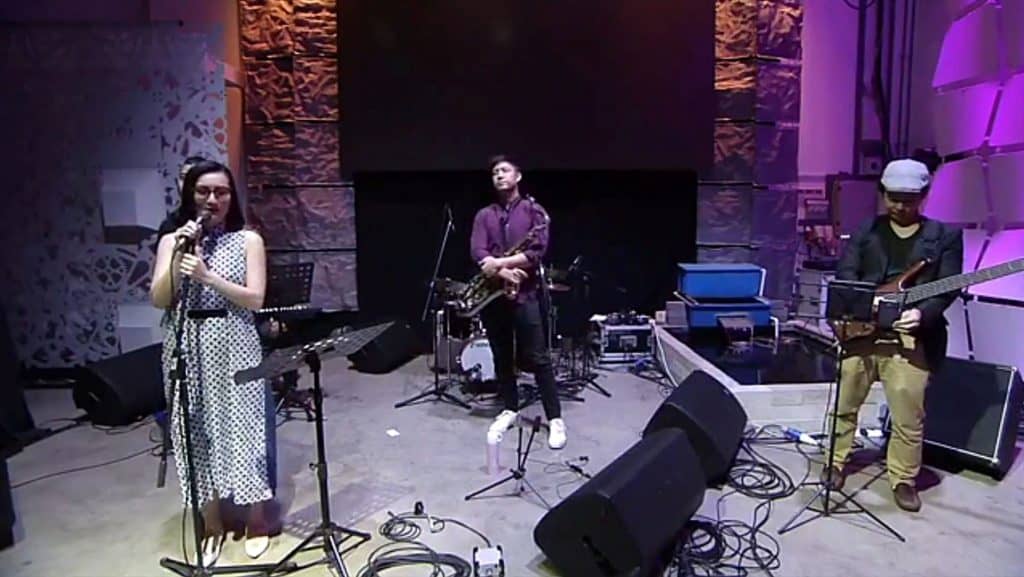
The pair also recognise that they were fortunate to have been a part of the Covid-19 Circuit Breaker Show – a livestreamed concert dedicated to Singapore’s frontliners – which gave them an idea of the possibilities that opened up when livestreaming from a studio.
The entire set-up, including transitions and the inclusion of screens in front of performers which enabled them to interact with the audience in real-time, were “things that we gleaned from that experience to put into our own studio set-up in future,” Miss Lou says.
For Chia, it was also about discovering how much could be done with equipment that they already had. He reflects that live-streams were not a big part of the business for Arthur Lee and the team at Glorious Singapore (organisers of the Covid-19 Circuit Breaker show), rather it was a creative response to the challenges of the pandemic, capitalising on the equipment at their disposal.
In similar fashion, the team already had much of the sound equipment they would need – mixers and speakers – from providing sound-system rentals, and as a result Chia says, they were able to set up their home studio in almost no time.
Since then, they’ve moved into a performance space that is a far cry from the home studio they started in. The studio now boasts a grand piano, a full range of Audio-Technica mics and three Blackmagic cameras, accommodating 18 – 20 musicians in the space, Chia estimates.
And they’ve learnt a lot along the way. Livestreaming, says Miss Lou, is a lot about customer (or listener) engagement. Customers “want to know they are interacting with somebody in real time and not just listening to music, because they can do that on Spotify,” calling it a privilege, she likens it to having “a TV show or a radio show where we get to perform our music as well”.
The comments section, she observes, is also “the next best thing to having a face-to-face conversation with somebody” and creates a very different experience compared to a live performance.
The pair have now produced more than 300 livestreams of concerts, and Chia shares that he has been approached by international artistes to run live stream productions for everything from album and product launches to masterclasses, all of which can be done without him ever leaving Singapore.
The journey was not all smooth sailing though. Chia shares that in the beginning they really struggled because they had set a certain standard for themselves but were met with real world limitations around the tech and equipment available to them, especially since they couldn’t just “go out and shop for more stuff” during Circuit Breaker.
That and the two-fold challenge of doing creative work as a business while continuing to find space for that creativity, as well as being in business with a romantic partner, meant that the artistes’ lives were very crowded, or as Chia puts it, “it was tricky at the start”.
It’s a delicate balance that needs recalibrating each day, and navigating those tensions, says Miss Lou, is all about intentionality, so while being practical may feel like it takes the romance out of things, the couple “intentionally make[s] time for the things that we want, and view as important – and that’s our marriage, that’s the company, that’s our music, that’s our craft”.
One challenge the couple haven’t fully worked out yet, and one that we’ve heard often throughout this series, is how to price and monetise virtual events. Though there does seem to be a consensus converging around fans being willing to pay for more intimate events and for the chance to interact with performers.
So while the couple hasn’t got it all figured out yet, they’ve certainly come a long way from a home studio, and they are generous with advice for other musicians who might be thinking of following in those footsteps.
Starting with equipment, Chia says, set-ups don’t have to elaborate to be effective, quipping “We will be the best people to answer about inexpensive set-ups, because we started from there”.
Any new MacBook or new laptop will probably have a good enough webcam for video, but he advises investing in a USB mic because onboard mics aren’t quite good enough. His recommendation – the Audio-Technica AT2020 USB microphone – was used by artiste Billie Eilish to record When We All Fall Asleep, Where Do We Go? The Grammy winner for Best Album in 2020.
Social Media engagement says Miss Lou is also crucial, and part of how she stays connected to her fans. Even when not streaming, she says, she tries to keep fans in the loop with what she’s working on or offering behind the scenes footage from the studio.
Monthly “hangouts” with subscribers to her inner circle are something she describes as wonderful because feedback and comments were enriched by body language and non-verbal cues, and because they were a platform on which she and her fans could “just hang out and get to know each other as human beings”.
For musicians hard-hit by the pandemic, Miss Lou entreats them to stay in the game, saying “musicians still have many avenues to find work within music itself,” the industry, she continues, had already been undergoing a slow transition to digitalisation. With an inexpensive home set-up, “there’s a lot of studio work that can be done… [and] you can even expand your business internationally.”
So does the duo think that virtual events are here to stay?
Nothing quite beats the energy of a live event says Miss Lou, sharing how she didn’t even realise how much she had missed that until she did her first live show post-Covid.
At the same time, Chia thinks that learning to be in front of the camera has “levelled-up” his abilities as a performer, something he “will not trade for anything”.
He maintains that even when shows return, the Loudandclear studios will always maintain a livestream option, and sees the possibility of this becoming a permanent “value-added” option for example as live music resumes, bars might still stream these performances to reach a wider audience.
When they do, we’ll be there to watch the saxophonist and the songbird perform.
Until then, you can listen to Miss Lou and Daniel Chia on Spotify!
• Featured image credit: simpson33/Getty Images