Attractions business looks even more attractive as Covid forces travellers to go local.
IF Covid has offered something positive to the travel trade, it is the extra time given to people to reassess their businesses, to contemplate next steps, to read books and draw inspiration from the words of writers.
Between watching Netflix with his family, Jon Owen, chief executive of Go City, the world’s largest sightseeing pass business, read a book called The Year 1000 by Valerie Hanson.
Rejecting the thesis that global trade started in 1492 with the European discovery of North America, the author writes about all the systems of trade that existed in the year 1000.
“The relevance for us now,” Owen says, “is that it shows this willingness to exchange ideas, and to travel, is a fundamental human need that’s been around forever.
“And that gave me great confidence in both the mission we’re all involved in, helping people to travel, and the ability of the travel world to recover.”
For Eric Gnock Fah, COO and co-founder Klook, the go-to app for booking travel and leisure experiences in Asia Paific, Daniel Kahneman’s book, Thinking Fast and Slow, opened his mind to two systems of thinking. One fast, intuitiv, and emotional. The other, slower, more deliberate, more logical.
At the start of the Covid pandemic, Fah went for the first option, believing that the crisis would be short-lived and fast thinking was required to keep pace with developments. “We moved straight into system one, doing things we’ve never had to do before, to make sure the business stablised.”
The pandemic dragged on. And Fah changed his thinking.
“The crisis was not as short as we initially thought it would be. So, the more logical approach has worked better for us,” he says.

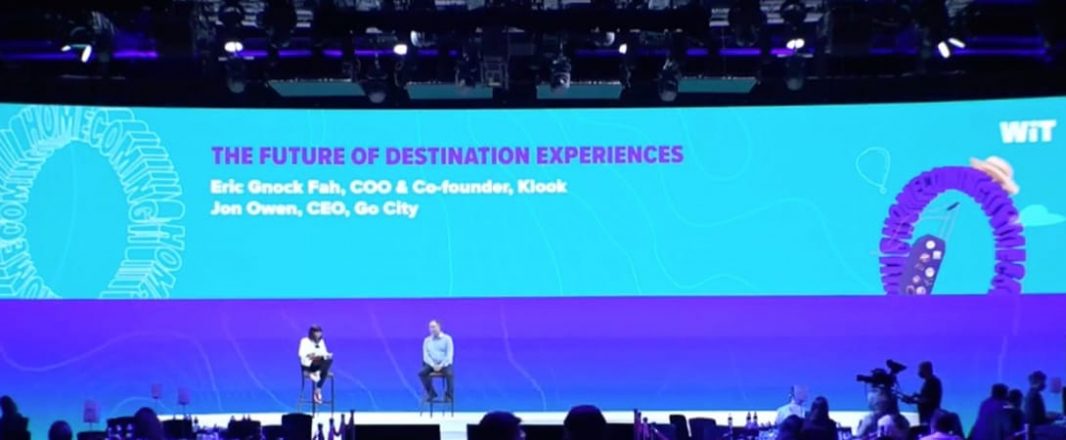
Speaking at WIT Experience 2021 in Singapore, both Owen and Fah agreed that positive signs are emerging through the grey clouds of Covid.
For Go City, which serves 30 destinations globally, the US has been a standout, with cities such as Orlando and Miami producing higher revenues in the first half of 2021 compared with the same period in 2019.
It has been a similar story for Klook, whose business has spiked in Hong Kong, Singapore, Taiwan and China.
Says Owen, “Destinations in the United States recovered quickly because the US government were the most relaxed about opening things up. When destinations open, people travel and visit to attractions.”
For Fah, the near-death experience didn’t eventuate, commenting, “We have seen the coffin but there’s always a way back.”
The way back has been forged by domestic travellers. “Domestic travel has always been there but it’s actually expanding now, given people can’t travel overseas.”
Fah says that staycations – where the hotel is the destination – will drive business to Klook, “because what we do best is built around the experiences and in-destination service.”
Bundling experiences has also proved popular with Klook customers, including experiences built around transportation. For example, Fah offers a Taiwan high speed train connecting with an Uber ride. “We managed to bring those experiences together, so that it’s become a much more seamless and frictionless experience for the customer.”
Klook has tweaked its operations during the pandemic. “We were always proud of the setup we had, which is a global company with very localised operations, quite different from OTAs, especially the previous generation of OTAs.
“Now, with this new landscape of domestic travel, I think a much more localised approach to the team setup will be very much needed.”
Go City has plans to expand beyond the destinations is currently serves in Asia and is looking at both outbound and inbound APAC markets.
London and US-based Go City plans to attract Chinese, Korean Japanese outbound customers and will outlay investment funds to reach customers in those markets. “It’s a big scale business and we are the biggest trade partner for a lot of high-profile Western attractions. APAC can be a huge part of that ecosystem,” Owen says.
Other highlights from Yeoh Siew Hoon’s interview with Klook and GoCity at WIT Experience 2021
On marketing:
Fah: “it’s all about demand capture. A lot of players and platforms tend to spend more on search advertising, for example, which is quite expensive and low return. But within the domestic travel landscape, we find that working on social content, KOL, has done much better. I do think Tik-Tok will be one of the key channels to create demand going forward.”
On profitability:
Owen: “It’s quite good. Customers visit a lot of attractions when they come to a city. The price of the product can be quite high but still gives amazing value to the customer. If a family of four buys a three-day New York pass, it’s an US$800 transaction. And that gives you a bit more acquisition money to spend.”
• Watch video of panel here.
• Featured image: WiT’s Yeoh Siew Hoon with Go City’s Jon Owen